

- Contributed by
- Rupert Lyons
- Location of story:
- Egypt, Libya
- Background to story:
- Army
- Article ID:
- A6062988
- Contributed on:
- 08 October 2005
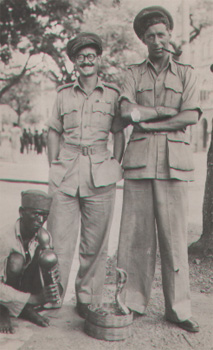
With "Lofty". Cairo, 1942
At Suez, the Rail Transport Officer had a train to take us to Genifa, where we waited until we were re-equipped to enter the desert, resume our training and form part of the reserves of the 4th Indian Division, ready for the forthcoming battle of El Alamein which was then a few month away.
On our first day at Genifa, a VCO reported that one of the camp followers was ill. Maurice Fortune and I went to see him and were astonished to see how old he was. We had no medical services at that time not even a stretcher, and no vehicles. So we placed the old man on a sheet of corrugated iron that we had found and hitched a lift to the hospital. When we arrived at the Indian military hospital the fellow was pronounced dead. The doctor said that he was about eighty years old and that his death was due to senile decay. They refused to admit him, saying that they didn’t take dead bodies, so we had to hitch him back to the camp for burial. We now had to try and find out how on earth he came to be with us in the first place.
No one seemed to know much about him, and he was recorded on the role of camp followers as being aged eighteen. The camp followers were a class peculiar to the Indian army. They were not enlisted and took no oath of allegiance to the King Emperor. They were civilians enrolled to serve with the army. Although they wore uniforms they carried a certificate to prove that they were non-combatants and protected as such by the Geneva Convention. They were all from lower castes, but were essential and acted as sweepers, water carries, cleaners, cooks and all the rest of it. They were also subject to a special code of discipline and could be flogged or summarily imprisoned, although I never heard of this ever happening.
I went one weekend to stay at Shepherd's Hotel with Dickey Deaks. All sorts of strange things happened in and around Shepherd's Hotel. It was out of bounds to other ranks, but that did not stop strange things happening. One day a gang of Australians (other ranks) burst into the Long Bar, which was generally regarded as a General's or Brigadier's reserve. One Brigadier tried to explain the situation to them and they just got hold of him and threw him out onto the road. Within minutes the place was swarming with “Red Caps” (military police). In another instance, which…well I suppose I had a hand in, was when Dickey and I were on leave. We were also in Cairo to pick up our Colonel's little dog that was with his wife in a flat in Cairo. His wife didn’t want it, and he wanted it with him in the desert. We went for a drink at the Long Bar and took the dog with us. Dickey was at one end of the bar ordering drinks and I was at the other end with the dog which sat on the bar top. Dickey, very naughtily, called the dog to him. The dog galloped off along the bar knocking peoples drinks over as he went. Dickey picked up the dog and we quickly retired to the foyer were we saw some military police come racing in. We took evasive action by running up stairs to our room. We opened the veranda doors, which lead to the fire escape. Dickey then hid in a wardrobe and I dived under a bed. The “Red Caps” come running through and out onto the veranda. We then heard them clattering down the fire escape. We closed the veranda doors, went into the hall and locked the door, then disappeared. When we returned later that night everything seemed fairly quiet.
There was one other incident… which I don’t think I ought to tell you about it really…that happened on this weekend. There was an Italian girl called Anna, or something like that, and some officers from our division made a bet with Dickey and I, that we couldn’t get her out of this place, where Italian women were supposed to be interned, and take her into Shepherd's Hotel and pass her off as a British officer. We took up the bet of course, and took her to our room to dress her up. We shortened her hair by greasing it backwards and squashed her into a uniform. Then we took her into the dinning room at Shepherd's (into a dark corner I admit) and ordered dinner. She was so amused by the whole thing that she kept bursting out laughing, and she certainly didn’t laugh like a male. As soon as we had dinner we vacated the place and took her back to her place, a former hotel. With the aid of my Arabic we persuaded the guard to open the door, she crept in, and that was the last we saw of her. Although we had won the bet, the chaps we had made the bet with, had also disappeared, so it was all a complete waste of time.
One other reason why we were in Cairo was to procure supplies, rum and the new “Nescafe”. A senior officer had come to my slit trench in the desert one evening. Looking down at me he said,
‘Good god boy…what have you got in there? Where is your light?
‘I haven’t got one’ I replied.
‘Well you should get yourself a Petromax lamp. It’ll provide warmth and light so you can read with it…and you should get a little stove to make coffee with, and rum…don’t you realise boy, any fool can be uncomfortable’
‘No no, quite right sir, quite right’
So we took the opportunity whilst in Cairo to get these supplies to fix ourselves up in our slit trenches.
The whole idea of desert warfare was based on dispersion, so when the Me109’s came over to strafe in the morning or the evening (always out of the sun of course) they would only hit a limited number of vehicles or people. So the theory went that one’s slit trench was supposed to be away from your truck. In practice however, it had to be as near as possible to one’s truck, perhaps even underneath it. This was because at night-time there was so much movement, with tanks rushing about all over the darn place, lining up and rushing about. Where as a tank driver could see the outline of a truck at night-time and veer away from it, he would simply drive over a slit trench without noticing it. Many people, hundreds, were crushed to death in their slit trench by our own tanks at night-time.
Another thing was the question of “going roaming”. You see there was nothing to the South of us just miles and miles of desert. So when you left your slit trench to go to the mess you had to take a compass bearing on the mess before it got dark, then later that night coming back from the mess you would walk on the back bearing in order to find your trench. Other wise you may lose your way and wonder into the desert and never be seen again.
The whole of the army in the western desert and in the Middle East generally, was in a state of tension. Rommel had pushed the 8th back into Egypt and the front was only 60 miles from Alexandria. He was stopped by the line that General Auckinleck had prepared at El Alamein. One quick thinking young officer of the engineers switched the water supply to draw from the sea, so that Rommel’s men got salt water instead of fresh water. In Cairo banks and other businesses were preparing to quite Egypt for Sudan. There was gloom amongst the large British population, and delight among the Italians and the Egyptians. Two British Divisions that had arrived from the UK were digging defensive positions actually in Cairo, and post cards were on sale that depicted Rommel marching into Cairo. King Faruk tore up the treaty of occupation with the British Army and refused to resign, so a squadron of tanks had to be sent to Abdeen Palace. They trained their guns on the palace with orders to open fire (and at the King if he appeared) if the treaty was not resigned by 12 noon on that day. The King signed. It was at this time that I visited the Newson's. (Family friends from my childhood in Cairo). They look pale and drawn, and it was clear that they had little faith in the 8th Army.
So it was against this background that Churchill visited the Middle East.
The front now lay between the sea and the Qattara Depression. Although it might appear to be a continuous line, it was in fact broken by physical features. These included a series of high ridges, the El Telel, the Miteiriya, the Ruwiesat and the famous Alam El Halfa ridge. There were two smaller ridges the El Munassib and the Razib. General Montgomery made an immediate impact when he arrived. He reduced the head quarters to small tents and everyone there now had to rough it like everyone else. He moved the army headquarters to be on the same camp as RAF headquarters. He ordered the two divisions that were digging defences in Cairo up to the front. He then visited every unit in the desert and explained his plan. There was to be no retreat. The 8th Army was to hold Rommel or die. Montgomery asked his staff officers where they thought the Germans would attack. He agreed with their assessment that the attack would come to the left (South) of the front, near the Quatara Depression. He gave command of 13 Corps to General Horrocks and positioned them at Alam El Halfa with 400 new Sherman tanks with their 75mm guns, dug hull down into the hill side and scores of new 6-pounder anti tank guns dug in. (The new 17-pounder guns were not yet in the field). Horrocks had strict orders not to leave the positions. The divisions on the left where temporarily withdrawn to allow the German armour to pass. The rouse worked perfectly, the German tanks attacking our positions at Alam El Halfa and suffering tremendous casualties, their first major defeat. On the retreat the German armour found our lines had closed in again and they received another bashing. Now it was at this point that Horrocks made an appeal to Montgomery, arguing that we had bashed up their armour and this was a chance to follow through and finish them off. This was on the 30th of August 1942. Montgomery refused, saying that he would attack when he was ready. To many this was a disappointment. Here was an opportunity to have smashed the Germans. As it turned out the Germans had the whole of September and the first 3 weeks of October to regroup and repair their tanks. More importantly Rommel now knew about the new 6-pounders, they knew how many Sherman tanks we had; the secrecy of the whole thing had been broken up. Of course, as no one really knew at the time but would find out, Montgomery was a man who wanted personal distinction, he wanted to be the hero of the battle, it must be his plan that would win.
And so it was not until the 23rd of October 1942 that the big battle began at El Alamein. It started with possibly the most famous artillery barrage of the war, as with that preceding the Battle of the Somme in the First World War. Our infantry started to suffer great losses as they attempted to punch holes in the German lines, for our armour to pass. Some of the Divisions and many Battalions had been together for several years, and in those days the Battalions consisted of county regiments so many of the officers and men had known each other in civilian life. Many commanders disliked sending their men to a seemingly unnecessary death. A few approached Montgomery to suggest that the attack be slowed down. They were sacked on the spot, to be replaced by from a supply of officers held ready in the UK. The attack continued relentlessly until after 20,000 dead and 80,000 wounded the enemy broke and our tanks passed through. The German Afrika Corps was now in full retreat, pinching the Italians transport and leaving them to be captured. So now the whole of the 8th Army was moving forward. The desert roads were crowded with Germans trying to get away and the allies racing across the desert to try and cut them off at Tubruk or Gazala. Our advance was halted by the heaviest rains for 30 years, which turned the desert sand into deep mud. The RAF continued to strafe the retreating enemy and bombed the Saloom and Halfya passes relentlessly. This delay allowed the Afrika Corps to establish semi permanent lines at Agedabia and El Agheila. The enemy’s position at Mareth had been prepared several months before and included a deep tank trap. The taking of Mareth took many days, but soon the mad chase was on again. The allies had to traverse many passes, the Wadi Hoof particularly, taking a lot of time. Progress was slowed also, because the retreating enemy had blown every bridge and culvert. There was a short action at Ben Gardane. (These names were all so misleading, as there were no recognisable features, not even a mud hut. It was only Tubruk, Derna, and Benghazi that were what we would call actual places).
Here at Ben Gurdun we were with the Essex Regiment when a vehicle got stuck in the sand. I shouted to the soldiers inside the truck to get out and push. No sooner had they started to push then the nearside rear wheel set off a German Teller mine, which blew off the whole of the rear axle assembly, killing 3 men and wounding 4, 2 seriously. I was slightly wounded in the left leg. It was a very unfortunate incident, but no one bore me any grudge.
© Copyright of content contributed to this Archive rests with the author. Find out how you can use this.


 Recommended story
 Story with photo