

- Contributed by
- Brenda Edwards
- People in story:
- Brenda Edwards
- Location of story:
- Blakehill Farm, near Swindon, Wiltshire
- Background to story:
- Royal Air Force
- Article ID:
- A1161479
- Contributed on:
- 01 September 2003
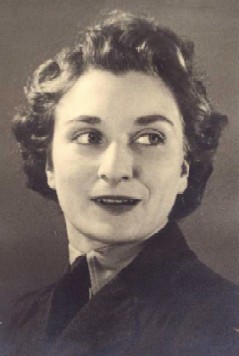
WAAF Brenda Edwards 1942
I was happily working in Cambridge when I suddenly was told to go to Blakehill Farm, near Swindon. Unfortunately it wasn't on the map, and no-one could tell me where it was. I was the first of 5 WAAFs to arrive at the camp, and luckily I was met at the train station and taken to the camp, which was still uncompleted. We were knee deep in mud and the huts weren't finished and they were very damp.
I found later that the area was actually one of three aerodromes that was being built for D-Day. This aerodrome was to be used for Hawser gilder training, which were pulled by Dakota planes to launch them into the skies.
I discovered that there were crack airborne troops being trained at the Farm, who were later known as the 1st Airborne Division, and they did the first airborne landing in Holland.
While I was stationed there I used to work at the Station Sick Quarters, and I drove the small Morris ambulance in a 24-hour on / 24-hour off rota. Later on many more girls arrived at the Station Sick Quarters to drive the ambulances, all in preparation for D-Day.
When D-Day arrived we were kept on the camp and told not to talk to anyone outside in the village for about 2 days. The atmosphere in the camp was electric, we knew something big was going to happen but we didn't know what . . . .
Finally we were told that D-Day was on and we waited up all night in a crew hut on the Aerodrome. The sky was black with Dakota's towing gilders, The gilders carried equipment and 30 odd gilders pilot troops heading over to Normandy. The Dakota also flew to Normandy accompanied by a WAAF nursing orderly, who helped with the injured in the aircraft on the way back.
We waited all night until dawn when the first Dakota arrived back on the tarmac. The doors opened and the first wounded came out on a stretcher, with the WAAF nursing orderly holding a bunch of flowers and a German tin hat. The casulties were offloaded into our small ambulances, still covered in blood and mud from Normandy. Our result efforts were hampered by the crowds of war correspondants all trying to get headlines for that evening papers!
We spent weeks carried the injured between the planes and the marques, and some of the men were in a terrible conditon which was very upsetting. Put we were able to give them cigarettes and help them write postcards hoem to tell loved ones that they were ok. The smell of gas gangrene was overpowering and would steep into our battle dresses and would stay for hours.
Occasional the wounded would be shell shocked and we would have to take their cigarettes and leap on them to stop them writhing about.
© Copyright of content contributed to this Archive rests with the author. Find out how you can use this.


 Recommended story
 Story with photo