

- Contributed by
- Rupert Lyons
- Location of story:
- Monte Cassino
- Background to story:
- Army
- Article ID:
- A6134474
- Contributed on:
- 13 October 2005
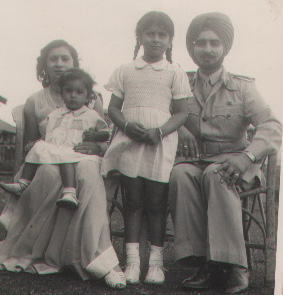
Fellow officer with his family.
I had to go back to see about some mules that we needed to take ammunition up to the ridges. I took a slightly different route and came across this dry riverbed that had been occupied by an American field regiment. They were supposedly going to give us support during the forthcoming attack. I didn’t like the look of them one bit, I mean they seemed easy going, but one wondered whether they had been properly trained and whether they knew what on earth they were supposed to do. Anyhow I went on and met the Captain chap who was to be in charge of the mules, that were to bring our ammunition up to the front on this occasion. I fixed things up with him and made all the arrangements. I was then chatting to this veterinary officer, when a shell burst fairly close, but it wasn’t that close. He fell instantly to the ground. A small piece of shrapnel had entered the back of his neck severing his spine; he was dead in seconds.
A few days later I was in charge of another convoy taking ammunition towards the front at night-time. I gave instructions to these Americans, who had not been up to the front before, to put up their windscreens so that the moon would not reflect on the glass and be seen by the people in the Monastery. There was also to be no smoking. We had picked up a Free French officer who was on his way back to his unit which was very near to where we were. When we stopped to make a difficult manoeuvre, with these big vehicles, the French officer wondered away, about 20 yards of so, and he sheltered a cigarette lighter under the lapel of his greatcoat and lit a cigarette. The next moment he was dead on the ground, shot by a sniper. Every night German snipers would creep down from their positions and look out for any sign of activity or for any body to snipe at. Anyhow we got over this exercise quite well and with no more incident.
A few days later we were preparing to receive this batch of ammunition that was going to be bought up to us in the mountain by mules. My ammunition point was below an overhang of this rock face. Unfortunately it was overhanging the wrong way so provided no cover. There was really nowhere one could go to escape being seen by the Germans, particularly those on the high slopes just below the monastery.
The mules were to come up under cover of darkness, and I don’t know what the devil went wrong, but they started coming… after daybreak. Down the valley they came, crossed the river, and then started to climb up to towards us. Of course the Germans had seen the mules and… it was so unfortunate. They were a completely new outfit that had just been trained in India with their Sepoys, the complete unit, all brand new. Suddenly the Germans put down a hell of a barrage and so did these Americans, who were supposed to be “supporting” us. The whole of the mule company was scattered about, many being killed or wounded, it was such a terrible sight. As soon as there was a lull in the shelling my VCO and I went down with our revolvers and killed off the poor animals that had been wounded. It was a terribly sad morning, and of course completely wasted. The object of the exercise was not now going to be achieved.
One unfortunate thing that happens when you have dead mules about the place, or dead anything for that matter, is that gasses start to develop in their bowels and they start letting off the most appalling smells. They turn on their backs, their stomachs bloated with gas, and let off more and more smells. We would send Sepoys out at night with bayonets to make slits in the stomach and bowels, allowing the gasses to escape, so that they would not turn into huge farting machines. There would also have been the smell of decomposition, but it was too cold for that to take place.
Both sides used spotter planes to discover the positions of the enemy. These were slow aircraft, and were sitting ducks to such an extent that many had been shot down. So many in fact that the allies and the Germans came to a gentleman’s agreement. We wouldn’t shoot their spotter planes, the Storks, and they wouldn’t shoot down ours, the Lysanders. I thought this a rather balmy idea actually, because this was obviously to their advantage, since the Germans were defending a known line (Gustav line) with more or less static positions. They didn’t know were we were going to place our forces, so aerial reconnaissance revealed much more to the Germans than it did to us.
Now the allies agreed that the Monastery had to be destroyed. A stupid idea, because I think I really believed the Germans when they said after the war that their forces were not in the Monastery, but on the slopes just below it.
However on the morning of February the 14th 1944, everybody was supposed to have been told to withdraw their troops from the front line, because there was to be a terrific bombardment and bombing of the monastery. As one might expect they didn’t inform the whole of the 4th Indian Division about this.
So the bombardment started and the Germans replied in like. We suffered the most tremendous casualties, not only from the German shells but also from the “friendly fire” of this American field regiment that were supposed to be giving us “support”. You see it was so easy to tell that the Americans were shelling us. When the American shells explode all one sees is a blinding flash, in exactly the same way as with the British shells. Not so the German 88mm shells. When they burst there is a blinding flash and the stuff is dispersed about, but then there is a dull amber glow for an infinitesimal short fraction of the second. There is also a spiralled plume of rather beautiful purple coloured smoke of about 10 inches long. It all disappears in a flash but you knew that shell was from a German 88 just as you knew the other ones were from the Americans. Once again appeals went back to these people to raise their sights by 5 degrees and that sort of thing. However nothing was done about it.
The ammunition we had accumulated for the mules to take up into the mountains was being blown up in parts. We had to disperse it so there wouldn’t be too much damage. We did this also because most of the area had not been swept for mines and if you deposit a load of heavy ammunition boxes in one place, a mine underneath would think it was a vehicle wheel and blow up.
I had a sort of premonition that something was going to happen to me, because the day before a shell blast had blown my hat off (a very good hat made my the Bangalore Hat Co) and it had landed in a minefield, that hadn’t been cleared. My orderly volunteered to go a fetch it, but I certainly wasn’t going to have anyone risk their life for the sake of a hat. It meant however that on the fateful day, the 14th of February, I had to wear a new hat, (it was also a good hat made my Rankins of Rwalapindi). But it is a bad omen to wear a new piece of kit, on a day when there is a battle in the offing.
On the morning of “the” day I was again sorting out ammunition prior to it being taken up to the front by mules. Again I was dispersing the boxes. There was shelling going on all the time, but I really couldn’t get on without taking some risk. I moved off to another pile of boxes and as I moved I suddenly felt my left leg collapse, and I fell on top of it. Then I felt the whole of my chest warm and wet. Blood was seeping though my battle dress. I didn’t look down at my leg at first, because I feared it might have been shot away. I managed to turn over, and was very pleased to see my leg was still in place. I tried moving my foot, and a huge quantity of blood shot up into my face, from the top of my field boot. This was caused by the pump action of my foot being moved in a boot full of blood. I started to lose a lot of blood very quickly and fainted off and on. It was an amazing situation. I felt as though I was settling into a most peaceful sleep. Occasionally I could no longer hear the noise of the battle, or the guns. The ammunition was burning fiercely now, and I was leaning on it. I realised that at any moment it would go up, but I didn’t really care. I just felt so peaceful. This was due of course to the loss of blood. A Gurkha officer rushed over, grabbed me by the waist, and dragged me across the road. I did my best to help by hopping on one leg. I told him, as he dragged me, to leave me as the whole lot would be going up any moment...and believe it or not, I felt a slight resentment at being dragged away from my peaceful state.
We rolled into a shell hole that had just been made. It was so recent in fact that I could feel the heat of the soil against my back, as the Lieutenant undid my collar. Then a shell thudded into the edge of our hole. We exchanged glances and both said ‘dud’ at the same time. This was extraordinary because if it had been a live shell it would have certainly killed us both. Now the ammunition started going up, the whole lot of it. And as might be expected the more it blew up the more the Germans turned on the shellfire. However then there was a moment of calm when the shelling was less. Of course at 11 O’clock one would find this happening whilst the German gunners had their coffee; but this wasn’t eleven. It was earlier, not even ten, I should think. Anyhow, in this moment my Viceroy’s Commissioned Officer rushed out of the dug out and round to the back, got hold of a jeep and drove over to where I was. He and the Gurkha Lieutenant put me in and we drove away, risking driving over the Rapido instead of going the long way around.
We got out OK and I was dropped off at the American Advanced Dressing Station. They took off my field boots, held on by three straps, so easy enough. My breeches were another matter because of the tightness of the leg, and this American apologised for having to cut my fine breeches. And they were a really good pair that I had made at the Hazard Gunge in Lucknow. Anyhow he cut them off, along with my other clothes and examined me. He put a dressing on my leg and part of my shoulder, but said there was a piece of shell sticking out of the back of my shoulder. It would only bleed more if it were removed, so I would have to wait until I reached the main dressing station, where they could take it out and plug the wound.
So on I went, this time in an American ambulance, most uncomfortable…no it wasn’t, it was one of ours, most uncomfortable. It was one in which some of the time I lay down and some of the time sat up. We arrived at the main dressing station, where they were absolutely crowded out with people. I was beginning to faint off again. No pain had started yet, because as you probably know, if you have through and through gun shot wounds, the bullet or missile cuts all the nerves, and most of the tendons too, but it cuts the nerves so you have no feeling at all. They sat me down on a chair. An American Lieutenant, a medical man, said he’d pull the shell piece out with a pair of forceps. An orderly held me down whilst the American pulled it out from the back of my shoulder. Suddenly I had the most appalling sensation of grinding bone. I asked ‘Do you have smelling salts?’ The orderly said ‘Yes’ and waved some in front of me. Then I was put on to another ambulance, naked and wrapped in a wet blanket; wet from snow and blood, to go to a New Zealand Casualty Clearing Station. These front line ambulances, when there is a battle going on, operate a taxi rank system. They line up as far forward as they can get. The front one is filled up, four stretcher places and one on the floor, then off they go to the CCS and return to join the back of the queue. Now these ambulances are in a frightful state. The stretchers were literally soaking in cold blood, and you find yourself naked with a wet blanked lying on this blood.
As the ambulance moved off, I noticed that Jim Showers was put in the stretcher place above me. Jim Showers, Colonel of the 1st 9th Gurkha’s…one of the most popular and bravest Colonels in the Division. He said,
‘Oh they’ve got you too have they?’
‘Yes’
‘Are you bad?’
‘No, no I don’t think its too bad…what about you?’
‘Well yes they’ve torn my guts open I’m afraid, I’m losing far too much blood’
As we were driving down this road the driver of the ambulance, well he was doing his best, but whenever he came across a shell hole in the road, or that sort of thing, he would jam his brakes on. And as he jammed his bakes on a huge quantity of Colonel Jim, what’s his name, Jim Showers blood would shoot off the end of his stretcher and on my face and chest. He guessing what was happening would say,
‘Sorry about that old boy’
It happened again and another lot came down. The third time there was no blood, he said nothing…he had just bled to death.
© Copyright of content contributed to this Archive rests with the author. Find out how you can use this.


 Recommended story
 Story with photo