

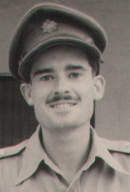
Lucknow, 1942.
- Contributed by
- Rupert Lyons
- Location of story:
- The Rajaputan Hills
- Background to story:
- Army
- Article ID:
- A6401161
- Contributed on:
- 25 October 2005
There is a book called the ‘Ethnicological Survey of India’, which lists all the various tribes and races. Among the listings were the ‘Martial Races’ like the Jats, Sikhs, Maharatas, Dogras and so on, that contributed to the 19 regiments of foot, and 21 regiments of cavalry, which formed the Indian Army. (The 10 regiments of Gurkhas were not included as they were a separate entity). All these tribes and races had at this time been recruited to the full extent. There were no more men in the villages of the right age to join up, although as young boys reached the right age, the retired soldiers in the villages would encourage them to join up. This provided a steady stream of new recruits but it was decided that more people were needed, if they could be found. The Chamars, very low caste Hindus, who deal in leatherwork and tanning, had been drawn from to raise a regiment, and they proved to be absolutely magnificent (which just goes to show that the caste system is so stupid).
In the back of this book there was a separate section relating to the criminal tribes of India. Amongst these were bandits, the Dacoits, who lived by swooping down from the hills to raid villages (as so graphically portrayed in the film “The Long Dual”). One of these groups was the Rajputs, who had a subgroup the Mena Rajputs. It was men from this tribe that I was to recruit.
We were to go up to Rajaputan, and a district called Kota Bundi, to the South of Jaipur.
We took two bands, a full regimental band, a drum and fife band, with the two tame Leopard mascots. I also had a small leather chest, full of cash and chained to the floor of a truck, with a 24-hour guard of three armed Sepoys.
So off we went. It was, I thought, all very exiting. I had with me a VCO (Viceroys Commissioned Officer) who was a Muslim. Really, this should not have made any difference at all, but he was old, in his forties, and not at all pliable or game to new ideas. And frankly, for this particular job of recruiting, a Hindu and younger officer would have been better.
We set off early in the morning to try and beat the sun. There were twelve lorries in the convoy. We had 3 kitchens, longers as they are called, tons of atta, to make chapatis, tons of vegetables for the vegetarians and tons of goat on the hoof.
We reached a point beyond which was impassable to trucks so we transferred all the stuff into bullock carts that were waiting for us, which I had arranged before we left Lucknow. Then up we went further into the hills along paths and through villages toward Kota Bundi. When we arrived in the late afternoon I gave the order for the four field kitchens to be erected and for the food to be started right away. We cooked rice, chapatis, vegetables, meat and sweetmeats, like ladus and bukaras. And of course we brewed plenty of tea, all of which was fixed up with condensed milk, which was the great favourite with everyone in India. Smoke started to rise from the ovens and the smell of the cooking drifting across the valley attracted people from other villages who began to gather at our camp. Then the bands started playing, marching and countermarching on the little midar in the middle of the village. The two Leopards had been trained to march with the band and to walk between the bandsman’s legs. This amused the children no end. Then I noticed that there were not many women coming to the kitchens. This is why I had wanted a Hindu VCO (who understood the importance of getting the women on our side) instead of my Muslim, who had a peculiar attitude toward women. So I set off with one of our Havildars (sergeants) who spoke a little of the dialect to find more women. (The Mena Rajputs who lived in this area of Central India spoke Urdu, but with a particular dialect). We found one group of women who told us that they could not eat with the men. So I arranged for some 45-man deckchjies, full of food, to be bought to those women who did not want to eat with the men.
I sent messages out to the villagers for people to could come and eat, the old the woman the little chicos (children), everyone. Soon our camp was overrun with people. Then we started the propaganda.
I went with my Havildar to find the head woman of the village. We told her, and the group of women that gathered around, that we wished to recruit the men of the village into the army.
‘Your men will be well fed with two meals like this, every day, as much as they can eat…and’ I said ‘they will send home money to you women. You will be able to go to the post office and collect your money every month. Not paper money, but solid silver Rupees, from the Sirkar, will be there for you…into your hand!’
Of course they all laughed and giggled and started nattering about what they would do with their money.
‘But you must be sure’ I said ‘you must insist that the men come with me. Don’t let them have a good meal now and then slip back into their lazy ways. They must come back with me tomorrow, otherwise you won’t get your money.’
They all said that they would insist that their men join up.
Those of my men who could speak some of this Rajputi went to all the houses telling people we had come to recruit the men into the army. We told them that for centuries the army and Mena Rajputs had been enemies and had fought each other, but that now we needed their help and they could become soldiers. The same message was repeated, that all the soldiers would be well paid, and the men would send money home every month to the wives and parents. This information was very well received . Everyone in these villages was terribly poor, and I noticed nearly all the roofs of the houses were in a frightful state. I told the interpreters to tell them that they would be able to afford new roofs before the monsoon. (All these people had traditionally lived as bandits by raiding the plains. This way of life had now been curtailed because the police were providing strong escorts and better protection for the villages on the plains. All the former bandits had had to sell their horses to feed their families, there were no jobs around and the arid rocky terrain was not suitable for any form of agriculture. So these people really were starving and on the way to emaciation.)
The next morning we started the kitchens again and we told everyone again they could have as much as they wanted to eat and take away.
Then we started recruiting the men, and they came very willingly. We signed people up provisionally, although in order for them to get some money straight away the men had to sign the acquaintance role. Of course none of them could write so they signed with a cross. I told them that before the next months pay was due they would all be able to write their names properly, in Roman English. This impressed them no end. So the bands started to play, the men were loaded into the bullock carts and off we went with the little chokras running along beside. All the other villagers, the old men and the women came to wave goodbye to the men folk, who were to serve with me for the next few years in North Africa and then Italy. Some of those who were reluctant to come were being pushed along by their wives and mothers. All were keen to be getting some money.
So we came back to the main road and transferred all the men and gear back into the lorries for the long journey back to Lucknow.
We arrived late at night. I told the quartermaster,
‘You must keep the food going all night; these chaps eat like anything. We must occupy their minds until they sign up in the morning’
So the next morning we started signing up the 170 new recruits, using the most complicated form, which in essence had remained unchanged since 1650, when Indians were first recruited into the army.
My friend, Maurice Fortune, came to help me. They took hours to fill in.
‘What is your name?’ So you put his name down.
‘What is your fathers name?’ So and so.
‘Has anyone in your family ever been in the army?’ No. Well that was easy enough, because up until now they had all been bandits.
‘What illnesses have there been in your family?’ And on, and on.
‘What is your Testeel, Kutu Bundi or another one?
‘What is your caste? I asked the first man.
‘We are Yardo Bunsie, sahib’. Ok. I asked the next man the same question.
‘Yardo Bunsie’ and the next man,
‘Yardo Bunsie’
Then next in the queue was a tallish man with a rather brilliant smile.
‘What is your cast?’ I asked him Yardo Bunsie?
‘No, I am Yardo Bunsie Aherd’
‘You are Aherd?
‘Yes sahib, all my family are Aherd’
Perti Singh was his name. I made a note of him. He was an intelligent chap and was obviously going to have to be promoted to a corporal pretty soon.
© Copyright of content contributed to this Archive rests with the author. Find out how you can use this.


 Recommended story
 Story with photo