

- Contributed by
- Rupert Lyons
- Location of story:
- Parkhurst Barrracks, Isle of Wight, Matlock, Winchester, SS "Empress of Japan"
- Background to story:
- Army
- Article ID:
- A6006359
- Contributed on:
- 03 October 2005
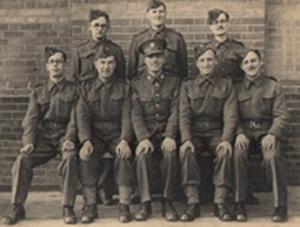
Dad (top right) with comrades. Parkhurst barracks, Isle of Wight. 1939
Out side each barrack room hung the bath book, which everyone had to date and sign when they had a bath. Anyone who did not sign this ran the risk of a regimental scrub. The victim would be pinned to the ground, naked, and scrubbed with two bask brooms.
The two old Irish regulars would clean or blanco equipment and polish boots, all for the odd shilling. One of them went absent without leave one time and returned to find himself on an AWL charge. He protested his innocence by saying he had been asked to rescue people from a burning building during an air raid. Asked for some sort of proof he showed the CO the soles of his boots, which were blackened and charred. The CO let him off and told the quartermaster to find him a new pair of boots. We, knowing him, didn’t believe a word, and he confessed to us that he had his local blacksmith provide the alibi with a blowtorch to the soles of his boots.
Going sick was quite a game. You had to join the sick parade in the open whilst the colour sergeant tried to whittle down the list with a bit of persuasion. The regimental doctor ascribed varying degrees of sickness.
RD — Return to Duty
M and D — Medicine and Duty
BD — Bed down in the barracks
Because so many men were needed to man the sea defences, duties of quarter guard or in line piquet came quite frequently. The River Medina runs close to the barracks and on clear nights the odd Heinkel would come along, after bombing “Pompey” or Southampton, and following the silvery moonlight river would machine gun our barrack box. Against this a dozen or more sangers (sand bag gun emplacements) were erected and manned with Bren-guns on AA (Anti Aircraft) tripods.
On one occasion Romero and my self were on duty with the in line piquet. We were stamping our feet to keep warm when there was a terrific whoosh and two bombs came down. We fell flat on our faces. Fortunately the bombs struck soft soil so there was not much damage. A few seconds later, a second aircraft was heard. By now the Bren guns were ready to open up, which they did. Later on that morning Battalion Headquarters received a rude telephone call from an irate Spitfire pilot, who had been hit by our gunners and had to crash land a few miles away!
When things eased up a little I got permission for a weeks leave. When I was at home in Braintree one night, a couple of sticks of bombs came rattling down and hit, mainly on some concrete, at her end of our road (Warren Road). One house was split in half but fortunately no one was in at the time. However later on in the war there was a terrible tragedy. A parachute bomb was dropped on East Street and completely wiped out the whole street on both sides killing hundreds of people.
When our infantry training had finished we were released to go to the IC training college, in King Alfred’s College Winchester. We lined up to go, with Sergeant Smith putting his homo boy in charge of the detail. So off we marched to Winchester to a life of comparative comfort. We slept in the dormitories, which for some reason had palliasses, straw mattresses. Later that summer there was an epidemic of what was then called Infantile Paralysis (Poliomyelitis) and there was a terrific flap with the straw mattresses being deemed a risk as they might harbour the virus. We all had to take our mattresses down to a farm and empty them into a big pile for a bonfire, and then fill them up with fresh straw…a frightful bore.
All the drilling was done by ex guard’s instructors who strove to be smarter then their regimental counterparts. We changed our Hampshire Regiment badges to IC badges. The amenities were so good, showers cubicles bathrooms, a gym, recreation rooms with a billiards table, and of course central heating throughout the building. It seemed quite the height of luxury.
Our studies consisted of the methods of maintaining the army in the field, and advanced motorcycling. On our first day there were IQ tests and other guessing tricks, to see I suppose, if we really were intelligent enough.
We then prepared to go to the secret IC centre in Matlock. Smedley’s Hydro, the largest hotel in the town had been taken over for this purpose.
We folk who were training in the IC were promoted to sergeant.
We were issued with a Webley .45 Revolver, as our personal weapon, and a motorcycle with panniers and a rack. The kit bag with all the usual army gear was stowed on the rack, behind the rider. One pannier contained a complete set of civilian clothing including shoes, scarf and a trilby hat. The other pannier contained summer clothing, a sports jacket etc. One was also given an identity card giving one access to any military establishment throughout the British Empire.
The bombing had started in London and we received lectures on the psychological effects of bombing, including the possible effects on the moral of large civilian urban populations. At the time little was know about the subject, apart from some small scale Zeppelin bombing of the First World War, and bombing a few years earlier during the Spanish Civil war. It was expected that the aerial bombard of our cities would be many times worse and of a much longer duration than that which had been seen before. A study of the behaviour of the civilian population of Barcelona had been made, and the findings led to great concern that similar “panic walks” would take place in Britain. Any mass exodus of the large civilian population from our urban centres (to escape bombing) would be potentially disastrous. The roads and lines of communication would become blocked and the army unable to move freely to respond to the threat of land invasion. It had become vital therefore, to monitor civilian moral, and develop strategies to deal with such problems. One of the IC’s roles at the time was to do this.
We were sent on a mission to London to gain an idea of moral among the population. We went to rest centres for people that had been bombed out of their homes, those who in theory would be the most demoralised. No sooner had Romero and I arrived at one of these centres, when someone from the fire and rescue service said,
‘Well what are you doing sergeant, come and give us a hand’
So we were shoved off to help with rescue. We helped for a while and then went back to our motorcycles to put on our civilian clothes, so that we were able to talk to the people, unhindered. We found no sign of people being demoralised. The moral was absolutely marvellous. We went back to Winchester the next day and everybody else had reported the same thing.
It was rumoured that there had been signs of a panic walk in Liverpool. I didn’t believe it and there was no evidence to prove it. I think it was just the North — South thing again.
Shortly after this a war office letter arrived asking for people to join the Indian Army, those especially whose languages were based on Arabic (since the war in North Africa would be drawing on the Indian Army) and those who had a knowledge of Urdu.
Four of us volunteered. We attended an interview in Winchester and before we went in to see the General, who was the area commander, his adjutant looked through our records. To his surprise the entries for my 3 days CB at Parkhust were entered in red ink, only used for serious crimes. I told him about the limejuice.
‘Ah’ he said ‘you’re one of those people from Hampshire. We’ve been having problems with them. There’s some bloody ridiculous affair going on down there with the NCOs.’
He ripped up the conduct sheet and gave me a clean one.
Back at Winchester we four, two Yorkshire school-masters, one a short stocky chap called Holroy and his friend whose name I’ve forgotten, and a bumptious Jew who had a new Ford Ten. This Jewish chaps parent’s had a shop somewhere, and he was continually telling us how rich they were. We got pretty bored with him, and if he had carried on much longer, I think someone would have pocked him in the eye. When we were called to the final interview, with an Indian Army Officer in Salisbury, he invited to take us in his new Ford Ten, provided we agreed not to smoke in the car, as he had just had the inside cleaned. Everyone thought this stipulation was pretty appalling and Holroy ignored this, lighting up as soon as he got in the car. He then proceeding to spread about as much ash as he could. This was a bit unfair really, I must say.
The interview was in Salisbury Cathedral and we asked the verger on arrival where the Colonel was.
‘Oh he’s that old boy in the boiler room’
So we had our interviews in the Colonels cramped makeshift office, and then went back to Winchester.
We went to (William’s) barracks in Aldershot to join the other 700 Cadets who were to join the Indian Army. They had been drawn from every Regiment and unit of the British Army. We were formed into the 1st Indian Army Cadet Battalion, and although we had the odd parade and lessons in Urdu the time was mostly spent just waiting to go to India. There was plenty of leave and time off. It was pretty good being there really. The old barrack was wonderful. They were so spacious, with large verandas out to the front and back, simply splendid. (However I heard the other day from our local Brigadier that they have been demolished. Absolutely typical…wonderful barracks and they pull them down.)
We were now wearing the white Cadet bands around our caps and white shoulder tabs. The sudden improvement in status we had with the civilian population was miraculous. We had an entrée to everywhere in Aldershot. All the main tailoring companies, Austin Reid, Hector Power, Army and Navy, Moss Bothers and others would all come to us begging to supply our officers kit, up to the full extent of our allowance. We were now of course, invited to all the parties. This was the difference between being in the officer class and being in the ranks. The other ranks had a pretty grim life, whilst we were now having a marvellous time. (This was so accentuated in India were the other ranks were completely ignored by everybody.)
We had a kitting out parade and were given the most ill fitting tropical kit, complete with pith sun helmets. (Troops in India were usually issued with pith helmets and those in the Middle East with cork helmets)
Shortly after this the whole battalion was marched down to the railway station behind the Grenadier Guards band. We were bound for Glasgow and the ‘Empress of Japan’ that was to take us to India.
In Glasgow some of us were staying in Merryhill barracks. It was quite incredible to think that the Scots are supposed to be so mean. We found the hospitality of the Glaswegians to be absolutely unbounded. We went on trams and busses free, went to the Cinema and had meals at restaurants free, and if you went to a pub you were never allowed to buy any drinks. Drinks were bought for you, all night!
Then we went to our ship to wait for the convoy to assemble, which took about a week. The ‘Empress of Japan’ had been a former Canadian Pacific liner, but had been refitted, and stripped of any vestige of luxury.
When all the ships were assembled we set sail. (The convoy code name was RAZZO.) They were all fast ships and we learned that we were to be partially escorted on the first part of our voyage across the Atlantic. We were terribly packed in. Some slept on the floor. Then more above on tables then above them more in hammocks. There were no portholes and those that existed were battened down, so the fug down there was absolutely unbearable and the heat appalling. In addition to this, for the first three or four nights we had to sleep fully clothed in our battle dress, in case we were torpedoed and had to abandon ship.
So then we arrived in American territorial waters, sailed down the US and Central American coasts then back across the Atlantic to Freetown, South Africa. We refuelled then went on to Cape Town were we were to disembark for some weeks. The docks were lined with people shouting and cheering and offering help. Disembarkation was by deck so we Cadets were last to come off the ship. We had seen the welcome being given to other troops; people shaking their hands and taking them back to their cars and offering them billets etc. When we got off the ship however, no one rushed forward at all. We were completely ignored, and we couldn’t understand why. Apparently a Gunnery Sergeant, who was one of the first soldiers to disembark, had shouted out that the people last off the ship, wearing the white hats, were conscientious objectors and were being taken to a punishment centre.
Fortunately there was a girl there who had some common sense and who worked for the local radio station. So it was broadcast that those in white hats were in fact officer cadets en route to India. So we were then picked up and well looked after.
Me and the friends that I had made on the boat, Logey and Langdon, were all taken off by an Afrikaner family, to Stellimbosh. The father Mr Geroutz was a lecturer at Stelimbosh University. They often spoke Afrikaans. We met many English-speaking South Africans who pleaded with us to come back and settle after the war. On the ship we had been working hard at getting a concert party ready. The so-called talent, performed in Cape Town.
So then we sailed again. At Bombay only we Cadets disembarked. The ‘Empress of Japan’ then sailed to Singapore and into Japanese hands…what irony.
© Copyright of content contributed to this Archive rests with the author. Find out how you can use this.


 Recommended story
 Story with photo