

- Contributed by
- Rupert Lyons
- Location of story:
- Potenza, Lanciano, Venafro, Monte Cassino
- Background to story:
- Army
- Article ID:
- A6134447
- Contributed on:
- 13 October 2005
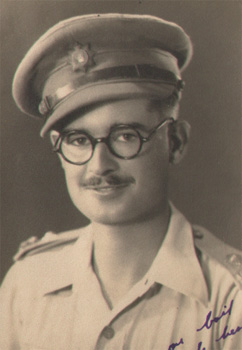
Unknown date and location.
It was wintertime in Potenza, and all these Italian girls were wearing their usual winter gear, which consisted of fairly short skirts, above the knee, with thick knitted stockings up to the knee, all secured with garters that had attached several knitted baubles. They looked ever so smart. I had found this building for a mess although it was pretty useless really and had no electricity. However, it was sound and was near the railway station. The stationmaster’s wife was a girl who I think was called Anna. Her husband, poor man, was a prisoner of war in Egypt. I invited her with her children over to our mess several times, for tea. I got to know her quite well, but we could never get rid of her mother in law. She would coast around and kept popping up all over the place, which was a bit of a darn’ nuisance.
During this time at Potenza the officers would take it in turns to take men for several nights at a time to go up and watch over this pass which, if the weather eased and the Germans broke through, they might come up. Well it was to be my turn the next day, and I had a bad turn of bronchitis. I was upstairs in our mess lying on a camp bed with the regimental doc seeing what he could do for me. Then everybody else pilled in, the whole lot of them, to see how I was. So we had a few drinks and everybody was smoking. Soon the fug was so bad one could hardly see the person next to you, because of the smoke.
(There was a personal cigarette ration, in the army, of 50 cigarettes a week that came in a round airtight tin. Pipe smokers were much better off, because they got a quarter of a pound of tobacco, and you’d have to smoke pretty hard to smoke that quantity in a week. The poor old Sepoys, as usual, were badly treated. All they got were “V” cigarettes made in Bombay. These were so bad it was really like smoking manure. However, many bought English cigarettes from the NAFFI. Our Sepoys were now very much westernised. They all used toothpaste, soap, perfumes and all the modern things that they could get from the NAFFI.)
Of course all this smoke made my chest much worse. In the morning I set off with my orderly and men, taking some small tents, and climbed up to this pass. That night coming back to our tents from the first patrol, it was so cold, that our boots had frozen onto our feet. So we had to light a fire and place our feet and legs over the fire until the boots were defrosted. And a strange thing was happening. As time went on my cough was easing, and by the third day it had gone altogether. I assumed that it was the extreme cold that had fixed me up. When I was back to base, and the smoke filled mess, my cough came back, so then I realised that it was the fug in the mess that was the cause.
Shortly after this we moved to the Adriatic front, and worked our way up towards Lanciano, where we took over a position from these Canadians. We had great difficulty in taking over their gun positions. The Canadians had thought that they could leave their field guns in position for us to take over, and they would then go off with our guns. But, as our gunners found out, they had been using “super cart” charges, and they had been doing this all the time. As you probably know with some modern field guns, like our 25 pounders, two parts are loaded into the breach of the barrel, the shell, and then the brass cartridge case. Prior to loading, three bags of high explosives are packed into the cartridge case. These bags are numbered and of different colour depending on the power of explosive contained. One would use the appropriate bags according to the range one wanted to fire. Now if one wanted to fire the shell very much further, perhaps an extra four or five miles, as one occasionally does, one would use “super cart”, super cartridge. In this instance the brass cartridge case would be filled with a very powerful high explosive that looks just like Macaroni. “Super cart” propels the shell from the gun with much greater speed and in consequence wears out the barrel much more quickly. Where as our gunners would only use this stuff when it was absolutely necessary, this was all the Canadians used. They fired “super cart” all the time. So, in consequence, the condition of the barrels of their field guns was absolutely shocking, and our gunners simply refused to swap guns. This meant that the whole process was much more time consuming. The Canadian guns were pulled out, and our guns reset in the positions during night-time, as these positions were fairly close to the enemies. It l was all a frightful bore. The Canadians couldn’t understand why we wanted to keep our own guns. despite having been told why. So eventually they pushed off, rather in disgust, taking with them a load of dud field guns, ruined by their own misuse.
Well, this front was right up against the Adriatic Sea, and there was one coastal road one could go along to get up to the front. This however was a long way, about 30 miles. Then there was the short cut down the “mad mile”. Every front has its “mad mile”, and this one was particularly mad. The Military Police had a post at the start of the ”mad mile” and would control traffic. Usually one vehicle at a time would be allowed into the valley, driving as fast as it could, reach a sharp bend and go up out of danger just behind the front line. The whole of the valley was under near constant shellfire. At the bottom of the valley there was what had been a brick and tile factory. (Of course it was now in absolute ruins ). All around this factory were wrecked vehicles that had been hit by shell or mortar whilst fire trying to get through the mad mile. Recovery had been out from divisional HQ and had pulled them off the road to keep it clear. It now looked like a vehicle graveyard.
The first time I went down the mad mile, I had with me a whole brigade lift of ammunition, about 20 lorries full of ammunition. In my truck I had two units of high explosives for the engineers. The MP controlling traffic told me to go the long way, and not to go down the mad mile with such a dangerous load. I didn’t take his advice; I was behind schedule as it was. I told him it was too far and we set off down the hill into the valley. It was quite extraordinary; there was no shelling at all on this occasion. It was only when we were approaching Castel Frentano that there was some shelling but none of our vehicles were hit. I went through the valley several times after this on motorcycle and there was always heavy shelling. One would simply open up the throttle and go like mad.
Actually in Lanciano itself there was a large tobacco factory. (Italy seemed to be smothered in tobacco factories, you could find one in almost any town. There must have been an awful lot of smokers in Italy). Our divisional CCS had been set up next to this factory. The flat roof of this factory made a wonderful observation post. One could see all that was happening on the battlefront, in the town and all the rest of it. I was up there one day and there were all these war correspondents also on the roof. Some of them came up to me.
‘We can’t understand it, we’ve seen buckets of legs coming out of that tent over there’ said one of them pointing to the CCS.
‘Yes’ I replied ‘I expect you have’.
I stayed a while and saw what they were talking about. There were buckets of white legs and buckets of brown legs coming out of the tent, and some buckets with both brown and white legs. So I told them this was because the 4th Indian Division has British and Indian soldiers. However they still thought it was a rather amazing thing.
We now had to trundle all the way back to the Mediterranean side of the front, funnily enough to just North of Potenza, where we had been before. Here, the snow was so deep that we were given guides by the Italian government. The Italians, as you probably know, were fighting with us as co-belligerents. (Of course, they weren’t allowed to be called allies). One day our guide was supposed to be showing us over this mountain pass when he suddenly disappeared and was never seen again. However we managed all right and worked our way up to Route 6, the famous road from Rome to Naples. So we moved on toward Venafro. Christmas day arrived and we were awaiting orders to move up to the front. Maurice Fortune and myself took a jeep up into the hills to reconnoitre routes. On our way back we got lost and stopped at a cottage to ask about the snow conditions on the road ahead. The cottage door was slightly ajar. I knocked and the door flung opened. Inside were two children huddled together around a few glowing embers, set in what looked like a millstone. From upstairs came the sound of people coughing very badly. The children told us it was their parents, who were ill. All these poor kids had to eat were a few chestnuts, which they were trying to roast on this miserable fire. We told them with a combination of poor Italian and sign language that we would soon return with food. Both of us had a mind to collect our Christmas dinners and bring it back for the children and their parents. Unfortunately back at camp we found ourselves in deep trouble. The column had orders to move an hour ago, the mess tent was packed and we had missed our Christmas dinners. So we had to move out immediately and so did not return to those poor children. Even now, 50 years on, it still hurts to think how badly they must have thought of us, in breaking our promise.
Now we were moving as swiftly as we could toward Cassino. We were now part of the American 5th Army. The two Texas divisions the 34th and 36th had been trying to break through at Monte Cairo and Monte Cassino and had suffered heavy casualties.
Late in January up on a hill near Venafro, our Brigadier gathered the officers together and asked us to look across the valley. There in the distance perched high on a hilltop was the Cassino monastery. The significance of the sight even at the time was deep. He addressed us.
‘Once in the valley’ he said
‘There are only three directions you can go. You can go forward, or you can go down into the ground, or you can come back here, smashed up. We must aim always to advance…’
We looked again across the valley toward the monastery, dark and forbidding against the skyline. It seemed the very epitome of bleakness.
One day, soon after this, I was driving along and saw this American soldier standing in a hole (to protect him from shelling). It seemed rather strange because he appeared to be a sentry, guarding a smashed up old barn. So the next day, when things were a bit quiet, I went to investigate. I asked him whether he was guarding the place and he immediately asked if I had come to take charge of the “K” rations.
‘How many are there’ I enquired.
‘About 120,000’
‘Well that’s right, I’m here to take charge of them’
So I signed a piece of paper and that was it. We suddenly had all this stuff, which was ideal to take up to the forward positions.
They weren’t very exciting these “K” ration packs, but they proved very handy. They had a little tin of spam, some biscuits, a little pull opener tin of cheese, four pieces of kaki toilet roll, 5 cigarettes (American) and various other bits and pieces. They were pretty boring in the long run, although they saved us a great deal of inconvenience, with the forward units using them straight away.
We were now engaged in getting ammunition to our positions on the high ridges overlooking the monastery. This was difficult because of the broken terrain and the terrible weather in Italy that winter. The ground when it was frozen was ok, but with the slightest thaw it became extremely muddy. It was so muddy that our 4 wheel drive trucks could not cope, and we had to borrow American 10x10 trucks, GMC’s and the like. The only trouble with these is that they came with Italian drivers. Although they loaded with ammunition in Naples, as was required, we had difficulties towards the front. On one occasion when we were going up to the front at night, I left the convoy in a village and went ahead to select a place to form an ammunition dump (prior to it being taken up to the ridges with mules). When I returned I discovered that these darned Italians had emptied the ammunition into a ditch and pushed off. So the whole of exercise was wasted and we had to bring more ammunition up from reserve. There was really only one thing to do with these Italians, and that was stay with them all the time and make sure they did what they were supposed to do. They were a terribly jumpy lot. However we managed to get some American drivers and they would bring the ammunition up to the right place.
I was with this American captain, in a jeep, leading an ammunition convoy on one occasion. It was very tricky because on the narrow road that passed the last village before the front there was a very sharp bend. It was so sharp that our trucks couldn’t get around, so we had to send the convoy up into the village around this fountain and back on another road to go out on toward the front. We arrived at our destination behind schedule and had an awful sweat to get the ammunition into some sort of order before daybreak. Of course at first light the Jerrys started to shell us. They had noticed, being so high up, that something was going on and opened up the shellfire.
All routes to the front involved some danger. Some people would come out to were we were, not going over the River Rapid as that was far too dangerous, but on a road that passed a row of trees, then in to Cassino, turning right and then coming out on the road we were on. This traffic was controlled by a military police man, who had a hole in the road, so that only his head and arms could be seen. He was under constant shellfire, and in fact on one particular day, by the evening a forth policeman was on duty in the hole, the others having been either killed or wounded. The German shelling was terrible.
© Copyright of content contributed to this Archive rests with the author. Find out how you can use this.


 Recommended story
 Story with photo