

- Contributed by
- Albert Grundy
- People in story:
- Albert Grundy
- Location of story:
- West Ham, London
- Background to story:
- Civilian Force
- Article ID:
- A3672542
- Contributed on:
- 16 February 2005
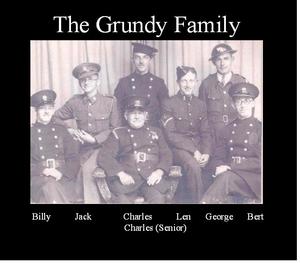
The Grundy Family From left to right Billy, Jack, Charles, Len, George, Albert (Bert) front Charles (senior)
It was in 1941 that the Auxiliary Fire Service (AFS) became the National Fire Service (NFS) run by the government. Fire stations then started to get new machines. Albert Grundy was made a Section Leader, in charge of five pumps and crews.
Albert covered the City of London and the North side of the Thames down to Dagenham and across to Enfield. He moved around several stations including Chingford, Chigwell, West Ham and Plaistow.
West Ham was a ten-pump station. While Albert was stationed there the Flying Bombs — V1’s (buzz bombs) started. The very first time he saw them, Albert thought they were German aeroplanes that had caught fire, he soon realised that they were a lot more deadly than that and were in fact falling bombs. The German’s targeted the docks, King George V and Victoria Docks. Albert remembers spending several nights there on duty while the British troops were loading up petrol for the D-Day landings.
© Copyright of content contributed to this Archive rests with the author. Find out how you can use this.




 Recommended story
 Story with photo