

- Contributed by
- Dave Thacker
- People in story:
- Leonard Stanley Thacker
- Location of story:
- St Tropez Bay, Southern France.
- Background to story:
- Royal Navy
- Article ID:
- A6197420
- Contributed on:
- 18 October 2005
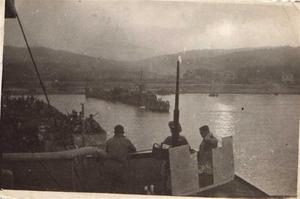
View from Thruster: D-day, Southern France, August 1944.
This story is submitted to the People's War Website by David Thacker, a volunteer from BBC Radio Northampton, on behalf of his Mother, Isabella, wife of the late Len Thacker, and has been added to the site with her permission. She fully understands and accepts the site's terms and conditions.
Here are Len's words written in a W/T Operator's Log book, about Operation Dragoon in August1944. He is believed to have written this soon after the war's end:
"For weeks it had been apparent that an Operation was impending. It was fairly obvious too that it would be Southern France. WE sailed from Naples to Oran, where we loaded with tanks and vehicles, and French Army personnel. On the way over we were given an idea of what it was all about, and where. Opposition by air wasn’t expected to be heavy for the Germans had only 375 aircraft in Southern France and half of these were expected to be knocked out by D-day. Over 2000 of our aircraft were helping. However we did expect shore batteries to oppose and were warned of heavy minefields, underwater obstacles and all sorts of radio bombs and torpedoes.
For days Southern France was heavily battered by air and terrific naval bombardments. A huge Allied Fleet was taking part. It included 6 battleships, approximately 30 cruisers, several aircraft carriers and numerous destroyers.
We arrived off the assault area at about 1600 on D-day and proceeded to beach. It was an ideal beach and we went in with no trouble. Whilst there, a few air alerts went but no planes were seen except for wave after wave of our aircraft. From inland we could see huge columns of smoke.
On the beach many small craft were unloading and there was great activity. Then I saw large numbers of prisoners huddled together. These were later taken away by empty landing craft.
A little further along the beach, a few Germans under guard were carrying stretchers bearing their dead, to a lorry, and just tipping them in. Further along the beach was the burnt out wreck of an LST.
After unloading, we took on many glider pilots and paratroopers who were to return to Corsica on route for England. They all said that hardly any opposition was encountered.
We re-loaded at Corsica and came back to the beach, which by now seemed like its old peace-time self. There were even several French civilians who cycled down to the beach and waved to us, as we poured load after load of supplies, troops and vehicles ashore.
Altogether we made 11 trips from Corsica to the beachhead. And, although each time we had signals of Elizabeth-boats, mines, air attacks etc, we never met with any excitement.
Several months previous in months of hard work, Thruster and our sister ship Bruiser had almost solely built Corsica into one huge airfield and dump of equipment. Our task after D-day was to move it to France, a task which we accomplished well."
© Copyright of content contributed to this Archive rests with the author. Find out how you can use this.



 Recommended story
 Story with photo