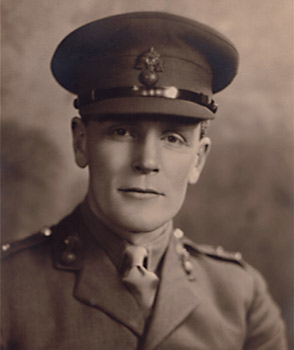
James Hill
Read this introduction to James Hill's story, then listen to him describe his experiences, using the links at the foot of this page.
James Hill was born in 1911 and went to Sandhurst in 1929. He lived the comfortable life of a traditional army officer, then went into the family business. As soon as war was declared he was called back into service, and in September 1939 was put in charge of the advance party of the Royal Fusiliers to go to France. He found himself on the Maginot Line over the freezing Christmas of 1939-40. He was promoted, and went to General HQ to work on the staff of Lord Gort, whom James Hill remembers as a great man.
The blitzkrieg started on 10 May and he was soon ordered to help organise the refugee route out of Brussels. The refugees were slowly organised into overnight camps, but the Germans bombed many of these, causing such carnage that James Hill remembers this as the most horrifying memory, for him, of the whole war.
Eventually he was told to get a French petrol convoy to Dunkirk. This, after many trials and tribulations, he succeeded in doing. Once on La Panne beach, he was left to organise soldiers onto the boats and to keep order as the evacuation proceeded, before making his own way back to England.
In order to see this content you need to have both Javascript enabled and Flash installed. Visit BBC Webwise for full instructions
James Hill: ... there was one place where this woman came up and said, 'Will you please shoot me, because I don't want to get in the hands of the Germans?' At the end of the war, a number of Germans came up and said, 'Will you please shoot us? ... we don't want to get in the hands of the Russians!' ... and in one case it was French people not wanting to get in the hands of the Germans, and the other it was Germans not wanting to get in the hands of the Russians, but I mean ...
Interviewer: What did you do?
James Hill:.... well you don't ... no, you don't ... probably kinder if you had ... no.
In order to see this content you need to have both Javascript enabled and Flash installed. Visit BBC Webwise for full instructions
I think ... how you mentally survive the awfulness ... if you're sensitive of the situation. I mean ... you picture the fields full of people, no facilities, may have some food dumped there, may not ... As the battle went on they got a bit better at it, got a bit of food ... and then you get them being bombed, or machine-gunned, and you get the casualties where they lie, and they've got nowhere to lie except on the grass ... you get the horses bolting all over the place ...
No, it was very, very unpleasant, and I ... the only reason I ever survived was really hardening my heart, you had to take these things in your stride, and you had other things to do. But I think all those private soldiers that you've interviewed, dozens of them and ... this and the other the ... Dunkirk ... I mean they weren't ... I was trained ... and they weren't trained.
Well they were trained - I mean their unit - but the whole thing was new to them, and of course later on I got to know so much about human nature ... commanding a parachute battalion and brigade for three years in war, but I learnt a lot, in France!
In order to see this content you need to have both Javascript enabled and Flash installed. Visit BBC Webwise for full instructions
I remember later on, as the thing gradually whittled down, I was given the job of ... looking after one of these columns going out to sea. In the last 36 hours I was the only one, because everybody else had been evacuated, and there weren't very many people going, but one of the interesting things, a thing I always enjoyed was ... here was this column, and the chaps in the brigade headquarters came up, and the Brigadier was a splendid sort of chap, with a brilliant moustache ...
... and this that and the other, and a great big lifeboat came in, a lovely one. It was motor, it wasn't rowed or anything, it was a big one, and ... bumping about, and I popped this brigade headquarters onto this lifeboat, you see, and that was splendid ... they all got on, and looked over the top and then, of course, the thing stuck on the sand with the weight of them.
So the Brigadier doing what he should do, got out - 'Come on chaps, give me a hand!' - and half a dozen other good chaps got out, and they pushed and shoved, and gradually the lifeboat went off. Well instead of waiting for the Brigadier to sort of wade out and somehow get to it, they all waved him - 'Goodbye, see you later!', and he was furious. And he really blamed me for this misfortune! I couldn't wait to get him on the next little boat that came in and get rid of him!
In order to see this content you need to have both Javascript enabled and Flash installed. Visit BBC Webwise for full instructions
The other thing that was so interesting on the beach was, of course, not only were you attacked relentlessly by Stukas, dive bombers, and machine guns, by Messerschmidts, the Stukas were the worst thing here and ... but the Germans had now got sufficiently close, that they could shell the beach, so you had it coming ... all ways. And these little boats continued to come in ... and one of ... while I was on that job, I remember seeing a paddle steamer, and I watched a Stuka dive bombing it. And to me the thing was probably 2,000 yards out, it was a long ... quite a long way out, and you could see from the Stuka, you could see the bomb, you see ...
...and to me, 2,000 yards away, it looked exactly as if this bomb had gone down the spout, the funnel of the paddle steamer ... the whole thing disintegrated. In fact, it had gone down the funnel of the paddle steamer. The whole thing disintegrated, and I think they lost 2,000 chaps.
In order to see this content you need to have both Javascript enabled and Flash installed. Visit BBC Webwise for full instructions
You can only ask people to die if it's in a worthy cause, the right cause, and you can only ask people to die if you're prepared to die as well as them, and if you've got those two you're in business. It was as easy as that.