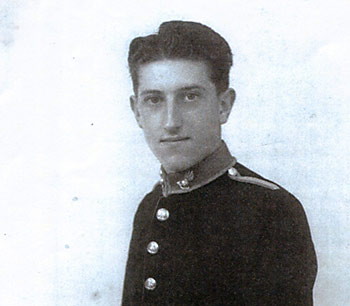
James Bradley
Read this introduction to James Bradley's story, then listen to him describe his experiences, using the links at the foot of this page.
James Bradley joined the Territorial Army in the first months of 1939, aged 18, because he says that Hitler was doing a lot of damage in Europe, and he wanted to be ready to fight for his country.
He trained to be a machine gunner and went with his unit to France. They drove to the Belgian frontier where fierce fighting soon started. After 10 May, he and his unit were ordered back into France and he was witness to some terrifying Luftwaffe bombing as the Allied retreat got under way.
Then he was told to 'get back to Dunkirk', and as he headed north he became embroiled in fierce local fighting, saw refugees machine-gunned as they fled to escape danger, and thought the world had gone mad. On reaching the the coast, he could see Dunkirk was a blazing mass of burning oil.
In order to see this content you need to have both Javascript enabled and Flash installed. Visit BBC Webwise for full instructions
... we were told that we'll have to stand and fight to the last here. But then we were told, a second time, 'We've got to get out of here, we've got to save the regiment - or what's left of the regiment'.
And they said that you were to get a rifle and a bayonet and you were actually on your own now, and you've got to get back to Dunkirk. If he'd said New York I couldn't have been more surprised, because I didn't know where Dunkirk was. But I began to think to myself, 'I've got to survive, I must survive to fight on in this war'.
In order to see this content you need to have both Javascript enabled and Flash installed. Visit BBC Webwise for full instructions
... and it's a really hot day and I'm looking round behind me, and I could see at the house ... the door opening and a woman came out and all black, an oldish woman, with grey hair. And she looked over and she saw me, and I was dying for thirst. I needed, and I was going like this ... 'aqua', or what is it in French? ... and I was going like this. And she went ... and closed the door and went in, and I thought, 'Well, that's bad luck for you'.
But the next minute the door opened again, and from the pump, that I could see inside, she brought out a tray, with cut glass and a jug with water, and walked across the farmyard, and there're bullets - bew!, bew! - going over - you know - and a few mortars crashing, and I thought, 'She's mad!' And she came over to me, I couldn't speak French, she couldn't speak English.
She said something about ... 'ma bonne ami', or something, and she gave me the water. And I said, 'Get going, get going, go!' So she got up, and she walked straight across, and half way across she stopped and turned, and spit, and waved her fist at the 'sal bosch'.
And I thought, 'She's some woman this', you know, I wouldn't cross her! Anyway, she went back into the house, and then they came round and said, 'We're moving,' and we moved out onto the road, ones and twos. And there's the young officer came and said to me, 'Thank you for being with us but we don't need you, you're not one of their unit you're an artillery man, we're infantry'.
So I said, 'Well, I'll do anything, you know, to stay with you.' 'No, go,' he said, 'we're going down the road - you go ... head north ... get to ... Dunkirk' - again, I hear this Dunkirk place.
In order to see this content you need to have both Javascript enabled and Flash installed. Visit BBC Webwise for full instructions
I went over the sand hills and moved along to La Panne, which is a little bit to the right of Dunkirk, and there were hundreds and hundreds of soldiers on the sand there. And ... ships coming in, trying to pick them up. But there were so many I thought - 'They'll never get these people off here', but you've just got to be disciplined, it's only discipline.
And I saw the most magnificent bit of British discipline there - taught me something. They went down in the water, they stood in rows of four, and they stood in the water ... and the tide came in .... and it went up to here ...and then the tide went out ... and then it came back. I have I, I was there for ... I remember three tides, and staying there at night, but of course there was the odd guy who left for obvious purposes to nip back over the sand dunes. But when he came back, a hand would go up, 'Over here!' 'Over here!', and it was just so terribly British. I, I think I became a man there.
And then ... unfortunately the dive bombers was ... you know ... knocking the ships out, and there were terrible things happening. I saw a destroyer actually packed with men on board that were hit, and it just went on its side and hundreds of men went into the sea ... thrashing about there, many of them couldn't swim, I'm sure.
But to get back to my situation. The night came, and the next morning I thought - it was getting light - I thought, you know ... this is gonna be too late, cause I think it was the 24th of June. Getting towards the end, very end you know. ... Lots of chappies there who were dead lying about, and nobody could do anything about that. But there were others that were moving around ... there were some badly wounded people.
In order to see this content you need to have both Javascript enabled and Flash installed. Visit BBC Webwise for full instructions
One surprising thing happened there ... We had a dispatch rider, he was one of twins who came from Hastings. And he was behind me, and I thought he must be mad, because he's got a tin hat on, and a rifle, and everything ... his equipment. I thought, 'If he's going in the water, he won't have a chance'. Anyway in the moving around, he got in front of me ... but I wasn't mad to get on that ship, there was no panic.
'It must be done calmly,' I thought, 'if we're gonna get there, let's do it like real men' ... well, I was a boy actually, although ... that's a difficult thing to measure in a person. Anyway, this chappie stepped round in front of me, went to step, and he fell in the water, and I shouted to him, and I saw him going down, like this ... and all the bubbles coming up ... and he's still got a tin hat and ... a rifle around him, and all this equipment, and he just went down ... down.
And voices and people were pushing, other chaps, naturally ... you can't do anything, and shouting advice, 'Get up that ladder! Get up there!'
In order to see this content you need to have both Javascript enabled and Flash installed. Visit BBC Webwise for full instructions
I got on the deck, and they just said, 'Get down the deck, get down the deck, we're gonna take off as soon as possible, before the Stukas come'. So I went over, and there was a thing called a, a kali float, and it was like a frame of wood, with oil drums in it that had been sealed up, and it was just lying on the deck, with bits of rope put onto it. And that, if the ship went down, would float.
And in my simple childish mind I thought, 'If I get in there, and I put me legs through all the wood and so forth, that I shall be all right in there, because if it goes down I, I shall float'. And all I can remember was the humming of aeroplanes coming, Stukas are coming, Stukas.
And I fell asleep, and I don't know how long it took to get across the Channel, because I slept all the way. And the next thing I knew was a sailor standing over me shouting, 'Wake up!, wake up!, are you going ashore or aren't you going ashore?' And I thought, 'Where are we?' I said, 'Where are we?' He said, 'Dover, you bloody fool!' And I thought, 'Well, I don't even mind him swearing at me, it's Dover'. So I pulled myself up and went off, went down the gangplank.
And I knew I was back in England ... they'd got tables there with loads of tea and buns, and so forth, and I was ravenous. I think I ate six buns, which was greedy really. But I, my stomach was so empty! And then the military police were there too, and they were saying, 'Keep moving, keep moving!' And they had the train in the station.
And I said, 'Where's the train going?' Nobody knew, but anyway, 'Get on the train, you must get out of here, must get out of here!' - because there were masses of troops coming off, although we were now very much the tail end. And then we drove across England and stopped at side stations, and people were all waving ... the WVS ... I thought, 'Oh, this is England, you're worth fighting for!'