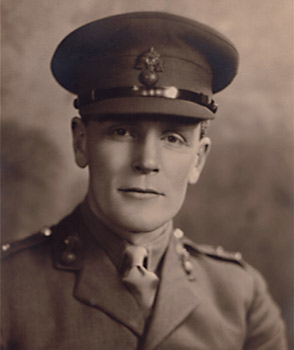
James Hill
Read this introduction to James Hill's story, then listen to him describe his experiences, using the links at the foot of this page.
James Hill was 33 on D-Day and he commanded the Third Parachute Brigade, Sixth Airborne Division. Over 2,000 men were under his orders during the landing of Normandy.
Hill was parachuted in to the flooded valley of the Deve - which cost him a delay of four and a half hours. On the way to Brigade headquarters, he and some comrades came under fire from German planes, and 18 of them were killed.
Hill was one of only two survivors of the attack. Subsequently, he managed to get to the divisional headquarters in Renville, where he learned that the Brigade had achieved its objectives.
Still before 1pm, Hill was submitted to a surgical operation, due to a wound suffered on the road. He says 6 June 1944 was the Sixth Airborne Division's 'big day', despite of heavy losses. His brigade started the day with 2,200 troops, but finished with '700, at the most'.
After D-Day, Hill was taken to a hospital in Britain, and afterwards fought in the Ardennes, Holland and Germany before leaving the Army.
In order to see this content you need to have both Javascript enabled and Flash installed. Visit BBC Webwise for full instructions
I heard this horrid noise and I knew exactly what it was, having seen much fighting before. And it was aircraft in tight formation dropping anti-personnel bombs. And so I shouted to everybody to get down as quick as they could. A thing like that goes over in 20 seconds. And in the meanwhile, you had this ghastly noise and I was hit in the ... I threw myself on top of Lieutenant Peters, the mortar officer of the 9th battalion.
And I flung myself on top of him, and there was this awful noise, the smell of cordite, death, powder, gunpowder, everything ... and that passed over. I knew I'd been hit, and I looked to my left and I saw a leg in the road and I thought, 'By God, that's mine'.
I had another look at it, and it had a brown boot on it, so I knew it wasn't. The brown boot belonged to my friend Lieutenant Peters, whom I was lying on, and he was dead, and I was alive.
Dust, dirt, crying people. And then I found only two of us could get to our feet, out of the 18 in my immediate area. So the decision was ... 'What do you do?' So I decided that I must push on, Brigade Commander, I had a lot of responsibility and things still to do of course, and more so. And so we took the morphia.
The two of us saw to the dead. We helped the living to get at their morphia, gave it to them, and then we set on to our objective, and they gave us a cheer as they went. You know, they were all dying. Later on that day, the Germans buried 18 of them in the shower houses next door.
In order to see this content you need to have both Javascript enabled and Flash installed. Visit BBC Webwise for full instructions
Well, the sky ... it was a windy, overcast day. At 7 o'clock, I don't remember the sun rising, but it was getting light. And you knew the direction of the beach, you knew where it was ...
And then suddenly ... bang, just like that, at the given moment of time, everything opened up. And you had these great monitors, these big ships with 15-inch guns, you had the cruisers, everything that could fire was firing. And then you had the chaps, and you knew what was happening, of course, the landing craft were coming in to the beaches.
Of course the Germans thought, 'This is a good idea, we'll fire too'. So you've got both sides firing away, and the light ... you were silhouetted against the dawn, really, a late dawn. I mean, the thing was getting light, the twilight. And it was very encouraging.
You thought, 'Well, you'll never ... never hear one of these things, barrages again in my life' - and I didn't. And it was tremendous. It was awe inspiring. I think that's the best thing you can say. And it was cheerful, because you knew then that you weren't alone. You weren't the only people.
In order to see this content you need to have both Javascript enabled and Flash installed. Visit BBC Webwise for full instructions
So I eventually turned up at divisional headquarters at Ranville and there, on the road to greet me, to my delight, was our divisional commander. And the first thing he said to me was, 'James, you'll be delighted to know that your Brigade has taken all it's objectives'. Well, of course, I was absolutely delighted.
And then, at that moment, his ADMS, who is the head doctor in the division, turned up, seized me by the collar and said, 'I'm taking you off to the main dressing station'. So I said, 'Hey, you certainly aren't'. And he said, 'Yes, you must have an operation'. So I said, 'OK, I'll have the operation on one condition. That you promise, when it's over, you'll take me back yourself to my Brigade Headquarters'.
And so he promised that he would. And as 1 o'clock came along, and I was lying in this dressing station waiting to be operated on, suddenly, a concentration came down over Ranville. A concentration is a dense shelling. And I thought to myself, 'Well, this is counter-attack'. In fact, it was 21 Panzer putting in a counter attack on our division.
And about two hours later I came to. It was quite an op ... about 3 o'clock, I think, and sure enough there were Brits all round. And to cut a long story short, I was told afterwards that I was the first person to be given penicillin. And I had, strapped to my side, a bottle and attached to the bottle were tubes and that went in to my wounds, so that I had penicillin dripping in to them all the time.
Rather undignified you see, half your backside, your trousers shot away and everything else. And as the Brigade commander, I like keeping up a bit of style.
In order to see this content you need to have both Javascript enabled and Flash installed. Visit BBC Webwise for full instructions
I was having tea with Colonel Ottway in the middle of a battle - this happens - and he and I were sitting under his slit trench at his headquarters, under a fir tree. And his batman was a splendid chap and produced tea, you see, with a lovely silver teapot out of the house, and every thing else, in the middle of the battle. So that was all right.
We sat there drinking our cups of tea, and then of course a mortar shell went and landed literally on top of our tree. And from then, I never heard out of that ear again.
But I don't count that as anything, because it didn't mean anything except you've lost your hearing. But of course, all the chaps said, 'They never even spilt their tea.'
You know, you've got great kudos. Colonel Ottway and I we were supposed never to have spilled our tea. Those silly little things happen in a battle. But I know I haven't heard out of my right ear since that day.