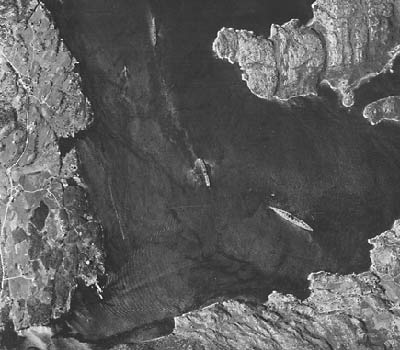
The German warships 'Bismarck' and 'Prinz Eugen'
The 'Bismarck'
On 18 May 1941 Germany's Bismarck battleship, accompanied by the Prinz Eugen, sailed with over 2,000 men on board from Gdynia on the Baltic coast. British intelligence had been monitoring the progress of the battleship and had noted increased reconnaissance by the Luftwaffe in the North Atlantic, which suggested that the German fleet would soon break out into the Atlantic Ocean.
The first indication came two days later from the British naval attaché in Stockholm, who had received a report that the Bismarck was sailing through the Kattegat and towards the North Sea. The following day, members of the Norwegian resistance sighted the ships off the south coast of Norway.
In response, two reconnaissance Spitfires took off from Wick in Scotland to search the Norwegian coast, and at 1.15pm on 21 May - whilst reconnoitring the approaches to Bergen, pilot officer Suckling found the ships at anchor, and photographed them from 7620m (25,000ft).
Such was the excitement on his return to Wick, that Suckling and the station photo interpreter viewed the prints whilst they were still wet from the darkroom. A telephone call was put through to Coastal Command headquarters immediately, and officials there ordered the prints to be flown direct to London.
A slight difficulty arose. The only available aircraft was Suckling's and he had just completed a three hour sortie. Suckling took off nevertheless, with darkness falling. He flew south until he found himself short of fuel, at night, on the outskirts of Nottingham, his hometown. Determined to complete his journey, he landed his aircraft, and made his way to a friend who owned a car.
Suckling and his friend continued the dangerous journey together, driving through the night and the blackout, and eventually delivered the prints to Coastal Command in the early hours of the morning. The prints were examined again, and the Admiralty was able to confirm that Suckling had indeed photographed the Bismarck and Prinz Eugen.
This most famous of the early reconnaissance sorties led, within seven days, to the sinking of the Bismarck - and also brought fame and glory to the art of photographic reconnaissance. The pilots took extreme risks in order to get their photographs, however, and when, two months to the day after spotting the Bismarck, Suckling went off on another reconnaissance sortie, this time he unfortunately failed to return.