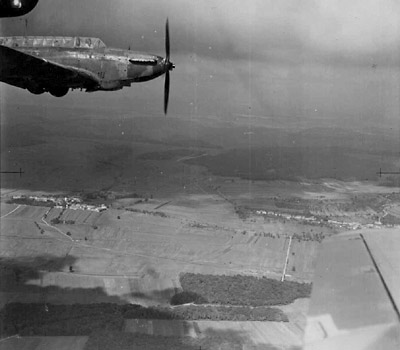
Fairey Battle aircraft
Early reconnaissance
By the end of World War One, photographic reconnaissance had proved itself, and was universally recognised as the indispensable eye of the modern army. Yet, despite this history, and the steady development in the civil applications of aerial photography, in the early months of World War Two the RAF philosophy was that no special skills were involved. It was considered that on those few occasions when aerial photographs might be helpful, the best course of action would be to use existing aircraft, with the appropriate holes cut for cameras.
In practice the modified Bristol Blenheims and Fairey Battle aeroplanes used were frequently shot down, and their cameras often froze. The photograph shown here of a Fairey Battle of 266 Squadron, Advanced Air Striking Force, is one of the earliest of the war. It was taken from another Fairey on 20 September 1939, 20km (12 miles) south-west of Saarbrucken, when the Squadron was based at Reims-Champagne. It was around the time this picture was taken that the British remembered just how important aerial reconnaissance was to winning war.