Industrialisation of war
- Industrialisation of war
- The industrial revolution dramatically increased the killing power of weapons, and afforded means to produce them in unlimited quantities. These developments were amplified by the willingness and capacity of modern states to mobilise an ever-larger share of their populations for war, through systems of universal conscription that had become general in Europe by the turn of the 20th century.
The intersection of these two trends is evident on the battlefields of the Western Front in World War One, where armies numbering in the millions, armed with the newest and deadliest machines of war, remained locked in static, attritional combat for almost four years.
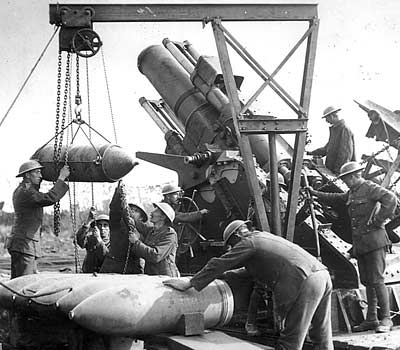
The dominant weapon of World War One was artillery, which accounted for about 70 per cent of all casualties. Its deadly effectiveness was owed to the development of a new technique called 'indirect fire', by which guns were employed against distant targets the gunners themselves could not see. The weapon shown here, a 15in howitzer, was designed for this purpose. It could fire a shell weighing half a ton upwards of 15km (10 miles), almost invariably at targets that had been identified hours or days in advance by forward observers, aerial reconnaissance, and so on.
At the same time the gun's own immobility meant that its enormous firepower would be limited value in dissolving the tactical stalemate of the trenches. A gun like this one might blast a hole in the enemy's position, but having done so it had no means of moving forward to exploit its initial success.
Nevertheless, to the extent that the great guns of the Western Front relied upon remote sensors, complex communications, and mechanised fire-control systems to do their work, they represented the future of war. The gunners of the Great War were the first to have known their targets only as coordinates on a map. The enemy, of course, generally had a similar map. But the easy postures of the men in the picture suggest that they already recognised how little they could do about it. On a modern battlefield, anything that can be seen can, in principle, be hit.