Operational art
- Operational art
- Everything that fights on land, from the individual soldier to an army, is stronger on its front than on its flanks and rear. And it is stronger when it has its feet under it than when it is moving. It is also dependent upon lines of communication and supply, which grow more vulnerable and less efficient in proportion to their length. Since the latter half of the 18th century, Western ideas about the conduct of war on land have been centrally concerned with the search for advantages among these seemingly immutable facts.
What soldiers call the 'operational art' is the means by which those advantages, once identified, can be seized. Its aims are simple, to concentrate strong forces against weaker ones, by exploiting favorable terrain, or by striking the enemy at a place where he was inherently or inadvertently weak, or at a time when he was poorly prepared.
Actually doing this, of course, is not so simple. Every battlefield lies enshrouded in what the great Prussian theorist, Carl von Clausewitz, called 'the fog of war'. Every army suffers from 'friction', the tendency for even the simplest things to go wrong in the heat of battle. The natural element of war, Clausewitz said, was chance, against which even the greatest military practitioners have been condemned to labour, if not absolutely in vain, then certainly on bitterly uneven terms.
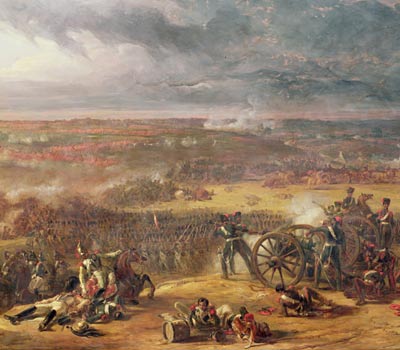
No commander has ever mastered the vagaries of the battlefield more completely than Napoleon Bonaparte, whose climatic defeat at Waterloo (1815) is portrayed in the painting shown here by the British artist Denis Dighton. Napoleon's enemies were finally able to defeat him because they had learned to fight as he did, by manoeuvering large, independent forces so as to bring them together with crushing effect at the moment of decision.
Dighton's painting is unusual in that it does not focus on the drama of individual combat, but draws the viewers attention to the immensity of the battlefield - a modest one by the standards of the future, but already large enough to dwarf the greatest soldier of modern times, portrayed as a small figure on a white horse, in the lower right.