


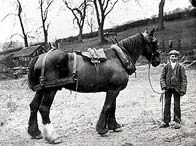
Memory as source
As we grew up, there was only one thing for us and that was to go on farms. I never looked for anything else.
I left school when I was 13 ... Our year-end was November 23rd. We were supposed to have seven days holiday, what they called Martinmas week. It was supposed to be seven days only but we generally used to have a few extra days. Now that was for the year. And you couldn't get out of it - you signed that contract for a year. If you left during the year, well - it was up to your employer whether he paid you any money or he didn't ...
I had £8/10s the first year, I had £12/10s for the second year. And then I had sixteen for the third…
Anyway, I went to work ...
These are the words of William Johnson who was born in 1893 in Hutton Cranswick, in the East Riding of Yorkshire. Although this account of his early working life is full of detail, professional historians used to reject this sort of reminiscence as a source for history.
'Little is left of most of the occupations and skills of the pre-machine age.'
Influenced by scientific attitudes, they relied entirely on written documents because they wanted everything to be verifiable. With accounts based on memory, a reader could not go back to the original and check for themselves that a witness, such as Mr Johnson, had really said or done the things they said they had.
Today, however, people's memories are back on the agenda, especially among local historians. Family and community life in Britain have been changing at a furious pace, and little is left of most of the occupations and skills of the pre-machine age, except for what survives in elderly people's memories. It has also become refognised that such memories are very accurate, because they draw on years of experience, and are easily checked by comparing the testimony of several speakers with similar backgrounds.
Tape recording oral testimonies offers a way - sometimes the only way - of capturing some of the detail of this vanishing past, before it is lost forever. Although Mr Johnson has died since I recorded his memories, his words are still available to historians in just the same way that documents are.
Published: 2005-01-31

