William Wallace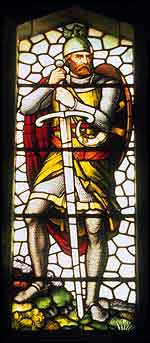
'This is the truth I tell you:
of all things freedom’s most fine.
Never submit to live, my son,
in the bonds of slavery entwined.’
William Wallace - His Uncle’s proverb,
from Bower’s Scotichronicon c.1440’s The reputation of William Wallace runs like a fault line through later medieval chronicles. For the Scots, William Wallace was an exemplar of unbending commitment to Scotland’s independence who died a martyr to the cause. For centuries after its publication, Blind Harry’s 15th-century epic poem, ‘The Wallace’, was the second most popular book in Scotland after the Bible.
For the English chroniclers he was an outlaw, a murderer, the perpetrator of atrocities and a traitor. How did an obscure Scot obtain such notoriety?
Who was William Wallace?
Wallace was the younger son of a Scottish knight and minor landowner. His name, Wallace or le Waleis, means the Welshman, and he was probably descended from Richard Wallace who had followed the Stewart family to Scotland in the 12th century. Little is known of Wallace’s life before 1297. He was certainly educated, possibly by his uncle - a priest at Dunipace - who taught him French and Latin. It’s also possible, given his later military exploits, that he had some previous military experience. Wallace’s Rising
In 1296 Scotland had been conquered. Beneath the surface there were deep resentments. Many of the Scots nobles were imprisoned, they were punitively taxed and expected to serve King Edward I in his military campaigns against France. The flames of revolt spread across Scotland. In May 1297 Wallace slew William Heselrig, the English Sheriff of Lanark. Soon his rising gained momentum, as men ‘oppressed by the burden of servitude under the intolerable rule of English domination’ joined him ‘like a swarm of bees’. From his base in the Ettrick Forest his followers struck at Scone, Ancrum and Dundee. At the same time in the north, the young Andrew Murray led an even more successful rising. From Avoch in the Black Isle, he took Inverness and stormed Urquhart Castle by Loch Ness. His MacDougall allies cleared the west, whilst he struck through the north east. Wallace’s rising drew strength from the south, and, with most of Scotland liberated, Wallace and Murray now faced open battle with an English army.
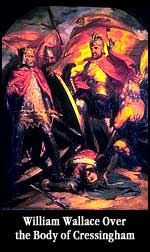 On 11th September Wallace and Murray achieved a stunning victory at the Battle of Stirling Bridge. The English left with 5,000 dead on the field, including their despised treasurer, Hugh Cressingham, whose flayed skin was taken as a trophy of victory and to make a belt for Wallace’s sword. The Scots suffered one significant casualty, Andrew Murray, who was badly wounded and died two months later. On 11th September Wallace and Murray achieved a stunning victory at the Battle of Stirling Bridge. The English left with 5,000 dead on the field, including their despised treasurer, Hugh Cressingham, whose flayed skin was taken as a trophy of victory and to make a belt for Wallace’s sword. The Scots suffered one significant casualty, Andrew Murray, who was badly wounded and died two months later.
'Commander of the Army of the Kingdom of Scotland’ - the outlaw Wallace was now knighted and made Guardian of Scotland in Balliol’s name at the forest kirk, at either Selkirk or Carluke.
It was a remarkable achievement for a mere knight to hold power over the nobles of Scotland. In a medieval world obsessed with hierarchy, Wallace’s extraordinary military success catapulted him to the top of the social ladder. He now guided Scottish policy. Letters were dispatched to Europe proclaiming Scotland’s renewed independence and he managed to obtain from the Papacy the appointment of the patriotic Bishop Lamberton to the vacant Bishopric of St Andrews.
Militarily he took the war into the north of England, raiding around Newcastle and wreaking havoc across the north. Contemporary English chroniclers accused him of atrocities, some no doubt warranted, however, in Wallace’s eyes the war, since its beginning, had been marked by brutality and butchery.

 | |  | The BBC is not responsible for the content of external Web sites. |
|









