|
The Battle of Stirling Bridge - Factsheet
|  | |
 'For this reason the Scots adopted a stout heart at the instigation of William Wallace, who taught them to fight, so that those whom the English nation held as living captives might be made renewed Scots in their own homeland,... Hence in the year one thousand three hundred less three time one the Scots vanquished the English, whom they put into mourning for death, as the bridge bears witness, where the great battle is recorded, which lies beyond Stirling on the River Forth.’ 'For this reason the Scots adopted a stout heart at the instigation of William Wallace, who taught them to fight, so that those whom the English nation held as living captives might be made renewed Scots in their own homeland,... Hence in the year one thousand three hundred less three time one the Scots vanquished the English, whom they put into mourning for death, as the bridge bears witness, where the great battle is recorded, which lies beyond Stirling on the River Forth.’
Poem in Bower’s Scotichronicon on the Battle of Stirling Bridge- September 1297
John de Warenne marches north with a huge force of cavalry and infantry. Earl of Surrey, Govenor in Scotland for Edward I of England, and spearhead of his imperial ambitions north of the border, he is confident of victory, whether by battle or negotiation. It has been four months since the rising of William Wallace and Andrew Murray began.
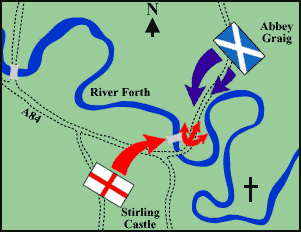
- Near Stirling Castle he arrives at a narrow, wooden bridge which crosses The River Forth. There, on the opposite bank is Wallace and Murray’s army. Warenne delays his crossing for several days to allow for negotiations, cocksure that the Scots will choose peace over war in the light of recent English victories and their obvious military superiority. He is surprised by their refusal to surrender and on the 11th September decides to force the crossing.
 - The Strategic Situation
The town of Stirling was the key entry point to the north of Scotland. The tidal River Forth was too wide to cross east of the town and upstream lay the enormous bog of The Carse of Gowrie.
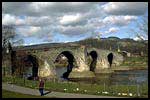
The Scots were encamped on the Abbey Craig, where the National Wallace Monument stands today. Their army was predominantly infantry armed with long spears, and was drawn mainly from the ‘lesser’ ranks of society - not because the Scots nobles completely resisted Wallace, but because many of them were being held captive in England. From the base of Abbey Craig a causeway stretched for a mile across The River Forth’s flood plain (roughly in line with the present day road between The Craig and the river). At the end of the causeway stood the bridge (lying 180 yards upstream from the 15th century stone that still crosses the river today - pictured above). It was wide enough to pass with only two horsemen abreast and the entire English army would have taken several hours to cross, after which they would have to enter a confined narrow loop in the river, leaving their flank dangerously exposed to attack. All this before they were even ready to give battle. Battle of Stirling Bridge, 11th September 1297
At dawn the English and Welsh infantry start to cross only to be recalled due to the fact that their leader, Warenne, has overslept. Again they cross the bridge and again they are recalled: as Warenne believes the Scots might finally negotiate. Two Dominican friars are sent to Wallace to acquire his surrender and return shortly afterwards with William Wallace's first recorded speech:
'Tell your commander that we are not here to make peace but to do battle, defend ourselves and liberate our kingdom. Let them come on, and we shall prove this in their very beards.’

 | |  | The BBC is not responsible for the content of external Web sites. |
|
|