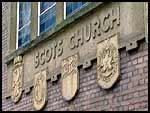
 In the 17th century the Dutch port of Rotterdam became the centre of a trading empire that spanned the globe. The Dutch were the first nation in Europe to value trade more than religion and nurtured a tolerant state which took in religious refugees from across Europe. Attracted by Rotterdam’s tolerance and the obvious economic opportunities, the town went on to outshine Veere as the focus of Scots trade in Europe.
 The Scots Kirk in Rotterdam
From the 1640s the Scots Kirk in Rotterdam attracted merchants and religious exiles alike. By the 1680s there were over 1000 Scots in Rotterdam. Scottish and Dutch Calvinism were very similar in outlook and the two seem to have happily co-existed, indeed the mild form of Calvinism developed in Holland seems to have positively softened the Scottish Kirk. In Rotterdam the closeness of the two schools of Calvinism had practical embodiment in that the Dutch state funded the Scottish Kirk. The Kirk did, however, continue to take its spiritual guidance directly from Edinburgh.
Most Scots lived in the poorer areas of Rotterdam and worked in a variety of skilled trades. The community flourished and integrated easily into Dutch society - many Dutch people still have Scots surnames.
While most Scots in Rotterdam were peaceful merchants, traders or craftsmen, others were religious exiles who caused considerable trouble for the Scottish government from the safety of Holland. One such example is that of Andrew Russell, a very wealthy merchant and Elder of the Scots Kirk, who was accused of sheltering the murderers of a Scottish Archbishop in Rotterdam. Infuriated, the Scottish government banned all Scots from trading with him. However, they underestimated Russell’s power as a trader and after bitter complaints about the disruption to Scottish trade the government was forced to climb down within six months.
 Education
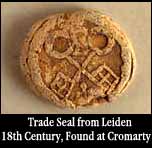
Since the Wars of Independence (1286-1328), Scots in search of university education had gone to the continent and especially to the leading university of Paris. However, by the 17th century those who were seeking a professional education sought out Leiden, near Rotterdam, rather than Paris. From the years 1572 to 1800, 1460 Scots students enrolled at Leiden. In Law and medicine, two subjects in which the Scots still excel, the impact of Dutch thought was immense.
Over half the Scots students at Leiden studied law. When they returned to Scotland, they dominated the Faculty of Advocates and laid down the theoretical basis of modern Scots law. Since lawyers were at the forefront of the nascent Scottish Enlightenment, the Dutch influence on Scotland’s culture cannot be underestimated.
In medicine too, Leiden gave the lead. Sir Robert Sibbald, the first Professor of Physic at Edinburgh in 1685, was educated there and went on to create Edinburgh’s famous Botanical Gardens - based on Dutch models for medical gardens. When Edinburgh University established its world-famous Medical Faculty in 1726, its founder, Alexander Munro, and four of its professors had all studied at Leiden and taught a modern curriculum based on Leiden’s own .Even Edinburgh’s Royal Infirmary, opened in 1741, was based on a Leiden hospital.