Crucible of the Modern World
 |  |
 In 1750 Scotland was much as it had ever been - a poor rural country ruled by its nobles. In two generations the Scottish Enlightenment changed all that, transforming Scotland into a modern capitalist economy. In 1750 Scotland was much as it had ever been - a poor rural country ruled by its nobles. In two generations the Scottish Enlightenment changed all that, transforming Scotland into a modern capitalist economy.
The Birth of the Modern World
From a modern perspective the Enlightenment seems a huge leap into the unknown. To those who lived through it, like Sir Walter Scott, it was ‘like those who drift down the stream of a deep and smooth river, we are not aware of the progress we have made, until we fix our eye on the now distant point from which we have drifted.’ It was an age of ideas, big ideas, which unleashed revolutionary changes in Scottish society and created the modern world we all recognise today. Two kindred forces were behind the change: The Industrial Revolution and the Enlightenment. The Industrial Revolution
The Industrial Revolution saw Scotland’s rural, agricultural economy overtaken by the rapid expansion of industry. Iron and coal production was increased massively, whilst traditional industries like linen weaving were efficiently mechanised. The age of factory work was born and Scotland’s trade reached out across the Atlantic to the developing markets of the New World. In transportation, the canals allowed far larger quantities of raw materials to be moved more efficiently, whilst the harnessing of steam to power locomotives and ships accelerated trade and induced a second wave of industrialisation. Each new inovation made possible a hundred more and history seemed to accelerate at an increasingly alarming pace. The Enlightenment
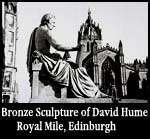
It was a time of questioning, of creating new theoretical structures with which to understand the world. It was also a time when the free exchange of these new theories and ideas was permitted, and this freedom was crucial to the movement which became known as the Scottish Enlightenment. James Hutton discovered that the Earth was millions of years old and developed a practical form of geology. Adam Smith analysed the market economy and wrote the handbook of modern capitalism - The Wealth of Nations. Most controversially of all, David Hume challenged orthodox religious beliefs. The Enlightenment, however, wasn’t simply the preserve of intellectuals, academics, the wealthy and the powerful. The Calvinist Kirk’s focus on reading the Bible ensured that Scotland was one of the most literate societies anywhere in the late 18th 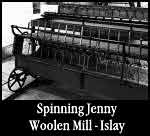 century. People who could read had access to the new ideas of the Enlightenment. century. People who could read had access to the new ideas of the Enlightenment.
At the centre of this intellectual revolution was a new scientific and rational approach to knowledge. There was a belief that reason could solve any problem and that through human ingenuity the riches of the Earth could be exploited for the benefit of mankind. Above all ‘improvement’ was the leitmotif of the Enlightenment.

 | |  | The BBC is not responsible for the content of external Web sites. |
| 






