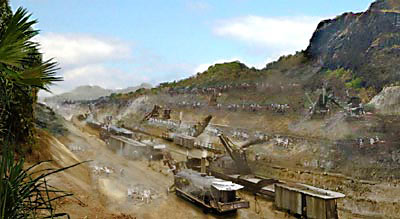
Reconstruction of the digging of the Culebra Cut, later known as the Gaillard Cut
The building of the Culebra Cut, later renamed Gaillard Cut, took place from 1907 to 1913. It was needed to link the artificial Gatun Lake with the Pedro Miguel and Miraflores locks that brought ships into the Canal from the Atlantic.
The Cut represented the Canal builders' biggest challenge. For although it is only 13.7 kilometres (8 miles approximately) long, it required the digging of a channel through Panama's highland region - the Continental Divide. A channel that had to be dug from hard rock and shale, rather than from soft earth.
More than a hundred million cubic yards of spoil resulted from the Culebra Cut, and it all had to be dumped. Part of it was used to join a series of four small islands in Panama Bay, to create a breakwater. More was used to claim nearly 500 acres from the Pacific Ocean, on which the town of Balboa was built - and the rest was taken to big waste dumps in the jungles of Panama.
In January 1913, a huge slide at Cucaracha spilled 2,000,000 cubic yards of earth into the Cut - so it was decided to flood it and to finish constructing the channel by dredging. The last steam shovel lifted the last rock on 10 September 1913, and in that same week, six huge water pipes at Gamboa were opened, allowing the Cut to be partially flooded.
On 10 October, 1913, the US President Woodrow Wilson pressed a button in Washington - sending the signal to Panama to blow out the dyke that separated the Cut from Gatun Lake to the west, and allowed water to completely flood the Cut for the first time. Then on 10 December 1913, the old French dredger Marmot opened up the channel for shipping for the first time by clearing the remaining spoil from the channel's bottom.