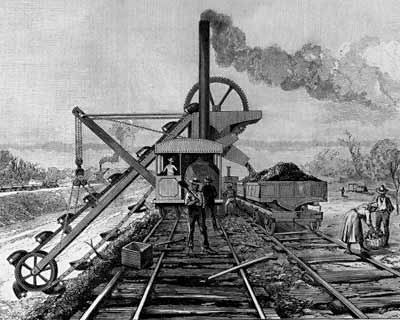
Drawing of French construction at Tabernilla in 1888
In 1878, the Geographical Society of Paris negotiated a treaty with the Colombian government, which granted exclusive rights to the French to build an inter-oceanic canal through Panama, joining the Atlantic and Pacific oceans at the narrowest point of the Isthmus that joins North and South America.
In 1879 a number of proposals were put forward for its exact route. One design envisaged an artificial lake in Panama that would be accessed at either end by locks, but this was rejected in favour of a one-level sea-canal. The sea-canal was the choice of Ferdinand de Lesseps - of Suez Canal fame - who used his considerable charisma to make sure his choice was adopted. The company chosen to run the project was the French Compagnie Universelle.
With the advantage of hindsight, it can be seen that the de Lesseps plan was a momentous mistake, and probably doomed the French to failure. Indeed, the present Canal largely follows the plan of the rejected 'locks and lake' proposal.
Even before the start of construction, the Compagnie Universelle realised the importance that the Panama railroad would have for their project, and so bought control of it in August 1881. However, the cost of this purchase - more than $25 million dollars - was huge, taking about a third of the resources available, and despite its key importance, the railroad was never properly used by the French engineers to move spoil out of the way.
By 1887, it was clear to the French that the sea-canal route would never work, and de Lesseps reluctantly agreed. A public subscription to raise funds for a revised project that year failed, and the shareholders of the French Panama Canal Company decided to dissolve it in early 1889. Later, Ferdinand and Charles de Lesseps were both indicted for fraud.
After years of negotiation, the US Congress bought the Canal project from the French for $40 million dollars - it was time for the United States to attempt to make the Panama Canal a reality.