Bridges and tunnels
The revolution in transport began in the later 1700s with the construction of the canal and rail networks. It meant that goods could be transported more quickly and cheaply than ever before and was one of the key factors in the Industrial Revolution. However, every transport system has to overcome mountains, rivers and marshes on the way. The first British bridges were simple and made of wood. By the Middle Ages, they could be constructed of stone. Up to the 1700s, the bridge builders were limited by the length of arch that could be built.
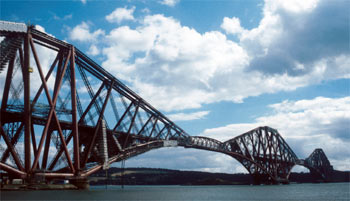
One of the greatest railway bridges in the world is the Forth Railway Bridge (pictured). It incorporates two major innovations - the use of steel and the cantilever principle. Three great piers were built with steel towers erected on them. From these towers, cantilever arms were built out on both sides. The bridge was finally completed in 1890 and still ranks as one of Scotland's landmarks.
In 1741, Europe's first wrought iron suspension bridge was built over the River Tees. This basic principle of suspending a path or roadway from cables rather than building one on top of arches meant that much broader rivers could be crossed. Further advances in the design and manufacture of wrought iron chains meant it was possible for Thomas Telford to build the famous suspension bridge over the Menai Strait. When it opened in 1826, it was the longest suspension bridge in the world. Another of his great achievements is the 1,000 feet long aqueduct which carries the Shropshire Union canal across the river Dee, near Llangollen in North Wales. It is called the Pontcysyllte Aqueduct.