Welsh castles
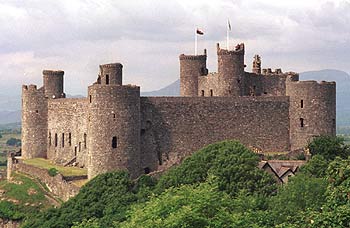
Harlech Castle (pictured), built by Edward I in 1283, has a history of occupation and assault. In 1404 Owen Glendower captured it and held a parliament there. Twice it was the last Welsh fortress to surrender, both to the Yorkists in 1468, and to the Parliamentarians during the Civil War in 1647.
Caernarfon first had a Roman fort around AD 75 and was the seat of local chieftains before the Normans built a motte (fortified mound). However, Edward's castle transformed the town into the capital of North Wales. The castle has been used for the investiture of the Prince of Wales since 1911.
The walls of Caernarfon Castle are patterned with bands of different coloured stone, deliberately reflecting the walls of Constantinople to commemorate Constantine the Great's reputed birth at the Roman fort nearby. As further homage, the towers are in an angular fashion rather than the usual rounded form of Conwy or Beaumaris.
Beaumaris Castle was the last of Edward's Welsh castles, but remains unfinished because the builders ran out of money and supplies before completion. It has a perfectly symmetrical concentric "walls within walls" design, with four successive lines of fortifications. This was state of the art castle technology in the late 13th century.
James of St George designed most of Edward I's castles and was named after his fortress of St George d'Esperanche in Savoy. Edward paid him a daily wage of two shillings, equal to a week's wages for an ordinary craftsman. In 1284 it rose to three shillings a day for life.
The castles required as many as 2000 skilled labourers and labour costs were correspondingly high. James of St George complained that "The men's pay has been and still is very much in arrears, and we are having the greatest difficulty in keeping them because they simply have nothing to live on".
Each of the castles was integrated with a bastide town, an idea borrowed from Gascony in France, where the town and castle relied on each other for protection and trade. Bastides were populated with Englishmen only: the Welsh were permitted to visit during the day and were forbidden to trade.
After Llywelyn ap Gruffudd's second defeat, Edward reorganised Wales along English lines with the Statute of Wales in 1284. It subdivided Wales into counties and, although they remained outside Westminster's jurisdiction, and did not elect representatives to Parliament, the legal system was brought into line with that of England.