Norman cathedrals
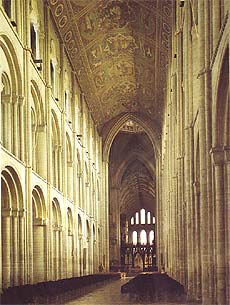
Ely Cathedral (pictured) is on the site of a convent, founded in 673 by St. Etheldreda, a Saxon princess. Work on the cathedral began in 1083 but the monastery was dissolved in 1539 after Henry VIII's break from Rome. Many statues, carvings and stained glass windows were destroyed including St. Etheldreda's Shrine.
Peterborough Cathedral was originally called St. Peter's Cathedral. Building began in 1118 and took 120 years to complete. It contains the tomb of Catherine of Aragon (Henry VIII's first wife who died in 1536 and whose divorce caused the Reformation) and the Hedda Stone, an Anglo-Saxon sculpture approximately 1,200 years old.
Rochester Castle was built by the Normans, and constructed along the lines of a Roman wall which protected a bridge carrying goods from Europe. Built by William the Conqueror's architect, Bishop Gundulf, the stone keep is 35m high and 22m square, with walls up to 4m thick.
Rochester Castlewas besieged by King John in 1215 after having been seized by a group of rebel barons. After a two month siege, the castle finally fell on 30th November when the keep was undermined and the supports burnt down using the fat of 40 pigs.
Rochester Cathedral is the second oldest in England, having been founded in 604. The present cathedral was begun in 1077 and contains a crypt which still bears graffiti left by Simon de Montfort's soldiers when they sacked the Cathedral in 1264. The crypt is considered to be one of the finest in the country.
Most Anglo-Norman churches had timber roofs instead of the usual Romanesque, rounded stone vaults. The exception is Durham Cathedral where the nave and choir are supported by the first known examples of pointed ribbed vaults. This anticipated a characteristic feature of Gothic construction by nearly one hundred years.
Durham was chosen by William the Conqueror as a fortress and defence against the Scots. The Normans built a cathedral and castle, and the city became a seat of the feudal prince-bishops. Durham was also a place of pilgrimage because the cathedral held the remains of St. Cuthbert, a 7th century ecclesiastic.
The Church of Saint-Étienne at Caen provides the definitive example of the early Norman style. Begun in 1067, this provided a model for the Norman cathedrals built across England and contains the tombs of William the Conqueror and his wife Matilda. William's remains were thrown out during the French Revolution.