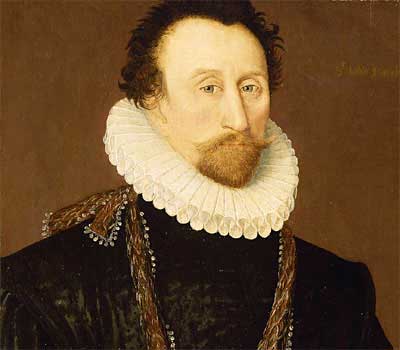
Sir John Hawkins
Pioneer slave trader, merchant
John Hawkins was born in Plymouth, Devon into a trading and seafaring family. His father William was the first Englishman to visit the Guinea coast of West Africa in the 1530s.
By 1561, Hawkins had made several voyages to the Canary Islands and heard about the possibility of trading slaves between West Africa and the Spanish Caribbean colonies. He made a first exploratory voyage in 1562-1563 with financial backing from London merchants and government officials and the support of Elizabeth I. He sailed down the West African coast capturing about 300 people, some from Portuguese slave ships. He then crossed the Atlantic and sold his captives in Hispaniola, and made a handsome profit for his investors.
Hawkins made two further slave trading voyages in 1564-1565 and 1567-1569. Both were semi-official, organised by William Cecil and given royal support. Hawkins chartered Royal Navy ships and sailed under the royal standard. He was given financial backing by London merchants and senior courtiers, including the queen's favourite, Robert Dudley, Earl of Leicester. On his return, Elizabeth granted Hawkins a coat of arms with 'a demi-Moor bound and captive'. On his third voyage, which included the young Francis Drake in the crew, Hawkins enslaved more than 400 people from West Africa. Despite fighting with the Spanish off the coast of Mexico, losing ships and men, and making no profit, Hawkins' reputation did not suffer.
From 1571 to 1581, Hawkins was MP for Plymouth and in 1577 he became treasurer of the navy, a post his father-in-law had held before him. He was knighted in July 1588 for his services against the Spanish Armada. He and Drake took the lead in founding a pioneering scheme of social insurance known as the Chatham Chest, in which a percentage of seamen's wages was used to establish a fund for injured, disabled and elderly sailors.
In 1595 ,Hawkins left England with Sir Francis Drake on another treasure hunting expedition to the West Indies, but he died off the coast of Puerto Rico.
Hawkins had proved that it was possible to extend the triangular trade between Britain, West Africa and Brazil to a new and potentially valuable commodity - African slaves. He also showed that trading in human beings was not an impediment to success in British society. Within a few decades of his death, Britain had joined the Portuguese, Dutch and French as leading European slave traders.