Women at the Heraia
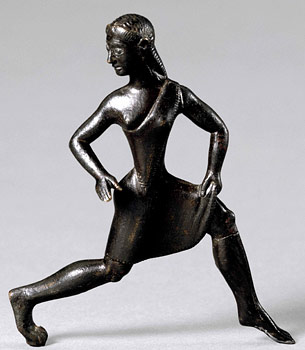
This Greek bronze statuette of a running girl, now housed in the British Museum, is 11.4cm high and dates to about 500 BC. It is Peloponnesian in style and may have been made at Sparta, though it was found at Prizren in Albania. The girl is dressed exactly as Pausanias describes the girls in the running events at Olympia ('Description of Greece', V, 16.4, second century AD).
Women in ancient Greece were rarely allowed to take part in sport, except in Sparta, where it was believed that mothers who were tough and strong would produce good Spartan soldiers. The events at Olympia were not part of the Olympics proper, but of a separate festival for the goddess Hera, wife of Zeus. Pausanias says of the women who took part: 'Their hair hangs down, a tunic reaches to a little above the knee, and they bare the right shoulder as far as the breast'.
Like the Olympics the Heraia were celebrated every four years, but the only event was the foot-race, with contests for three separate age-groups. The races were held in the stadium but with the track being shortened by one sixth, making it 158m long, instead of the 192m run by the men.
Perhaps this reflected the Greek male view of the physical inferiority of women. Religious conservatism probably also played a part in the exclusion of women from many sports, strengthened by a concern regarding women appearing naked in public, as male contestants did.
Plato, in composing the outlines of his ideal state, advocated both running and sword-fighting practice for women, but stressed that after the age of 13 they must wear 'appropriate dress'. The winning girls at the Heraia, however, were at least allowed to dedicate painted portraits of themselves in the colonnade of the Temple of Hera, where there is still evidence for the attachments of the portraits, although they have long since perished.