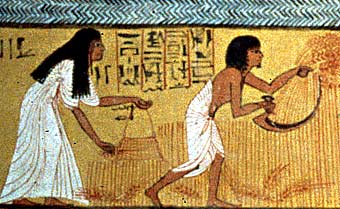
Farmer
The life of the farmer Heqanakhte is known from a series of short letters, found in the 1920s on the west bank at Luxor, the modern equivalent of ancient Thebes. They are now in the Metropolitan Museum of Art, New York. The readings here are a series of extracts from a range of his letters. Some were sent to a man called Merisu, written by his father, the same Heqanakhte. Merisu threw the letters into a tomb-shaft, where they were found 4000 years later. They are bad-tempered and judgmental, but reveal a timeless family story.
Heqanakhte lived at the end of the Eleventh Dynasty. He eked out a living through agriculture, and was a mortuary priest, which would have meant extra income for the family. Most of his sons are grown up, and apparently their mother is no longer alive. However, the father has taken a new wife, causing much resentment. A spoilt younger son, Sneferu, is the favourite. He, the father urges, should be excused unpleasant tasks and should not be accused of idling; indeed, his allowance is to be increased in view of all the criticism he has endured. To the sons, Sneferu is like anyone else, but Heqanakhte will not see this. All this is narrated against a background of whining from the father, labouring on behalf of an ungrateful family.
The old man also thinks his bride is being ill-treated; he accuses the family of molesting her and spreading malicious rumours. People are at breakpoint - the sons and most of the family on one side, and Heqanakhte, the bride and possibly Heqanakhte's formidable mother on the other. A crisis is at hand.
The outcome of this fraught situation is unknown, but Egypt at most periods has been the home of blood feuds, which can work their way down over centuries. One person who took a pessimistic view of Heqanakhte's affairs was the crime-writer Agatha Christie, who turned the contents of the letters into a murder mystery, Death Comes As The End (1945). Merisu and his brothers, if they could have predicted this, may have felt it was perfect, if belated, justice.
A note on the reading
The readings represent extracts from a number of Heqanakhte's letters.
In order to see this content you need to have both Javascript enabled and Flash installed. Visit BBC Webwise for full instructions
The cantankerous farmer: Heqanakhte and his angry letters (Middle Kingdom 1975-1640 BC)
Now, what do you mean by having Sihathor [the second son, who acted as a go-between] coming to me with old, dried-out, northern barley from Memphis, instead of giving me ten sacks of good, new barley? Fine - You're happy, eating good new barley while I'm going without. Isn't that so? Your ship has come in for you, when in fact you do nothing but evil .If you had sent me the old barley simply to keep the new barley intact, what could I have said, [except] "Well done !"? But since you won't assign me a single bushel from the new barley, I won't assign one to you - for the rest of eternity.
Bear this in mind: being half alive is better than being plain dead. Listen, you say hunger only about [real] hunger. Look, they are beginning to eat people here. Listen, there is nobody to whom your sorts of rations are given anywhere. So make the most of it until I return. Look, I am going to spend the rest of the summer here.
Now if Sneferu really does want to be in charge of those bulls, you must put him in charge of them. He did not want to be with you cultivating, walking up and down, nor did he want to come here with me. Whatever he wants, let him enjoy what he wants. Anyone who rejects these rations, woman or man, should come here to me and live as I live. But there is nobody who has come here to me.
Now, be sure to have the maid Senen thrown out of my house - take great care of this - the very day Sihathor returns to you [with this message]. Listen, if she spends one more day in my house ... But it is you who let her do evil to my new wife. Look, why must I scold you? What can she do against you, all five children? Also greet my mother Ipi a thousand times, a million times, and Hotepet and all the household. Now, what about this evil treatment of my new wife? You are taking a liberty. Are you set up alongside me as a judge? You shall stop - that would be the best thing.
Now, you are to send Iutenheb [the new wife] to me. I swear by this man - I mean Ipi [the deified tomb-owner whose ka-servant Heqanakhte was] - anyone who commits an abuse against my new wife, he is against me and I am against him. Look, she is my bride, and how a new wife should be treated is well known. Listen, as for anyone who acts for her as I have acted - would any of you be patient while his wife is being denounced to him? Shall I be patient? Is there any way I can be at the same table with you people? Will you not respect her?