Soldier
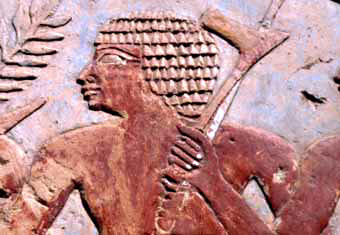
The life of the soldier Khusobek is known only from his funerary stela, a short autobiography which he composed for posterity. The inscription was found at the site of Abydos in Upper Egypt. It would have stood either in his tomb, or in some form of cenotaph: Abydos was the supposed burial-place of the god Osiris, and Egyptians who could not afford to be buried near the resting-place of this god sometimes built small chapels by the processional way leading to his sanctuary. The stela is now in the Manchester Museum.
Khusobek says he was born around 1880 BC. The lack of details about his family suggests that he was of humble birth, but he managed to attract the attention of the new king, Senwosret III, who made him a royal escort, perhaps a bodyguard. He was given command of a squad of 60 men, and took part in the campaigns into Nubia.
Egyptian interest in Nubia at this period is well documented, but the news that the king also conducted a campaign into Palestine comes as a surprise, since it had been assumed that the Middle Kingdom left this area to its own devices. The army, accompanied by the veteran Khusobek, penetrates as far as Sekemem, perhaps the modern Nablus on the West Bank. Khusobek had the dangerous task of protecting the rear of the Egyptian army, and he again distinguished.
In order to see this content you need to have both Javascript enabled and Flash installed. Visit BBC Webwise for full instructions
I was born in year 27 of Amenemhat II. When the majesty of Senwosret III ascended to the throne, his Majesty caused me to undertake weapons training in his presence, together with six men of the Palace. I cut a figure in his presence, and his Majesty appointed me a Retainer of the ruler. I was given 60 men. The king proceeded upstream to overthrow the barbarians of Nubia, and I hit the Nubian in front of my townsfolk. I returned north, in the company of six others of the Palace, and he appointed me Inspector of Retainers. I was given 100 men as a reward. His Majesty proceeded north to overthrow the bedouin of Canaan (later Palestine). His Majesty reached a land called Sekemem. He lost no time in returning to the Palace, and Sekemem fell together with the vile Levant. I was guarding the rear of the army. The soldiers of the army joined battle with the Asiatics, and I hit the Asiatic. I caused his weapons to be taken by two privates, without ceasing from the fight. Bless my eyes, I never turned my back to the Asiatic. As Senwosret lives for me, I have spoken the truth. And he gave me a throw-stick of electrum, into my very hand, and a dagger and sheath worked in gold, together with its handle.