Playing Games with Ancient Egypt
- Playing Games with Ancient Egypt
- The challenge of creating the 'Death in Sakkara' game was striking the right balance between excitement and learning. It had to be a game which people would want to play whilst still providing large amounts of information, without interrupting the flow of the action.
Although most games of this sort are able to delve far into the realms of fantasy using completely fictitious storylines, the learning content required for 'Death in Sakkara' meant that it had to stick to historical facts whilst still retaining the feel of a game. The logical compromise uses fictitious characters from the 1920s to explore an historically accurate mystery from ancient Egypt, a combined approach which allowed a certain amount of leeway. The fate of the heroine Elizabeth Armstrong, for example, meant that she could not be based on an actual Egyptologist. Instead she was partly based on a variety of female archaeologists. Although the square-jawed hero Charles Fox is totally fictitious, the character of Dr Mortimer Armstrong, the curator of Hull Museum, drew partly from Hull's real-life director Thomas Sheppard (1876-1945).
Avoiding the usual southern bias, the story begins at Hull's Albion Street Museum, an impressive classical-style building which once housed Sheppard's considerable collection of Egyptian artefacts until it was destroyed in the Blitz of 1943. A similar fate befell Shepheard's Hotel where Charles Fox stays in Cairo, this world-famous symbol of British colonialism burned to the ground during the nationalist riots of 1952.
By basing the story in Cairo, we were able to contrast the city locations of the Souq Chase Game (Episode 1) and Hat and Ball Game (Episode 2) with the ancient cemetery of Sakkara, where pyramids, tombs and temples give an appropriately atmospheric feeling to the Catacombs Game (Episode 4) and Speak my Name Game (Episode 4) . This location also allowed us to feature the legendary Prince Khamwese, the priest, scholar and magician whose final resting place, still shrouded in mystery, makes him the perfect central character.
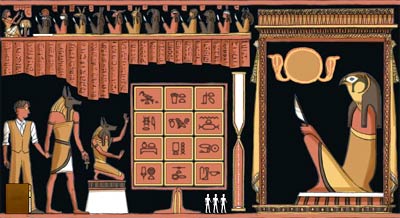
At every step of the design process, tiny details had to be checked out, from the type of camera flash used in 1929 to checking the British Museum's old floor plans to find out where Khamwese's statue had stood in the 1920s. The games had also to be to be thoroughly researched and based on fact, and even the apparently random elements of the Underworld Game (Episode 3) played out in Charles' unconscious mind are rooted in ancient Egyptian mythology. With hundreds of gods to choose from, the nine in this game were selected on the basis of name, with a maximum of three hieroglyphs required for speedy identification within a necessarily limited time frame. Only by identifying the gods who guard the gates to the Underworld can Charles - and the player - then pass through and succeed, an idea which formed a key part of ancient Egyptian belief in which name recognition was key.
The overwhelming popularity of 'Death in Sakkara' since its launch in October 2005 has completely justified the months of work and attention to detail. The positive feedback from those who have played the game confirms that the involvement of a historical consultant can only benefit such a project, in which a game-like format can make learning that little bit more fun!