The Power of the Curse
- The Power of the Curse
- Although ancient Egyptian curses featured in horror fiction dating back to the 19th century, the death of Lord Carnarvon in 1923 following the discovery of Tutankhamen's tomb fixed the belief in such curses' powers firmly in the public's imagination. This was largely fuelled by reports of the 'curse of Tutankhamen' in the press, which was said to claim that 'death shall come on swift wings to him that toucheth the tomb of pharaoh'.
Although the tomb had contained no such curse, with the story made up simply to sell newspapers, rumours inevitably began to grow. It was reported that various people including Egyptologist Arthur Weigall, novelist Marie Corelli and even the famous medium Cheiro had each warned Carnarvon of impending doom if he continued with the work, whilst crime-writer Arthur Conan-Doyle announced his death to have been caused by unseen 'elementals', put in place by the ancient priests to guard the tomb.
In the years that followed the discovery, every death with even the most tenuous connection with the tomb was attributed to the curse, although statistics drawn up by American Egyptologist Herbert Winlock in 1934 tell rather a different story. Of the 26 people who had witnessed the opening of the tomb, he noted that only 6 had died over the decade. Only 2 of the 22 who watched the opening of the sarcophagus had since died, and of the 10 present at the unwrapping of the mummy, all were still alive. Nor could anyone explain why Howard Carter remained unaffected by any such curse, a man who had not only 'touched the tomb of pharaoh', but every object in it! Carter himself simply brushed off the idea, adding that 'all sane people should dismiss such inventions with contempt'.
Although the ancient Egyptians did occasionally use such 'curses' in their tombs, the relatively few examples which have been found are fairly understated. More concerned with making sure anyone entering the tomb is sufficiently pure, the deceased place their trust in the gods to see that justice is done if their tomb is harmed. A rare example from a royal tomb is to be found in the Old Kingdom Pyramid Texts, which warn that 'anyone who dare lay a finger on this pyramid and on this temple which belong to me and my ka (soul) will face the judgement of the gods and will cease to exist!'. Perhaps the most graphic warning occurs in the Sakkara tomb of Ankhmahor, with the tomb owner stating that 'As for that which anyone might do against this my tomb, the same will be done to his property. I am an excellent priest, knowledgeable in secret spells and all forms of magic, and as for anyone who enters my tomb impure or who do not purify themselves, I shall seize him like a goose and fill him with fear at seeing ghosts upon the earth.... But as to those who enter my tomb pure and peaceful, I shall be his protector in the court of the Great God', a reference to Osiris, Lord of the Underworld, who was the ultimate judge of dead souls.
It seems that curses were more widely employed for the benefit of the living, largely confined to temple rituals performed to combat malevolent forces and enemies of the state. Recited in the form of 'execration texts', priests often inscribed the names of those to be cursed on pots, which were then smashed to destroy the enemies' power. Alternatively, figurines made from wood, clay or wax were then smashed, burnt, pierced or bound to gain power over those invoked, their names and various spells again added to make them more effective.
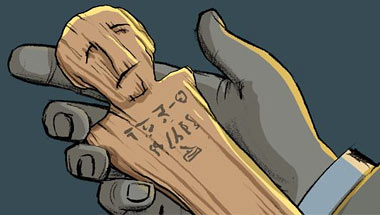
Such figurines were also used on a more personal level by those wishing to gain control over specific individuals. The courtiers put on trial for the attempted assassination of King Ramses III (c.1184-1153 BC) were accused of making wax figurines of the palace guards in an attempt to overwhelm them, and the curse figurine which appears in our story is based on a rare wooden example dating from c.2000 BC; with its arms tied behind its back to render the intended victim harmless, its hastily scribbled inscription simply states 'Die Henwy, son of Intef!'