| 24 September 2014 |

| |
| BBC Homepage | | |
| |||
| Contact Us | | |
About WorcestershireYou are in: Hereford and Worcester > About Worcestershire > The Lost Railway 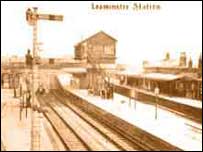 Leominster station copyright L. Oppitz The Lost Railwayby Leslie Oppitz Started in the 19th century railway boom, the line linking Worcester to Leominster took 30 years to build. When Parliament agreed a railway from Worcester to Leominster via Bromyard on 1st August 1861 it was hardly thought that it was to take another 36 years before the line was completed. The Worcester Bromyard and Leominster Railway Company had as its chairman Sir Charles Hastings, founder of the British Medical Association, but this did little to expedite matters. Eight years later in 1869 the promoters, probably reconsidering the sparseness of the route, abandoned the 12 mile Leominster-Bromyard stretch. In 1870 the GWR came to the rescue over the remaining section, by agreeing to work the section from Bransford Road junction (on the Worcester & Hereford line and to the north of Bransford Road station) to Bromyard. This opened on 2nd May 1874, although only reaching as far as Yearsett, where a temporary terminus was established. It took another three years before Bromyard was reached and when this 3¾ mile stretch opened on 22nd October 1877, Yearsett station was closed. It is thought that Yearsett had the shortest life of any GWR station! 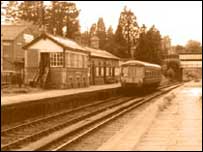 Bromyard station copyright L Oppitz Meantime plans for the abandoned Leominster to Bromyard Railway had been revived by an Act agreed in July 1874. Another ten years passed before part of the line opened, and then only a four mile stretch from Leominster to Steens Bridge, the latter built as a simple one-platform terminus with a run-round loop. The two sections remained isolated for another 13 years, during which time, on July 1st 1888, both companies were acquired by the GWR. Finally, on 1st September 1897, the whole line was complete. Opening of Fencote and Rowden HillWhen Steens Bridge was linked with Bromyard, trains could at last travel directly from Leominster to Worcester. The through opening meant considerable alterations at Bromyard where two platforms were now needed, although it was possible to utilise a section of the existing building as part of the enlargement. Since Bromyard was no longer a terminus, the small engine shed was closed and demolished. Between Bromyard and Steens Bridge two stations were added, these being Fencote and Rowden Mill. Despite the remoteness of its surrounding area, Fencote acquired two platforms, a crossing loop and a signal box, whereas Rowden Mill had to be content with just one platform for the single-track line. Intermediate stations between Bromyard and Bransford Road junction were provided at Suckley, Knightwick and Leigh Court. These were also single-platform stations, although Suckley acquired a second platform, a crossing loop and a signal box earlier last century. 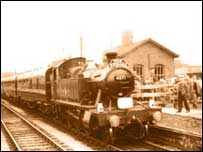 Bromyard station copyright L Oppitz At Worcester the trains used Shrub Hill station as their terminus, calling at Foregate Street on the journey. Since any population along the line was almost non-existent, passenger traffic was never heavy. The journey time between Worcester and Leominster took almost 1½ hours to cover the 27½ miles. Throughout much of the line's life, there were five trains daily in each direction, with no service on Sundays. In Bradshaw's July 1922 Railway Guide the first up train left Leominster at 7am each morning calling at all stations and arriving at Worcester (Shrub Hill) at 8.25 am. The first down train of the day left Worcester at 8.15 am to reach Leominster at 9.33 am. Each way trains had a few minutes wait at Bromyard.
The BBC is not responsible for the content of external websites last updated: 14/02/2008 at 14:24 SEE ALSOYou are in: Hereford and Worcester > About Worcestershire > The Lost Railway  Some the most interesting buildings in the two counties |
| | About the BBC | Help | Terms of Use | Privacy & Cookies Policy |