Down the woods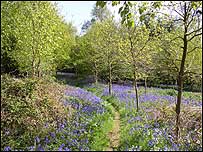 | Bradfield Woods National Nature Reserve is one of the UK's best woodland wildlife sites. This ancient working wood dates back to 1252 when it supplied firewood and wood products for local people nearby. | | Woodland. Photo - Alan Beales |
Bradfield is the archetypal English lowland woodland, and is probably the best example in Britain of a traditionally managed wood. Bradfield Woods is made up of Felsham Hall Wood and what remains of Monk's Park Wood. Over 130 acres of the latter were lost to agriculture in the 1970s. It was this destruction that led to campaign by local people resulting in the wood being purchased and set up as a nature reserve. Today the woodland is a profusion of colour and sound as a result of its sensitive conservation. Lush landscape Coppiced woods like Bradfield are famous for their fabulous flora. Coppiced woods like Bradfield are famous for their fabulous flora.
Today the wood is managed in the same way as in medieval times when the monks of Bury St Edmunds Abbey were its first custodians. Material from the woods still goes to be used as thatching, firewood, tool handles and rustic poles. Coppicing involves cutting trees to ground level every 10-20 years. A different part of the woods is coppiced every year according to a long term management plan. The stumps or 'stools' regenerate naturally, and the whole system of coppicing enhances the life of the trees. Some of the giant ash stools date back to the Middle Ages. Woodland sounds An early morning visit to hear the dawn chorus is a symphony of sound with Warblers and Nightingales competing to make the sweetest music. An early morning visit to hear the dawn chorus is a symphony of sound with Warblers and Nightingales competing to make the sweetest music.
The Nightingale is declining in numbers, but this woodland is perfect for them because they can feed on the forest floor and breed in the dense thickets which are typical of coppiced woods like Bradfield. The Nightingale is characterised by the exquisite beauty and variety of its bird song, although when the bird gives birth to its chicks, its exquisite voice is replaced by a raucous call. Bradfield Woods is also home to a range of woodland birds and mammals including deer, the yellow necked mouse, the enigmatic dormouse and badgers. The deer population includes Roe Deer and Red Deer as well as the tiny, dog-sized Muntjac Deer which can be spotted regularly in the woods. During the Summer there are breathtaking clouds of butterflies in the more sheltered areas of the woods, with 24 different types having been identified to date. The best way to enjoy the woods is to pick up a trail guide at the visitor centre on arrival, and a good time to visit the reserve is between April and mid-July.  Plant paradise Plant paradise
Bradfield boasts an impressive variety of plants, about 370 in total, as a result of its wide range of soil types. One of its specialities is the Oxlip, for many years thought to be a cross between a Primrose and Cowslip, but now a species in its own right. Another rare plant is Herb Paris or Herb True Love Knot, which looks like a traditional love knot, hence its popular name. Visitors can also see Bradfield's Early Purple Orchids and Wood Anemones, and the best time to see these colourful wild flowers is April. Photos courtesy of Alan Beales and Steve Aylward of Suffolk Wildlife Trust. | 






