Island paradise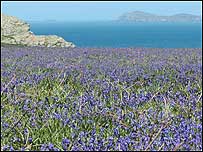 | Skomer is a spectacular island renowned for its sea bird colonies, which are amongst the most important habitats in North West Europe. The island lies to the south west of the Marloes Peninsula of Pembrokeshire. | | Blue spectacle - Skomer's flowers |
Skomer is effectively cut off from the rest of the coast by Jack Sound, a narrow stretch of water, characterised by strong tidal currents. The island's isolation means that it is protected from predators such as rats, cats, dogs and foxes, and also from the human impact on the mainland. This is one of the major reasons for the island's importance as a breeding ground for nesting seabirds. Lush landscape Puffins are the island's best known residents, nesting in burrows on the turf on the island's cliff top. Puffins are the island's best known residents, nesting in burrows on the turf on the island's cliff top.
They're a highlight of any visit to Skomer, characterised by its upright waddling gait and brightly coloured bill. The cliffs themselves boast a wide variety of seabirds including Razorbills, Guillemots and Kittiwakes.
Herring Gulls and Great Black-Backed Gulls nest on rocky outcrops, with the lesser black-backed gulls on the plateau. The island has more than 100,000 pairs of Manx Shearwaters, one of the largest colonies in the world.
Feeding at sea by day, they return to their nests in rabbit burrows at night. The birds make a huge noise with their raucous coughing calls as they fly in to the island. Time and tide Skomer's coast and seabed have been shaped by the constant battering of the waves, which can reach 13 metres high, and by tidal currents. Skomer's coast and seabed have been shaped by the constant battering of the waves, which can reach 13 metres high, and by tidal currents.
The warm waters of the Gulf Stream keep sea water temperatures higher than normal, and many animals feed on the rich food supply carried by the currents. Skomer has a great diversity of wildlife due to its geography. The Skomer Vole is unique to the island, and there's a unique opportunity to see all three species of Stick Insect. The island is a good place to watch seals. Grey seals can be seen on rocks at low tide throughout the year, especially near the Garland Stone. From late August to October the female seals come ashore to have their pups. Visitors can also see common porpoises, dolphins, and whales, if they're lucky. Flower power In spring and early summer the island has some of the best wild flower displays in western Britain. Visitors can see them in abundance of Bluebells during the Spring. In spring and early summer the island has some of the best wild flower displays in western Britain. Visitors can see them in abundance of Bluebells during the Spring.
The island's vegetation is shaped by wind and salt, manured and trampled by seabirds, and grazed by thousands of rabbits. Red Campion flourish in sheltered areas, with thrift and sea campion on the clifftops. There are no trees on the island, although willow, bramble and blackthorn scrub survive in the valleys. Species such as bluebells suggest there were once extensive wooded areas. Ancient settlers Skomer's coast and seabed have been shaped by the constant battering of the waves, which can reach 13 metres high, and by tidal currents. Skomer's coast and seabed have been shaped by the constant battering of the waves, which can reach 13 metres high, and by tidal currents.
The island is rich in history with evidence of ancient settlements dating back to the Bronze Age including a standing stone, known as the Haroldstone, and a group of small burial cairns. The most important archaeological remains date from the Iron Age (650 BC - 100 AD) when more than 200 people were thought to have lived on Skomer. There is evidence of four settlements, a small promontory fort, and Iron Age field systems. Skomer has been a National Nature Reserve since 1959, and is one of only three Marine Nature Reserves in the UK. | 






