Island spectacle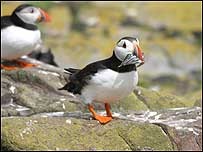 | Getting close to nature can be a real adventure at the Farne Islands which lie just off the Northumberland coast between the fishing village of Seahouses and Bamburgh. This is a great island for bird watchers and nature lovers. | | Fabulous Farnes - sea bird colonies |
The Farnes consist solely of volcanic igneous rock on the eastern edge of a geological formation called the Whin Sill. After the end of the Ice Age, you could have walked from these islands across to the mainland, but rising sea levels cut them off, making them a great place to enjoy wildlife. Sea bird sanctuary The islands are one of Europe's most important seabird sanctuaries. The islands are one of Europe's most important seabird sanctuaries.
The islands comprise between 15-28 islands, including several which are only visible at low tide. They have wonderful names such as Nameless, Elbow, Fang and Blue Caps. The Farnes are home to more than 20 different bird species, including Puffins, Eider Ducks, Guillemots, Razorbills, and four species of tern. The noise is deafening with up to 150,000 birds crammed onto the Islands at the height of the breeding season. Inner Farne is the largest of the Farne Islands and during the Summer it becomes home to many thousands of nesting seabirds. Arctic terns are a familiar visitor, flitting between the North and South Poles, and stopping off in the Farne Islands during the Summer. There is also a large colony of about 3,000 grey seals, the largest meat eating mammal in the UK.
Close to nature The islands' plant life is well worth looking at too, from the evocatively named scurvy grass to the scarce fiddleneck, an invader from California, introduced by the lighthouse keepers many years ago, and now growing wild. The islands' plant life is well worth looking at too, from the evocatively named scurvy grass to the scarce fiddleneck, an invader from California, introduced by the lighthouse keepers many years ago, and now growing wild.
The Farne Islands are also rich in their religious associations. Fourteen hundred years ago, St Cuthbert came to live on the island for peace and solitude, and the small chapel built in his memory can be visited. Getting close to nature can be a real adventure at the Farne Islands which lie just off the Northumberland coast between the fishing village of Seahouses and Bamburgh. The Farnes consist solely of volcanic igneous rock on the eastern edge of a geological formation called the Whin Sill.
Bird's eye view The best way to get close to nature on the Farnes is to take a boat trip during the Spring-Summer. The best way to get close to nature on the Farnes is to take a boat trip during the Spring-Summer.
There are a number of tours available of both Inner Farne and Staple Island. The Inner Farne tour lasts approximately two and a half hours including one hour spent on the island.
The tour includes a cruise around all the Farne Islands, viewing the sea birds on the cliff faces, visiting the Grey Seal colonies and also follows the route Grace Darling took her heroic rescue in 1838. During the breeding season (May 1- July 31) it is possible to make a morning landing on Staple Island and the trips leave at 10am and 11am.
This trip lasts approximately two and a half hours including an hour on Staple Island itself.
The trip also includes sailing round all the other islands including Longstone and Inner Farne and visiting the Grey Seal colonies at several vantage points with full commentary en route. Bird photos courtesy of William Shiel. | 






