| 28 October 2014 |

| |
| BBC Homepage | | |
| |||
| Contact Us | | |
The Mary Rose 25th AnniversaryYou are in: Hampshire > History > Local History > The Mary Rose 25th Anniversary > Diving The Mary Rose 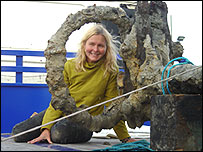 Alex Hildred with the Mary Rose's anchor Diving The Mary RoseMaritime Archaeologist Alex Hildred first dived on the Mary Rose in 1979. She is responsible for the wreck site and is an expert on Tudor weapons. Eric Sivier was one of 'Mad Mac's Marauders', the original diving team who discovered the wreck site. What was it like diving on the wreck?Cold, dark, frightening but awe-inspiring. You could only see little bits of it at a time. The biggest shock when she came to the surface was just how big she was. It was half of a ship! The immensity of it really struck me. We had been underwater working in 3m compartments and it was very difficult to link them together mentally to build up a picture of the wreck. 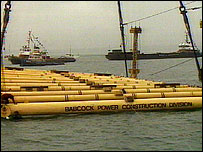 The Mary Rose is raised from the seabed Around 500 men died when The Mary Rose sank. Did you get a sense of that?I didn't have any sense of death down there even though I worked amongst human remains, but some people couldn't dive in certain areas where there were piles of bones. It was also crammed full of peoples' possessions which had all fallen to one side of the ship. Touching them gave you a feeling for the people who owned them. You could see the love and care which had gone into making them. They weren't mass-produced Navy issue. Did it sometimes seem as though The Mary Rose would never make it off the sea bed?I never felt that - I always knew from first dive that she would be raised. Even with all the problems and delays I always felt we'd do it. When we were attaching wires to the ship I remember handing a cable through a gun-port and thinking 'We've got a pathway right under the ship.' I knew it would be just a matter of months after that.
Help playing audio/video What were you thinking and feeling as she finally broke the surface again?I was diving archaeology liaison officer on Southsea common and was watching on a huge film screen. I had a microphone and it was my job to interpret the pictures for the press and public. When a leg on the lifting cradle collapsed and crashed onto the ship, I had to explain what was happening as best I could! 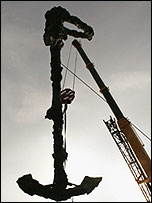 One of the anchors is brought ashore After the ship was raised, there was a lull and I went up in a chopper and flew out there. I remember thinking "We've done it!" I saw how huge she was. There was relief that all the problems affecting the lift had been sorted out. Then I felt sorry that I couldn't dive on her any more, when it was just you and the ship. You felt your way round so you knew every bit of her. It was an intimate relationship. That time of solitude had gone and the Solent was never the same for me after that day. All that was left was a hole in the sand. It was a project which captured the imagination of the whole country and millions around the world. Why was that?The ship was so iconic, England's most famous symbol, and the objects were so beautiful. The pewter, the wood, it was better than gold, every object had a story to tell. We also exploited every opportunity for publicity to help sustain the level of interest. That was essential from a fund-raising point of view. We had to lift the ship in 1982 because things were starting to wear away down there. Part of it was luck, but most of it was down to hard work! Eric Sivier from Southsea Sub Aqua Club was part of the original diving team which located the wreck of The Mary Rose in 1967.They were led by the Hayling Island historian Alexander McKee, who died in 1992.The volunteers, known as 'Mad Mac's Marauders', undertook pioneering work, operating from small boats in difficult and often dangerous conditions.Although the Mary Rose was eventually lifted by professional divers, the project could not have been attempted without the early efforts and boundless enthusiasm of McKee and his supporters.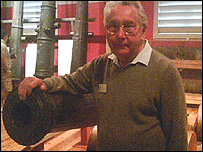 Eric Sivier with the Tudor Cannon he found burried What do you remember about those early dives?The visibility was six feet on a good day. On a bad day it was awful. You couldn't see at all! We started work on the port side and uncovered 93 feet of timber. We had to dig a trench four feet deep and four feet wide along the whole length with just shovels and spades, so it was hard work. We didn't even know it was the Mary Rose to start with, we just knew it was a big ship. It wasn't until we started bringing up objects from the time of Henry VIII that we knew. What sort of things did you find?I found the cauldrons that the cooking was done in. They were upside down and I thought they were mines from the war so we had to be very careful. We didn't work out what they were until we'd excavated underneath them. In 1979 I was digging in the mud and came across a flat piece of wood. I excavated around it and it got bigger and bigger. It was about three inches think. I thought 'I wonder what this is?' Then it hit me, 'This is a gun carriage!' As I went even deeper I found the rear end of the actual cannon itself. It was green bronze, and I thought 'My goodness, this is it!' I was running out of air by that time and had to go back up. When I got to the boat I drew a picture of it, and before I could say any more the other divers were over the side on their way down to have a look. It's in the Mary Rose Museum now. When was your last dive on the wreck?I was an amateur diver. We all were back then, but towards the end they wanted only professional people so we weren't allow to dive any more, but I dived up until the early part of 1982. What do you remember about the day the wreck was raised?The weather was terrible but all of us original divers, 12 to 14 of us, were on the fishing boat that used to take us out to the dive site. One of the pins on the lifting cradle broke and it crashed down onto the ship, I thought 'Oh no!' but it was ok. Then they seemed to take forever to put the wreck onto the barge. I thought 'Why don't they hurry up, they're taking forever!' It was the end of the diving which was sad, but it was a job which we were all very excited about, and we thought it was great that she was eventually up. Some of us thought she might never be raised and it was lovely to see her above the waves. last updated: 05/03/2008 at 12:48 SEE ALSOYou are in: Hampshire > History > Local History > The Mary Rose 25th Anniversary > Diving The Mary Rose |
| | About the BBC | Help | Terms of Use | Privacy & Cookies Policy |