 | 13 November 2014 |

| |
| BBC Homepage | | |
| |||
| Contact Us | | |
OccupationYou are in: Guernsey > History > Occupation > Surviving the Charybdis 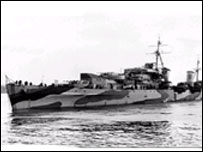 HMS Charybdis in 1943 Surviving the CharybdisTo mark the 65th anniversary of the sinking of the HMS Charybdis in the English Channel, survivor Gerald Evans returned to Guernsey in 2008 and told us his story. In October 1943 two navy cruisers were torpedoed in Channel Island waters. Bodies were washed ashore in Guernsey, Jersey and on the Britanny coast. In Guernsey the burial of the sailors at the Foulon cemetery produced a staggering show of solidarity from islanders who turned out in thousands to show their loyalty to Britain under the noses of the occupying forces. Every year the sinking of the Charybdis and Limbourne is remembered by islanders, by the families and friends of those who died and by the survivors. One such survivor was Gerald Evans who returns to Guernsey every year for the annual weekend of events held to commemorate the loss of life from the two ships. Remembering that fateful day Mr Evans told us that after spending time in the water he was covered in fuel oil that had leaked from the Charybdis as it sank and when the next vessel came along to rescue them because of a combination of exhaustion and the oil he was unable to climb aboard. To help him aboard one of the ship's crew used a bucket on a rope to hoist him aboard and Gerald said that since then he had been known as "the bucket man" by the group involved, but that he had also become best friends for life with the man who hoisted him aboard. Still covered in oil Gerald said he spent the journey back to Plymouth lying on a table which he was told it took 24 hours to scrub clean due to the amount of oil he left on it. On his return to Plymouth he was thoroughly cleaned, eventually getting all the oil off and then given 14 days survivors leave. Upon returning from leave along with the 107 other survivors Gerald said that is when he realised how few survivors there actually were. He said: "Sadness is a mild world to use (to describe my feelings), it's something that's ingrained in my mind". "Every year I have to go to the Foulon Cemetery and see the grave stones and remember the hundreds who don't have a grave stone," he added. Help playing audio/video last updated: 07/10/2008 at 11:47 You are in: Guernsey > History > Occupation > Surviving the Charybdis [an error occurred while processing this directive] |
| | About the BBC | Help | Terms of Use | Privacy & Cookies Policy |
