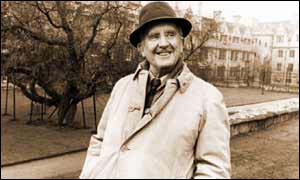
| | Fact File | + John Ronald Reuel Tolkien (1892-1973) wasborn in South Africa and moved to England when he was a small child.
+ From a young age, Tolkien developed a love of words and created a language called 'animalic' which he shared with his cousins.
+ At university Tolkien was a major scholar of the English language, specialising in Old and Middle English.
+ He wrote a number of stories, including The Hobbit (1937) and The Lord of the Rings (1954-1955), which are set in a world which he called by the Middle English name of Middle-Earth.
+ This imaginery land was inhabited by Men (and women), Elves, Dwarves, Trolls, Orcs (or Goblins) and of course Hobbits.
|
| Contact | Lydney Park Gardens
Lydney
GL15 6BU
01594 842844 Lydney Park is a quarter of a mile south-west of Lydney.
| |
| | | |
|  | The Lord of the Rings film trilogy is set to become one of the biggest movie successes ever - but exactly where did its author JRR Tolkien get his inspiration for the mystical landscapes of Middle Earth? 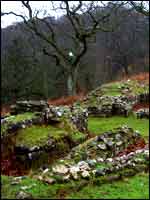 | | Dwarf's Hill at Lydney Park Estate. |
Did the magical and intricate landscapes spring straight from Tolkien's vivid imagination or were they subconscious reworkings of landscapes he had seen before?
According to Sylvia Jones, curator and tourism manager at Viscount Bledisloe's estate in Lydney, Tolkien was surely influenced by the ancient Roman archeological site that he worked on at Lydney Park, in 1929.
As part of an archaeological dig, run by the eminent Sir Mortimer Wheeler, Tolkien worked and advised on the site of an old Roman temple, known as Dwarf's Hill. 
It seems probable that Tolkien was inspired in some way by the folklore attached to the hill.....it seems so much like Hobbiton, that we think he found some of his inspiration here.
 | | Sylvia Jones, Curator of Lydney Park Estate |
Built upon an earlier Iron Age settlement, the hill was riddled with tunnels and open cast iron mines known as Scowles, and Tolkien is said to have been very taken with the whole area.
Rumour has it that within 20 years of the Romans leaving, the local people forgot it had been a Roman settlement and thought the crumbling ruins were the homes of little people, dwarves and hobgoblins and they were afraid of the hill.
The site then languished for approximately 1,000 years because of the fear surrounding the area.
Tolkien even wrote a chapter in Wheeler's book about the Roman excavations and on reading it you can see the influences of his research reflected in the Lord of the Ring tales.
Tales of everlasting fights and endless battles, mythological figures, forgotten gods and heroic characters with unusual names, all spring from the pages.
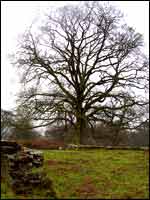 | | Was Lydney Park the inspiration for Hobbiton? |
It was during this time that Tolkien was working on The Hobbit and was excited by the superstitious rumours that surrounded the archaeological ruins. Lydney Park is a secluded wooded valley with an enchanted air - lakes, a deer park, fine trees, flowering shrubs and carpeted in spring with a profusion of daffodils, primroses and bluebells. There are certainly close similarities with Tolkien's Hobbiton and The Shire, which are said to describe an idealised version of rural England.
Says Sylvia Jones: "It seems probable that Tolkien was inspired in some way by the folklore attached to the hill. "Seeing the labyrinth of tunnels and little holes in the hillside, it seems so much like Hobbiton, that we think he found some of his inspiration here."
It does appear that the whole area, with its scowles and Devil's chapel are all wrapped up in the Forest of Dean folklore - a folklore that seems very similar to the Lord of the Rings tales.
Another coincidence is that the Roman God Noden was known, amongst other things, as the Lord of the Mines, not a far cry from The Lord of the Rings.
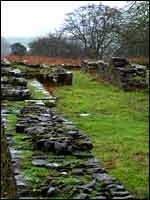 | | Roman archaeological ruins. |
So did JRR Tolkien's tale of hobbits and hobgobblins begin in Gloucestershire's Lydney Park? Sylvia Jones says:
"Some of the scenes in Lord of the Rings definitely brought me back to Lydney Park."
It doesn't take much imagination to transport the intriguing, sometimes eerie landscapes of Lydney Park to the mythical, magical homelands peopled by hobbits and goblins in Lord of the Rings, but one thing is for sure, only JRR Tolkien will ever know the truth. Lydney Park is open to the public on Sundays, Wednesdays and Bank Holidays from late March to early June each year. There is an admission charge. For more information call 01594 845497. |