| 13 November 2014 |

| |
| BBC Homepage | | |
| |||
| Contact Us | | |
Faith featuresYou are in: Gloucestershire > Faith > Faith features > Exploring Cotswold Churches 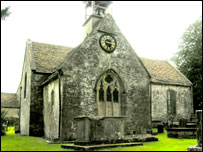 Didmarton, St. Lawrence Exploring Cotswold ChurchesWe explore some of the most remarkable churches in the county. From the ancient Saxon church at Daglingworth to the Victorian masterpiece at Selsley, historian Matthew Butler shows us round... Gloucestershire is blessed with some of the most beautiful, remarkable, and interesting churches in the UK. But how much do you know about them? Richard Atkins has been exploring a handful of these churches on his Sunday Breakfast Programme on BBC Radio Gloucestershire. He asked local church historian, church detective and enthusiast Matthew Butler to select six of his favourite Cotswold Churches. Help playing audio/video You can listen to Richard and Matthew's fascinating features, recorded as they explore the buildings, by clicking on the links within this page. Virtual TourAll of the churches featured are open to the public and well worth a visit yourself. However you can "explore" them from the comfort of your own home by viewing our fantastic 360° panoramic pics and photo gallery. (Click on the links within this page). We asked Matthew Butler to explain why he chose the six churches. Here are his reasons: Holy Rood, DaglingworthThe first clue that this beautiful Cotswold Church is also a very ancient one is in its name. The Cross or “Rood” had a very special place in worship to the early Christians in Britain, and it is celebrated in Anglo-Saxon prayers and poetry. The Romans settled this part of the Cotswolds intensively. Remains of many of their villas, farms and roads have been discovered. In the outside wall of the church – round the back near the oil tank – a Saxon window has been cut into an old Roman altar. 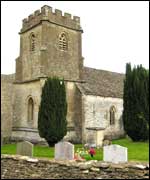 Daglingworth Church Daglingworth Church is Saxon – look at the way the large stones in the corners alternate – one horizontal, then one vertical. This type of masonry, which is known as “long and short work” is typical of the period. Inside, look first at the proportions of the Church. It seems, in a strange way, too tall for the ground area it covers. This is another common feature of Saxon Churches. Finally, don't miss the three wonderful carved panels – the Crucifixion, Christ in Majesty, and St Peter. They are the glory of this very early and very special church. Help playing audio/video All Saints, SelsleyThis Church of 1862 is about what Victorian money could buy. The man who paid for it, Sir SS Marling, made his wealth from the woollen industry, particularly Hawkers and Ebley mills in Stroud. It is said that Marling asked that the Church was a copy of the Church at Marling in the Austrian Tyrol, which he had visited on his travels.  Selsley Church The great wonder of this Church, apart from its fine position, is its stained glass, telling stories from the Bible. It is ironic that a manufacturer turned to William Morris and his fellow Arts and Crafts designers to design the windows, for Morris represented a rebellion against the values of mass production. But here are windows by Philip Webb (The Creation), Daniel Gabriel Rossetti (The Visitation), Ford Madox Brown (The Nativity) and Morris himself (The Annunciation). For the design of his church and Ebley Mill chimney, Marling turned to GF Bodley, one of the finest Victorian architects. 2007 marks the centenary of Bodley’s death. Help playing audio/video Hailes Church (dedication unknown)It is hard to imagine, looking at the tranquil ruins of Hailes Abbey, surrounded by lush pastures where sheep contentedly graze, that this was once one of the great abbeys of mediaeval England. But the Abbey was founded by Richard, Earl of Cornwall, brother of the King, who, in thanksgiving for his rescue from a shipwreck, gave to the monks a vessel which he claimed contained the blood of the Saviour. Pilgrims flocked from far and wide, and the Abbey even gets a mention in Chaucer. Hailes Church is actually older than the Abbey itself. It became a place where pilgrims waited and prayed before going into the Abbey itself to see the famous relic. 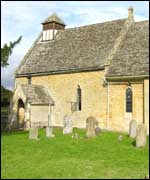 Hailes Church There is a lovely belfry, some splendid old pews, and, above all, some fantastic mediaeval wall paintings. These include St Catherine, with the wheel on which she was martyred, St Margaret of Antioch with a dragon, and, in the chancel, a fine Eagle, the symbol of Richard, founder of the Abbey. After looking at the Abbey, walk the mile up the old pilgrim’s route to Farmcote, where there is another lovely church. Help playing audio/video Nailsworth Quaker Meeting HouseNot far away from all the traffic and bustle of central Nailsworth is this peaceful and very special place, built in 1689. The year before, 1688, was very important for all those who were dissenters – in other words not members of the Church of England. When William of Orange came to the throne they were, for the first time allowed to have their own places of worship, or Meeting Houses, where people came to meet each other, and to meet God. However, this tolerance was not to stretch to Roman Catholics for more than another century. 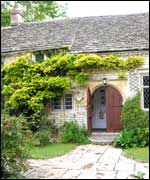 Nailsworth Quaker Meeting House The Nailsworth Friends, or Quakers, lost no time in building. Perhaps they had already been meeting secretly in the old farm house next door. From the outside, their new Meeting House looks as much like a house as a place of worship. Inside, all is calm; benches face each other across a simple, but moving interior. Up the winding stairs is a room where visitors may once have stayed, or where latecomers could look down into the Meeting. It later became a school –room. Help playing audio/video Before leaving, look at the beautiful garden, and the simple graveyard. St John the Evangelist, ElkstoneSurrounded by laurels and fir-trees, Elkstone Church is the highest in the Cotswolds. It has a wonderful fifteenth century Cotswold stone tower, with some fantastic gargoyles playing medieval musical instruments. The carved corbels round the top of the church wall represent signs of the zodiac. All this embellishment reflects the wealth that came from wool. Then look more closely at the shape of the Church. Apart from the later tower it is in three parts – nave, chancel and apse – a classic Norman layout. 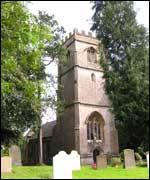 Elkstone Church We can confirm the church is Norman because within the entrance porch is a wonderful Norman doorway with a carving of Christ in Majesty above it, in a section above the door which is known as the tympanum. Christ is rather like a nursery rhyme Humpty-Dumpty, sitting on his wall. Go inside the Church, look right, and there are two glorious Norman arches – one from the nave into the chancel, and one from the chancel into the apse, where the altar is to be found. Think how gloomy it must have been when lit only by candles. Help playing audio/video Elkstone Church also has a secret. Open the door on the left of the chancel arch, and a staircase leads up to a small chamber. In the late Middle Ages this space was used as a dovecot, but it is likely it had an earlier use as a room where the priest may have lived. Didmarton – St Michael, St Lawrence, and St Arild.There are three churches in Didmarton. St Michael’s, on the south side of the main road, is nondescript and Victorian. It was built to replace the two older churches, but it proved too big. It has been converted into a house and is not open to the public. St Lawrence, at the Tetbury end of the village, is a gem. The mediaeval church contains a perfect set of Georgian fittings including painted box pews and a three-decker pulpit. At the back, high up on the wall, are a series of hat pegs – their position is a clue to the original lay out of the Church, for there must have been a gallery. In the aisle, a splendid old clock mechanism ticks away the hours. 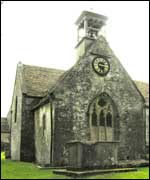 Didmarton Church Then, across the fields to the north, and a fifteen minute walk or short drive away stands lonely St Arild’s – in the hamlet of Oldbury on the Hill. St Arild was a Saxon princess martyred by a Viking when she refused to submit to his demands. There is only one other church dedicated to her – at Oldbury on Severn. With its overgrown churchyard and peaceful interior, this is one of the Cotswolds’ most atmospheric churches. last updated: 17/11/2008 at 17:17 Have Your SayWhy are churches in the Cotswolds so special? Which is your favourite church in the county? What did you think of our series? Where should we go next? Emma BDM65 Marie-Ann Alun Baz Mary Halliwell SEE ALSOYou are in: Gloucestershire > Faith > Faith features > Exploring Cotswold Churches 
Podcast[an error occurred while processing this directive]
| ||||||||||||||||
| | About the BBC | Help | Terms of Use | Privacy & Cookies Policy |