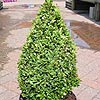
Common box is a vigorous, evergreen, bushy, upright shrub or small tree. It has small, rounded to oblong, glossy dark green leaves. Its dense habit makes it ideal for hedging or screening and it can be closely clipped into different shapes. An excellent plant to make into topiary, as you can leave a smart finish after trimming. It's best to choose the dwarf form of this shrub for low hedging to create a knot or parterre.
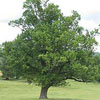
Quercus robur English oak
Holder of the Royal Horticultural Society's prestigious Award of Garden Merit (AGM), this oak is familiar to anyone who knows the English countryside. It's thought that trees can grow to more than 1,000 years old and their huge silhouettes dominate the landscape. In the garden, they need to be given plenty of space. They enjoy any fertile, well-drained soil in sun or partial shade. The lobed leaves clothe the bare branches from late May or June. Acorns appear in summer, turning brown before they fall to the ground in autumn when the leaves turn yellow and follow them.
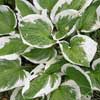
Hosta 'Patriot' Plantain lily
'Patriot' is arguably the best white-edged hosta. A sport of 'Francee', it has mid-green leaves with much wider white margins. A real stunner for the border or shady patio. Hostas benefit from plenty of organic matter being added to the soil before planting. They also enjoy being mulched in spring and autumn to help retain moisture in the soil. For the lushest displays, feed with a balanced fertiliser between March and June. Do not feed after this period or you will encourage the sort of sappy growth that slugs adore! To avoid the leaves looking like a piece of lace, take measures against slugs and snails, such as beer traps.
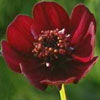
Cosmos atrosanguineus Chocolate cosmos
Formerly called Bidens atrosanguinea and comparatively unknown, this tender Mexican perennial is now a fashionable late summer highlight in warm borders, as much for its scent of vanilla and hot chocolate as for the dusky brownish-red blooms. As with most cosmos varieties, the blooms resemble small single dahlias, and its culture is similar too, for it has a tuber which, in mild gardens, may be planted at least 15cm (6in) deep and left in the ground with winter protection, or is more usually lifted in autumn for drying and storage.
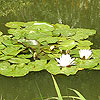
Nymphaea alba Water lily
This is a big spreading water lily with star-like, pure white flowers about 15cm wide, and distinctive yellow stamens. It needs to be planted in a large aquatic basket filled with aquatic soil, with the sausage-like stem (or rhizome) going just under the surface. Put gravel over the top. The container then goes about 20cm under the water surface, possibly supported on an old brick. Only buy it if you have a large, still pond (avoid running water) in full sun, which will not be choked by its growth. If you have a pond with running water, choose a Nuphar lily instead.
To view the panoramic image, click on the garden with your mouse and drag it around the picture. To find out about the planting hotspots in the garden, click on the leaf icon above. To start and stop the audio commentary click on the speaker icon.
If you're having problems viewing the panoramic images read our help page. Alternatively, take a look at our still photography of all of the show gardens.
"In our garden four oak blocks are carved with words valued by the Conservative Party Foundation. These ideas were translated into the garden; a classic yet contemporary design representing an independent Britain that wants to retain its values; living values in a valued world.
"The traditional layout gives a distinctly British identity with the cross design reminding us of our earliest celtic roots. The yew hedging is ramparted like a castle to give a sense of protection; with a doorway at the end 'to the future'. Traditional yorkstone combines with new sawn yorkstone, trusted and old with new.
"A modern-day-take on England's 'Green and Pleasant' land is depicted with Edmund's parterre filled with carpet bedding, evoking pride in our heritage. The predominance of blue may come as no surprise!"







 "In our garden four oak blocks are carved with words valued by the Conservative Party Foundation. These ideas were translated into the garden; a classic yet contemporary design representing an independent Britain that wants to retain its values; living values in a valued world.


