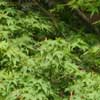
The delicate lobed foliage of the Japanese maple turns red, orange and yellow in autumn. Give it a prominent spot where its ornamental qualities can be admired, with shelter from both late frosts and hot sunshine. The best colour is produced on neutral to acid soil, but it will tolerate some lime. A good, low maintenance, ornamental tree.
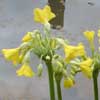
Primula florindae Giant cowslip
The largest and most impressive species cowslip. It has leaves up to 45cm long and clusters of up to 80, nodding, pale yellow flowers from July to August. Vigorous and long-lived, it thrives in moist soil which doesn't dry out, with bog gardens and stream-sides ideal. To avoid a build-up of large colonies, deadhead the plants before they get a chance to self-seed. To raise a few new plants, collect seed - which remains viable for several years - and sow when ripe or in late winter.
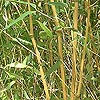
Phyllostachys aurea Bamboo
This is a decorative bamboo with bright golden-yellow canes and contrasting darker-green foliage. It makes a striking addition to the back of the shrubbery and also makes a good specimen plant. Several clumps grown together can also be used to make a informal garden screen. It will tolerate most soil conditons and is particularly at home in a damp but free-draining spot.
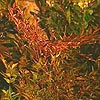
Nandina domestica Heavenly bamboo
Despite its common name nandina is not a bamboo, but a relative of berberis. It forms a tall shrub, up to 1.8m (6ft) high, with bright green leaves that turn reddish-purple in autumn and winter. The brilliant leaf colour often remains all winter. Plants also produce clusters of small white flowers that are followed by attractive bunches of red berries after a good summer. Although it is a hardy plant, grow it in a sheltered spot as the growth can be damaged by hard frosts of cold winds.
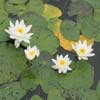
Nymphaea odorata var. minor Water lily
Water lilies come in all sizes, from expansive giants suitable only for lakes, to very small varieties such as N. odorata var. minor, formerly , which is ideal for planting in a small, formal pond or even in aquatic-tub and half-barrel gardens. Its gleaming white flowers, fragrant and enhanced with conspicuous yellow stamens, appear over a long season, as early as late May in a warm sunny position and continuing into mid-autumn. Like all small lilies, the plants may need protection if they are growing in shallow water that is likely to freeze hard, and they should be insulated if planted in tubs.
To view the panoramic image, click on the garden with your mouse and drag it around the picture. To find out about the planting hotspots in the garden, click on the leaf icon above. To start and stop the audio commentary click on the speaker icon.
If you're having problems viewing the panoramic images read our help page. Alternatively, take a look at our still photography of all of the show gardens.
"This garden shows a moving story widely known in China, a romantic tragedy between a white snake (transformed into a beautiful lady) and a scholar. The key to the tragedy is that the world of humans and that of beasts were strictly separated in Buddhist tradition. So, when the Buddhist Master Fahai saw the truth that the scholar married a snake, he tried to separate the two lovers. The white snake was finally suppressed and buried under the Leifeng Pagoda.
"This garden shows two symbolic scenes of the legend, the Broken Bridge and the Leifeng Pagoda. The pagoda and the gates are focal points; connected by the lines of the bridge, the stone-paved steps and the paths. The artistic union of these focal points and connecting lines creates a harmonious landscape."







 "This garden shows a moving story widely known in China, a romantic tragedy between a white snake (transformed into a beautiful lady) and a scholar. The key to the tragedy is that the world of humans and that of beasts were strictly separated in Buddhist tradition. So, when the Buddhist Master Fahai saw the truth that the scholar married a snake, he tried to separate the two lovers. The white snake was finally suppressed and buried under the Leifeng Pagoda.


