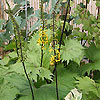
An exceptional ligularia, this has tall, thin, flashy spires of bright yellow flowers catching the eye from a great distance. The stems provide a good contrast, being jet black, while the leaves grow 35cm long. Rich, moist ground is vital because if the soil dries out the plant will quickly collapse. Perfect for the back of a border, or in the boggy ground surrounding a pond. It has been given the Award of Garden Merit by the RHS.
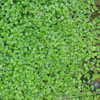
Soleirolia soleirolii Mind your own business
Best known as an indoor plant, baby's tears, or mind your own business, makes an attractive and maintenance-free alternative to grass as ground cover in moist, shady areas. It will tolerate sun or shade. Frost hardy, its leaves are killed by winter frost, but it will recover to grow vigorously in spring. The masses of tiny leaves clothe slender spreading stems that root as they run, forming a dense deep-pile carpet. As it covers the ground it will run over rocks, fallen logs, and so on, clinging to their shape so the features of the landscape are picked out. Quick to establish, it survives periodic dry spells and recovers quickly afterwards. It is a superb substitute for moss in a Japanese garden or shady courtyard. Propagate by division from spring to mid-summer.
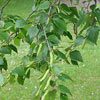
Betula pendula Silver birch
The plain silver or common birch, sometimes called 'the lady of the woods' because of its outstanding elegance, is a great landscape feature, especially in autumn and while still young - older trees can become enormous, but without dominating or shading the garden too much. When planted 60cm (2ft) apart, the trees make a fine hedge, or may be grown 2.4m (8ft) apart as a screen or windbreak, which can be trimmed each winter. Growth is upright, later slightly weeping, especially the young outer stems - trim shoots off the trunk to reveal the attractive bark. The Royal Horticultural Society has given it its prestigious Award of Garden Merit (AGM).
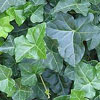
Hedera helix English ivy
A single English ivy plant can find many uses all round the garden. It can be used to cover a wall in shade where few other plants thrive, it can be trained to climb up or spread out along a low wall. Being evergreen, it is perfect for covering pergola poles, or creating a leafy backdrop under clematis and climbing roses that provides winter interest. Or use young plants to train around the outsides of winter hanging baskets. English ivy can be trimmed into shape at any time of year. It is a valuable plant for wildlife and is recommended by the RSPB and loved by Bill Oddie, particularly for providing berries for birds in winter when most others have been eaten. Many insects also feed on the nectar of its white flowers. Be careful when handling it if you have sensitive skin as its sap can be irritating.
Athyrium filix-femina Lady fern
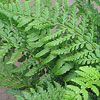
The lady fern is one of the prettiest of the deciduous hardy ferns, with delicate, lacy, ladder-like foliage which is a good fresh green colour it looks its best in late spring and early summer when the foliage is still young. It associates well in cool shady corners with other hardy ferns, woodlanders, and shade and moisture loving perennials especially others with superb foliage such as solomon's seal. It is also good planted in groups in woodland clearings and among rhododendrons, camellias and pieris. The Royal Horticultural Society has given it its prestigious Award of Garden Merit (AGM).
To view the panoramic image, click on the garden with your mouse and drag it around the picture. To find out about the planting hotspots in the garden, click on the leaf icon above. To start and stop the audio commentary click on the speaker icon.
If you're having problems viewing the panoramic images read our help page. Alternatively, take a look at our still photography of all of the show gardens.
"The concept behind my garden is the speed at which nature reclaims man-made constructs eventually absorbing them back into the ground - often where the materials used came from originally.
"The focus is the point at which the original structure is still recognisable but has become a framework for trees, plants and wildlife to exist in and on. It demonstrates that everything belongs to the same source and will always return to its original form regardless of our attempts to manipulate nature otherwise.
"I chose a house with its easily recognised elements - a door and windows - because of its symbolism as a home, representing permanence and security. Thus, the beauty of plants growing out of the debris of what was once a home will hold poignancy for observers."







 "The concept behind my garden is the speed at which nature reclaims man-made constructs eventually absorbing them back into the ground - often where the materials used came from originally.


