A small, native british tree which can grow in full sun or partial shade so its often found at the edge of woodland and in hedgerows. It rarely grows more than 15m tall and prefers moist, fertile soil. Young leaves are reddish-purple, turning dark green when mature, with clusters of yellow-green flowers in spring. Its winged seeds are similar to most sycamores.
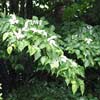
Davidia involucrata Handkerchief tree
The common name Handkerchief tree or Dove tree, comes from the long white bracts which surround the small male flowers as they supposedly look like either handkerchiefs drying or doves resting on the branches - take your pick. It's a lovely, clean looking tree, with heart-shaped leaves and when these fall in autumn, the smooth grey bark is revealed. The flowers appear in late spring, followed by greenish brown fruit the size of golf balls. It has been given an Award of Garden Merit (AGM), which is for plants of outstanding excellence.
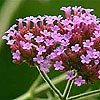
Verbena bonariensis Verbena
Tall, narrow, sparsely-leafed stems bear flattened heads of bright lavender-purple flowers that provide useful height in a herbaceous border. This is a short-lived perennial, and because it is borderline hardy, plants may be damaged by winter frosts. This may be avoided by leaving the dead stalks until spring, when new growth is evident, before cutting them back. A protective mulch should be added around them in the autumn with leaf mould or compost. They do, however, self-seed liberally and resulting seedlings are stronger and more drought-tolerant than those that are transplanted. This is a superb butterfly plant, rivalling even buddleja. The Royal Horticultural Society have given it the Award of Garden Merit.
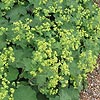
Alchemilla mollis Lady's mantle
A charming little plant with frothy lime-green flowers in early summer and neatly pleated apple-green, fan-shaped leaves which persist all season. These can be refreshed if they look tired after a hot dry summer by cutting the plants back hard. Often overlooked by gardeners in search of something exciting, the unpretentious appearance of lady's mantle makes it extremely useful all round the garden. Grow as ground cover in shade or beneath roses. If allowed to self-seed into gravel or cracks between paving, the resulting seedlings are very drought tolerant.The Royal Horticultural Society has given it its prestigious Award of Garden Merit (AGM).
Hydrangea arborescens 'Annabelle' Hydrangea
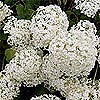
The basics species of this large bushy North American shrub has flowers that are a mixture of tiny fertile florets and the larger more showy sterile ones, which in fact have coloured bracts in place of petals. The variety 'Annabelle' has only sterile florets, which makes the flower heads much larger, like spectacular white balls up to 30cm (12in) across. Plants are nominally very hardy but late frosts can damage the buds, so grow them in a sheltered corner or against a warm wall in cold gardens. Regular pruning keeps the naturally open plants dense and compact. The Royal Horticultural Society has given it its prestigious Award of Garden Merit (AGM).
To view the panoramic image, click on the garden with your mouse and drag it around the picture. To find out about the planting hotspots in the garden, click on the leaf icon above. To start and stop the audio commentary click on the speaker icon.
If you're having problems viewing the panoramic images read our help page. Alternatively, take a look at our still photography of all of the show gardens.
"My garden is quintessentially the 'Darling Buds of May'. In front of the oast house is a riot of colour using plants in keeping with era of the 1950's. I have used varieties introduced then or the modern varieties closest to them. I've been surprised by the age of some cultivars, like Helenium 'Moerheim Beauty' which is a pre-war introduction.
"Around the house is a hazel coppice, a lovely pond, then, around the corner, a mass of annuals which can be used for cutting. I have arranged the fruit and vegetable area in rows traditional to the time. The planting is bold, with big yellow achilleas and violet campanulas."







 "My garden is quintessentially the 'Darling Buds of May'. In front of the oast house is a riot of colour using plants in keeping with era of the 1950's. I have used varieties introduced then or the modern varieties closest to them. I've been surprised by the age of some cultivars, like Helenium 'Moerheim Beauty' which is a pre-war introduction.


