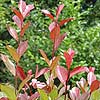
Photinia, or Christmas berry, is a genus of Asian and North American shrubs, which includes a group of evergreen hybrids grown specifically for their colourful young foliage. Most are forms of the garden hybrid P. x fraseri, with glossy dark green adult foliage, and variable red tinted young leaves, especially as they just unfold. 'Red Robin' is one, a choice form with eye-catching juvenile growth the colour of sealing wax, similar to a pieris. This is sometimes caught by late spring frosts, and some shelter is advisable. Plants enjoy a sunny or partially shaded position in moist but well-drained soil. The Royal Horticultural Society has given its prestigious Award of Garden Merit(AGM) to this plant.
Taxus baccata Yew
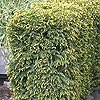
Yew is a native British evergreen, whose wood was once used for making longbows. Young plants are bushy and, if left unclipped, they eventually grow into large trees almost as wide as they are tall. However they are rarely allowed to grow naturally, being a firm favourite for classic style hedges and topiary. The plants withstand quite hard clipping and, if overgrown, can be rejuvenated by cutting them back to the stumps. The are also quite amenable to growing conditions and will grow in any well-drained soil. To propagate, take cuttings in late summer and early autumn. The Royal Horticultural Society have given it their prestigious Award of Garden Merit.
Carpinus betulus Hornbeam
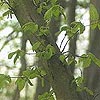
Similar in appearance to beech, hornbeam makes a superb specimen tree or hedging plant. Grown as a tree, it has a pyramidal shape that later becomes more rounded. As a formal hedge it requires clipping once a year in mid- to late summer to keep it looking tidy. Although it is deciduous, it retains its coppery dead leaves throughout the winter so it remains an effective screen. Green catkins appear in spring and winged nuts develop in autumn.
Rosa 'Flower Power' Rosa
One of the best patio roses available. This variety produces clusters of peach coloured blooms throughout the summer. Plants should be pruned in the autumn or early spring removing any dead, diseased or weak growth, and shortening healthy shoots by about half. Always prune to a healthy, outward-facing bud. After pruning, feed plants with a rose fertiliser.
To view the panoramic image, click on the garden with your mouse and drag it around the picture. To find out about the planting hotspots in the garden, click on the leaf icon above. To start and stop the audio commentary click on the speaker icon.
If you're having problems viewing the panoramic images read our help page. Alternatively, take a look at our still photography of all of the show gardens.
"I hope visitors are seduced with evocative smells and beautiful blooms from the fervent display of roses. A domed temple lies at the heart of the garden that is set in a structured rose garden, which harks back to the best of the original Victorian rose gardens.
"Secluded seating offers a place to sit and enjoy a 'tête-à-tête'. I have used standard and bush roses to create the rose garden, set among low hedging. I hope visitors are enticed to linger and walk around the pathways."








 "I hope visitors are seduced with evocative smells and beautiful blooms from the fervent display of roses. A domed temple lies at the heart of the garden that is set in a structured rose garden, which harks back to the best of the original Victorian rose gardens.


