No longer a hobby for bored ladies, floral art is enjoying a resurgence of interest. This year's show celebrated the latest designs in this art form. | 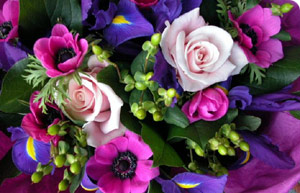 |
Floral artFlower arranging has undergone a revolution in recent years. Traditional, formal arrangements in tasteful colours have had their day: you're more likely to spot exotic calla lilies, proteas and tillandsia than chrysanthemums and roses. Nor is it any longer exclusively the preserve of the blue-rinsed at the Women's Institute. Men and increasingly younger people are getting involved. Cutting-edge designsThe Floral Art competition, held in the Growing and Showing Marquee at the Hampton Court Palace Flower show, was a fabulous exhibition of what can be created using just a few leaves, some flowers and a lot of creative imagination. There was hardly a vase in sight: these were sculptures in living tissue, using the forms and colours of flowers and foliage instead of paint. "When we put something together, we tend to do it more as an art form," says Tina Wallis, organiser of the competition for the National Association of Flower Arranging Societies. "It has all the same elements of design, as if you were doing a painting." Competitors chose from 12 different themes, this year all connected to the world of art in some way. They then had to interpret the theme, ordering and paying for their own plant material. Exhibits usually cost between £50 and £100, although there was no upper limit. Judges looked at a number of criteria, including original interpretation of the theme, and quality of design and plant material. At Hampton Court, competitors don't get medals, but receive prize money donated by the RHS. Floral artists - or flower arrangers, to use the old-fashioned term - have traditionally been considered the amateurs, while florists were seen as the professionals. The line between the two is becoming increasingly blurred as flower arrangers can take City and Guilds qualifications, while florists lean further towards the modern art school of floral display. "A few years ago, if a wholesaler supplied a flower arranger, florists would have nothing more to do with him," says Maureen Foster, editor of the floristry magazine, Flora International. "Now there are fewer differences." Hampton exhibitorsThe exhibits on show at Hampton Court belong to a specialised branch of flower arranging, which concentrates on show work and competition. It's a high-intensity affair: designs won't be finalised until days before the competition, and exhibits are 'staged' right at the last minute, in all-night sessions the day before opening. Like many artists, 39-year-old Yan Skates, who competed for the first time at Hampton Court, has a room full of props to use for the 'mechanics' - the non-floral elements of the composition. But he didn't decide which of his ideas to follow through until his flowers arrived - at the last minute to make sure they look fresh. Designs may change right up to the day before the show as sometimes the colour can be different from the order, or some varieties might not be available. Then Yan staged two designs in just five hours.  "If you go in with something that's been planned for three months you get bored - you need to have that freshness in order to be interesting." "If you go in with something that's been planned for three months you get bored - you need to have that freshness in order to be interesting."
"You rely on the last-minute rush to get it all to kick in," he says. "If you go in with something that's been planned for three months you get bored - you need to have that freshness in order to be interesting." Val Clark, a seasoned competitor and a gold-medal winner in last year's competition, believes that for all its modernism, the world of floral arrangement is still true to its roots. "It all stems from the Constance Spry way of doing things - you have to learn the basic principles and elements of design," Val says. "But it's an ever-open door of ideas and plant material. I'd like to think that there will always be people who can come up with something better." TerminologyFloral artAlso known as flower arranging, floral art is a hobby, practised by unpaid amateurs. You can take qualifications in floral art, but most floral artists are self-taught. FloristryA commercial business, done by qualified professionals. Florists compose and sell bouquets, and also create floral decorations for events such as weddings and funerals.

| | |








