What does it mean to work for the BBC?
What we expect of you, and what you should expect of us, as a Freelancer at the BBC.
Whilst working at the BBC we want you to be able to focus on producing the best quality work on our productions. We understand that there are things that we need to provide to allow you to flourish in your time with the BBC. As well as this, there are certain expectations that we have of you whilst you're working on one of our productions.
Support - Employee Assistance Programme (EAP) and Remote GP
Our Employee Assistance Programme (EAP) is available globally to support you with a range of needs. You can access emotional or practical lifestyle support, as well as legal and financial guidance. You will be signposted to the appropriate resources and where beneficial, a short-term series of counselling sessions.
Please note: EAP is NOT an emergency service and will not be appropriate for complex or long-term mental health issues.
Visit the Ele Digital Platform
Confidentiality
The BBC have outsourced their EAP service to CiC a 3rd party who are independent of the BBC and experienced in providing psychological support to the news and media industry across the globe.
All calls are treated in the strictest of confidence, in line with UK General Data Protection Regulations (GDPR) and The British Association of Counselling and Psychotherapy (BACP) code of ethics. You will need to tell them you work for the BBC to be eligible for the service but you choose what additional information you share.
Please note: Confidentiality may be broken if CiC believe you, or a third party is in significant physical danger.
CiC will provide anonymised statistical data to key BBC personnel to enable monitoring and continuous improvements to the service. No case or person specific detail will be provided to the BBC.
First Steps
When you contact CiC you will have a confidential and supportive conversation with one of their team of experienced BACP registered counsellors. They will take time to understand your concerns and ensure the conversation is tailored to your individual situation, providing a personalised experience and ensuring you receive in the moment support.
The counsellor will use their clinical expertise to ensure you receive the best outcome with the most appropriate level of support. This will be a two-way discussion rather than a diagnostic assessment after which the counsellor will recommend the best support options for you.
This may include short-term counselling, immediate wellbeing and emotional support, or a referral to other organisations including your GP/Medical provider or other UK NHS service who might be better suited to support you.
You can also access CiC’s digital platform Ele to access self-help resources and tools.
Advisory services
CiC can offer practical support and guidance on a range of topics, such as:
- Addiction - Alcohol or drug dependency
- Bereavement/Grief/Loss
- Career concerns
- Debt/Financial guidance
- Gambling
- Health concerns
- Legal advice
- Personal/Work Relationships
- Redundancy/restructure
- Stress
- Work issues
Counselling
All counsellors used by CiC are BACP accredited. During your initial conversation you will be able to express any preferences you may have for a counsellor that best suits your needs. The counsellor will discuss the number of counselling sessions that will be beneficial for you dependant on your situation.
Counselling can be offered via text, speech and video call options.
Global Eligibility
CiC offers support for you and your immediate family members. Immediate family members are defined as:
- A spouse, civil partner, or common-law spouse;
- A child who lives with you or is in full-time education, is financially dependent and has reached the age of 16 but is under the age of 23; or has reached the age of 23 but is financially a dependent due to physical or mental impairment.
Authorised BBC personnel can refer colleagues into the service on a case by case basis. This will need explicit consent from the individual to share contact details and enough detail to enable the authorised person to access the need. Referrals also become chargeable to the BBC.
Accessing the services
You can contact EAP services 24/7 globally by phone, email or WhatsApp. Calls are answered by BACP qualified counsellors in the first instance. The Health and Wellbeing Digital Platform Ele is also available 24/7.
UK
- Telephone: 0800 042 0140
- WhatsApp: message +44 7984 436819 (contact at any time and the CiC team will pick up your WhatsApp message between 9am and 5pm Monday to Friday UK time and book a call in with a counsellor or wellbeing advisor)
- Email: bbcuk@cicwellbeing.com
Outside the UK
- Telephone: +44 204 620 0828 (if you wish to save on call charges, you can ask for an immediate callback)
- WhatsApp: message +44 7984 436819 (contact at any time and the CiC team will pick up your WhatsApp message between 9am and 5pm Monday to Friday UK time and book a call in with a counsellor or wellbeing advisor)
- Email: bbcglobal@cicwellbeing.com
When emailing:
Support is available in all languages globally and you can email in any language you wish to set up counselling.
In your email, please provide as much information as possible to ensure CiC can provide you with the most appropriate support.
Please note: Please be aware that callbacks may be from an ‘unknown number’ so do look out for this.
Ele Digital Platform
Ele is CiC’s online platform that provides on demand access to clinically curated support on a full range of wellbeing topics, including physical health. The benefits include:
- Access to information, guidance and signposting for resources on a variety of themes: Examples include work and home life support and self-help programmes.
- Multi-lingual and accessible functionality with the ability to translate into any language;
- Lived experience videos and interviews with people discussing their personal journeys;
- Personalised playlists;
- Podcasts & roundtable discussions with experts/practitioners;
- Ability to request support from a member of the CiC clinical team;
- Ability to book a call and request support, and receive reminders of upcoming appointments;
- Live Chat (Monday – Friday, 9am – 5pm UK time).
Logging into Ele
Ele Digital Platform link: https://bbc.elewellbeing.co.uk
Username: elewellbeing@bbc.co.uk
Password: BBCWellbeing (please note: this password is case sensitive)
Once you have logged in using the generic login details above, you will have the option to setup a personal account by updating your profile with your own email address and password. You can then personalise the content within Ele to suit your needs and interests. However, should you choose not to set-up an account you can still access Ele content.
Feedback/Issues
CiC value your feedback and want to hear about your experience with their services. Whether you have positive feedback to share or concerns you'd like them to address, your input is vital. They take all concerns seriously and use them as opportunities to learn and improve, ensuring they deliver the best possible service to everyone.
Please email feedback@cicwellbeing.com to share your thoughts, whether they’re compliments, suggestions, concerns or a complaint.
Please be aware that after your initial contact with CiC you will be sent an Adviceline Service Evaluation Form (if you opt in to receive it) where you can give feedback about the service. If you have counselling sessions, when they end you will be sent a Feedback Form about your experience with the counsellor.
Support - Film & TV charity support
Available for freelancers on both gross paid and PAYE contracts, you can find a range of free support and advice from our partners at the Film and TV charity, They offer confidential support lines, wellbeing resources as well as financial aid. Contact them online or by calling 0800 054 0000
Speaking up / Raising a concern
We want the BBC to be a safe place for everyone that works here. At all times, we expect everyone, whoever they are, to behave in a respectful and inclusive way. Every individual should be treated equally regardless of their age, disability, sexuality, gender or gender reassignment, race, religion or belief, marital or employment status.
Bullying and harassment is behaviour that makes you feel intimidated or offended. We do not tolerate bullying or harassment; offensive behaviour or language is not acceptable under any circumstances.
Raising a concern
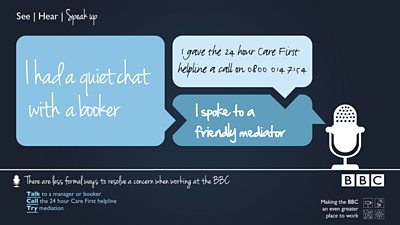
If you have a concern, please contact the person who engaged you in the first instance. Alternatively you can speak to your head of department, local HR contact or any of our leaders.
Bullying and harassment helpline
If you feel that you are being bullied or harassed or experiencing behaviours which are not in line with our values, you can access the Respect at Work Helpline provided by Care First, online (username: bbcemployed, password: line1234) or by calling 0800 014 7154 (or +44 1452623367 outside of the UK).
CareFirst offers confidential, independent advice to anyone at the BBC who may be facing bullying, harassment, or behaviour that goes against BBC Values. They can help you understand how to raise a concern and what steps you need to take.
This real time service is available 8:00am - 10:00pm, Monday - Friday.
After 10.00pm you can send an email and a counsellor will reply to you within 12 hours, or by 10.00am on Monday if you email at the weekend.
Whistleblowing
Whistleblowing, or protected disclosures, are concerns made in the public interest and can relate to issues such as health and safety, malpractice or wrongdoing impacting on others including breaches of the law. If you have a concern about malpractice at work, you should raise it with the person who hired you, or your manager, if you feel you can. You can do this verbally or in writing. You can also email the BBC Whistleblowing team on whistleblowing@bbc.co.uk.
Alternatively, you can raise your concern anonymously to the BBC Whistleblowing team via Navex Global, which is an external reporting platform. You can do this by clicking here or calling their reporting line on 0800 890 011. At the prompt, dial 833 573 1750. If you are outside of the UK or wish to make a report in a language other than English, click here.
Protect
If you want further independent advice, you can contact Protect. They are an independent charity that specialises in providing free and confidential legal advice on how to raise a concern about serious malpractice at work.
Your protection
The Director-General and Senior Leadership team are committed to the principles of the Protected Disclosures (Whistleblowing) Policy.
Your position will not be at risk if you raise a genuine concern.
If you raise a matter that you know to be untrue, disciplinary action may be taken.
We will not tolerate any sort of victimisation of anyone raising a genuine concern and anyone responsible for doing so will be subject to disciplinary action.
You may raise your concern in confidence; you can ask for your identity to be protected.
External Organisations
There are various external organisations that offer a range of support to Freelancers working in the Film and TV industry. Please see details below.
Free, confidential B&H advice and support for our freelancer community. Contact them online or by calling 0800 054 0000
This online module from ScreenSkills is designed to help you recognise and address harassment and bullying behaviours in yourself and others. It builds on the principles and zero tolerance guidelines developed with organisations across film, television and games industries by the BFI and BAFTA in 2018.
The Advisory, Conciliation and Arbitration Service (ACAS) supply up-to-date employee relations information, independent advice and high-quality training. They also work with employers and employees to solve problems. You can get free advice from their website or by calling the helpline.
Provide free, independent, confidential and impartial advice on your rights and responsibilities via their website, local bureau or by telephone. Resources are available on work issues including discrimination at work. Advice is also available on personal/ home life issues including money, benefits, relationships, housing, the law, tax, health and education.
The Equality Advisory Service offers free phone and live chat services (from most landline/mobile providers) that provide information, advice and support on discrimination and human rights issues in England, Scotland and Wales. Also offer guidance on the Equality Act 2010, resolving workplace issues informally or formally, legal aid, and how to access other support services.
Websites of Government departments, agencies and public bodies. Policies, publications and statistics available including information on bullying and harassment.
A national independent watchdog for work-related health, safety and illness. On their website, they offer information on bullying or harassment.
A Welsh-based service that provides advice and information on mental health issues and services to everyone in the UK. Also, offer useful information and resources on Adult Bullying.
Mind provides information on different types of mental health problems, where to get help, medication and alternative treatments and advocacy. The legal advice service provides general advice on mental health law covering mental health, mental capacity, community care, human rights and discrimination/equality related to mental health.
Providing guidance and information to anyone currently or previously affected by harassment or stalking. They also advise on legal aspects, gathering evidence and how to report, ensuring personal safety and reducing risks. Calls are free from landlines and some mobile providers.
A national charity that offers a confidential helpline for anyone suffering from emotional distress. It is staffed by trained volunteers.
54 of Britain's unions offering policy, research, training, lobbying, campaigning and worker representation. Information on workplace bullying and harassment also available.
Offering information on hate crimes and hate incidents relating to disability, race, religion, sexual orientation, or transgender identity. Hate crimes or hate incidents can be reported using their online form. Support is also available for victims
A website offered by the TUC that provides information on workplace rights, pensions, health at work and your career. Information is available on workplace bullying and harassment.
Expectations
We have a unique role in audiences’ lives: to inform, educate and entertain millions of people in the UK and around the world. To deliver this for all audiences, we aim to to attract and retain world-class, diverse talent and unite everyone behind a common set of values and behaviours.
BBC Values
As the world’s most creative organisation, we are committed to being diverse, inclusive and sustainable: reflecting our audiences across the UK and globally, connecting with new generations and perspectives, and respecting our planet.
More than just words on a page, our values inform everything we do. They are the DNA of the BBC. They set out who we are and how we do things. They define what you can expect from the BBC, and what the BBC expects from you.
Working with you, we’ve refreshed our values for our centenary year to help build a BBC that is creative, inclusive and full of opportunity. Where we’re all connected — to our audiences and to each other.
- AUDIENCES are at the heart of everything we do
- CREATIVITY is the lifeblood of our organisation
- TRUST is the foundation of the BBC — we’re independent, impartial and truthful
- We RESPECT each other — we’re kind, and we champion inclusivity
- We are ACCOUNTABLE and deliver work of the highest quality
- We are ONE BBC — we collaborate, learn and grow together
GDPR
The BBC is committed to protecting the privacy and security of your personal information.
Our BBC People Privacy Notice describes how we collect and use personal information about you during and after your working relationship with us, in accordance with the General Data Protection Regulation 2016/679 (GDPR). If you require further details as to how your personal data is processed, we ask that you refer to this document.
Additional information about how we use your personal information and how long we keep it for can be found in the Data Protection Handbook and our Corporate Retention Schedule.
It is your responsibility to familiarise yourself with the BBC’s data processing policies and notices set out above. If you have any queries regarding the processing of data by the BBC, or require a hard copy of the policies referred to above, please contact us.
BBC Census
In the same way that a national census records information about the population, the BBC Census is a short survey that records demographic information about the people who work at the BBC.
It’s carried out every few years and asks a few brief questions about you, such as your race/ethnicity, religion, background and whether you are disabled.
Just like a government census, the information helps us to build an accurate picture of our workforce that can be used to inform our diversity and inclusion plans for the future.
In the same way that a national census records information about the population, the BBC Census is a short survey that records demographic information about the people who work at the BBC.
It’s carried out every few years and asks a few brief questions about you, such as your race/ethnicity, religion, background and whether you are disabled.
Just like a government census, the information helps us to build an accurate picture of our workforce that can be used to inform our diversity and inclusion plans for the future.
In the same way that knowing our audiences enables us to create more impactful content, knowing our people helps us to make the BBC a better place to work for everyone. The information we gather through the census helps us to assess how representative we are and is reported in our Annual Report and Accounts, so we need to ensure the data is as accurate as possible.
As well as showing us how the makeup of our freelancer workforce is changing, the information also enables us to understand more about who works here so that we can ensure we meet everyone’s needs - and is valuable for informing and tracking our future plans. For example, if we know we have areas of underrepresentation, we can work to increase diversity in a targeted way.
We want to create the most inclusive, accessible and diverse workplace that we can, where everyone feels a sense of belonging. We know that it’s also key to our success. If we better represent the diversity of the UK, we can better reflect the ideas and thinking of a wide range of audiences and communities and deliver greater value to all.
The census is an important opportunity to refresh our information to ensure that we have accurate and up-to-date records, as we know that people’s circumstances can change. This year’s census also includes new questions that we haven’t previously asked.
The Census will be sent to everyone who is currently engaged as a freelancer for the BBC Group in the UK.
The Census has previously been a UK-only activity, but expanded last year to include BBC Studios colleagues outside of the UK as part of specific activity to gain a full picture of the BBC Studios global workforce. Each year we will review which elements of our workforce will be asked to complete the Census.
The Census will be live for completion from Wednesday 20 June to Friday 14 July. You can complete the Census at any time during this window. Once the window is closed, you will not be able to submit responses via the above links.
The information will help us to assess how representative we are, how the makeup of our workforce has changed, and to track the changes we want to see moving forwards – such as the progress we’re making towards our diversity targets. The information regarding our UK workforce diversity is also reported in our Annual Report and Accounts.
Individual information is strictly confidential and will never be shared or reported on. The data will only be reported on in an aggregated way, so you will not identifiable. The information you provide is strictly confidential. It’s held in a secure area on our HR system which is only accessible by a small number of people in HR. It cannot be accessed or viewed by your line manager. For more details, please see the BBC Census Privacy Notice.
If you can’t find your email from ‘BBC via CultureAmp’ with your link to complete the census, you can visit bbc.cultureamp.com at any time during the completion window and sign in via BBC Login. The BBC Census will be available to complete via your ‘Tasks’ page.
As the closing date approaches, follow-up emails will also be sent to anyone who hasn’t responded, so look out for those. Please note: The link you receive is unique to you and can only be completed once, so please do not forward your email on to anyone else.
The Census should take no more than a couple of minutes to complete. However, if you need to stop part-way through, please select ‘save and exit’ at the bottom of the page and your responses will be saved until you return. No information will be submitted until you select ‘submit’.
Yes, the census is on a web-based platform which is accessible for users of assistive technology and has been fully tested.
We publish detailed diversity data about our workforce each year as part of our Equality Information Report, which forms part of our Annual Report and Accounts and provides an update on the progress we have made in relation to equality, diversity and inclusion.
Census participation is optional, however it is important that we collect as many responses as possible, so that our data is as accurate and representative as it can be.
If you are not comfortable answering any aspects of the Census, you can opt out of any question by selecting ‘prefer not to say’.
Non participation of the Census will result in exclusion from the overall completion rate. Selecting ‘prefer not to say’ will mean participation is included in the published completion rate, however, responses will be counted as non-disclosures.
Non-disclosures support a more valuable data set than non-participation, so we’d please encourage everyone to participate even if you’d rather not disclose your information.
There are questions relating to the following:
• race/ethnicity
• religion
• socio-economic background
• sexual orientation
• gender identity
• if you are transgender
• if you are disabled, and the nature of your disability
• If you do not consider yourself to be disabled, we also ask if you consider yourself to be neurodivergent.
We also ask if you are open about aspects of your LGBTQ+ identity. We do not ask about your sex or your age in the Census as we hold this data as part of your general personal information.
The questions have been developed in consultation with our employee networks and follow best practice government guidance used by the Office for National Statistics.
In our 2021 Diversity & Inclusion Plan, we set ourselves a target that 50% our LGBTQ+ staff to be out at work, defined as being open about their LGBTQ+ identity to their manager, measured by an annual staff survey. We want to create an inclusive culture at the BBC for LGBTQ+ staff and freelancers to feel comfortable sharing that aspect of their identity to those they work with, in particular their manager and the person who engaged them for work at the BBC, and to measure our progress in achieving our target.
We have removed the words ‘disability’ and ‘disabled’ from the question, as the definition is broader than what is commonly understood within the organisation. The wording of the question will also be simplified. The aim of making these changes is to ensure that there is a common understanding of disability and improve the accuracy of disability disclosure.
We have also brought the question in line with the Equality Act (2010) definition – which also doesn’t contain the word ‘disability or ‘disabled’ – but allows us to, hopefully, use more welcoming language for people who have not previously identified under this protected characteristic grouping in the workplace.
Neurodivergent people are considered to fall outside the ‘typical’ range of neurotypes. People who are neurodivergent, or have a neurodivergent diagnosis, have brains that work in different ways to neurotypical people. Examples of neurodivergent conditions include ADHD, autism, dyscalculia, dyslexia, dyspraxia, and Tourette’s.
Although the Equality Act (2010) offers protection to some people who are neurodivergent, many neurodivergent people do not identify as disabled or as having a disability themselves. By asking the questions in this way, it allows us to gather more accurate information on disabled and neurodivergent freelancers at BBC and ensures that we are not missing anyone in our information gathering.
The information you provide is strictly confidential and cannot be accessed by your line manager or divisional HR teams, therefore no provision will be made if you have stated that you have a disability or need adjustments. We ask these questions to gain a broader understanding of disabilities and adjustments across the BBC. If you require advice and support on workplace adjustments, please contact our Disability Access Service.
We need to collect as many responses as possible so that our data is as accurate and representative as it can be, however each question includes a ‘prefer not to say’ option if you’re not comfortable answering.
The recent data breach did not impact the systems we use for census and, therefore, there is no increased risk to anyone completing the Census. The data breach was a result of a third-party leak and did not target or compromise BBC data systems.
We need to map people’s responses against our HR records to understand the makeup of different parts of the organisation – for example, by division and pay band – so your responses are not anonymous, but they are completely confidential. The information will only be used for reporting on the workforce as a whole and you will not be identifiable.
The information you provide is strictly confidential. It’s held in a secure area on our HR system, which is only accessible by a governed number of specialist HR staff. It cannot be accessed or viewed by your Team Manager. For more details, please see the BBC Census Privacy Notice.
Individual information is strictly confidential and will never be shared or reported on. The data will only be reported on in an aggregated way, so you will not identifiable. The information you provide is strictly confidential. It’s held in a secure area on our HR system which is only accessible to a limited number of HR staff. It cannot be accessed or viewed by your Team Leader. For more details, please see the BBC Census Privacy Notice.
BBC Census Survey 2024 Privacy Notice
COVID Support for Freelancers
Information on the support that we offer for BBC Freelancers in light of the Coronavirus pandemic can be found here.
You may also find useful

Freelancer Life Cycle
Follow your journey as a BBC Freelancer.
Training
Everything that you will need to know about the BBC's training requirements and how to complete them.
Useful Links
A full directory of all the important links and contacts that you will need during your time at the BBC.
Contact Us
Get in touch with our specialist team with any queries or issues you may have.
