Summary

  • The first of six Newsnight specials exploring the biggest questions about Europe

  • Evan Davis was joined by Peter Mandelson, Chris Grayling and a panel of experts

  • Watch the Sovereignty special again in the Live Coverage tab

  • Find out what the panel of undecided voters thought of the issue of sovereignty

  • Coming soon: specials on Security, Economy, Migration, Brussels and what Out might look like

  1. Thanks for following along...published at 00:16 BST 12 April 2016

    Ian Katz
    Newsnight Editor

    We've just wrapped up the post-mortem on tonight's show about sovereignty and the EU. The prevailing view on the production team was that we tried to squeeze too many voices into the show, with the result that several of our very knowledgable experts barely got a word in edgeways. 

    The idea behind tonight's format was to cut through the tit-for-tat quality of much of the referendum debate by calling on experts who could tell us whether the claims of the politicians stacked up. But our main guests, Chris Grayling and Peter Mandelson, were so keen to slug it out with each other that we didn't hear as much from the experts as we'd hoped. (They were still arguing about how many Brussels meetings Grayling had attended when they left the studio.) We'll be tuning the format ahead of the next of these special shows - about security - next Monday. All feedback very welcome.

  2. A few quick thoughts post-show...published at 00:05 BST 12 April 2016

    Evan Davis
    Newsnight Presenter

    My thoughts on our sovereignty debate (apart from how much longer we could have spent arguing about the issue.) The Remain side made much more of the fact that we influence European legislation than I expected. Peter Mandelson was keen to impress on us that EU laws are not imposed, but we contribute to them. It is true, but of course we can be outvoted and then suffer under laws we don't want.

    I had thought we'd hear more about the benefits of our influence on others, constraining their behaviour and getting laws that suit us in return for the ones that don't.

    I was also interested in the importance everyone attaches to the fluid EU situation. The club we see voting on remaining in, is not a constant. It is changing. Quite whether that means we should duck out while we can, or stay to help shape it, I'm not sure.

  3. Recap: How many UK laws are made in the EU?published at 00:02 BST 12 April 2016

    We asked Queenie, a British bulldog (and national symbol) to answer that question. She got the BBC's legal affairs correspondent, Clive Coleman, to help.

  4. Recap: Evan Davis visits the self-declared principality of Sealandpublished at 00:01 BST 12 April 2016

    Earlier this evening we got to see Evan Davis being winched up onto the Sealand as part of his film about sovereignty. 

    If you missed it, or even if you just want to re-watch Evan dangling from a swing in a hard hat, here it is again:

    Media caption,

    Evan Davis visits the self-declared principality of Sealand

  5. Highlights from our sovereignty debatepublished at 23:58 BST 11 April 2016

    Just some of the key quotes

    Quote Message

    It's hard to see any sovereign body within the EU. If there were one they would be able to solve the Euro crisis and they would be able to solve the migrant crisis... What we seem to be having is a dysfunctional and probably unworkable system of many nations

    Professor Robert Tombs, University of Cambridge

    Quote Message

    When you look across government activity that is not wholly or partly shaped by the EU, you are looking at quite a small number of areas

    Chris Grayling MP, Leader of the House of Commons

    Quote Message

    He (Chris Grayling) talks about this legislation and these EU obligations and this terrible impact as if it has been something over which we have no influence. It's very fundamental. This is not legislation imposed on us, we are a part of the process."

    Peter Mandelson, European Commissioner for Trade, 2004-2008

    Quote Message

    We’re all about independence, freedom, carving your own path in life. The EU isn’t really for us

    Prince Liam of Sealand

    Quote Message

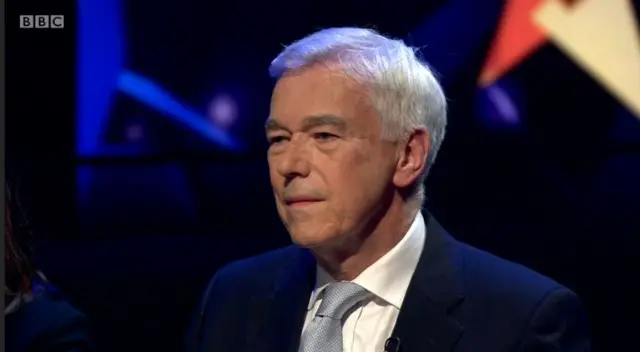
    We’ve lost the right to govern ourselves. Once you’re in the European Union , you have to ask the permission of the others… you are no longer in control

    John Redwood MP, Conservative

    Quote Message

    You give up some of your sovereignty because you choose to do so. Because it makes a lot of commercial and economic sense

    Vicky Price, Head of the Government Economic Service, 2007-10

  6. What did our undecided voters think?published at 23:52 BST 11 April 2016

    Have any of them been persuaded?

    We've just spoken to three of our undecided voters after they've braved an hour in the studio. Here's what they have to say after hearing the arguments:

    Quote Message

    I haven’t come to a decision but it’s widened my scope of issues. I’m actually probably pro-leaving slightly more because of all the issues Chris (Grayling) mentioned

    Angela Garvin

    Quote Message

    I’m still undecided but it seems to me from what I heard tonight I’ll be leaning more towards stay at the moment. The scaring tactic is not working.

    Shan Abizadeh

    Quote Message

    I’m still undecided, I still have more to hear. Based on sovereignty, based on law, I don’t think that the EU making decisions for us is entirely a bad thing so I think I am swinging more towards remain.

    Lewis Dockery

  7. Who are ya?published at 23:49 BST 11 April 2016

    This X post cannot be displayed in your browser. Please enable Javascript or try a different browser.View original content on X
    The BBC is not responsible for the content of external sites.
    Skip X post

    Allow X content?

    This article contains content provided by X. We ask for your permission before anything is loaded, as they may be using cookies and other technologies. You may want to read X’s cookie policy, external and privacy policy, external before accepting. To view this content choose ‘accept and continue’.

    The BBC is not responsible for the content of external sites.
    End of X post
  8. EU referendum... lessons from 1975published at 23:42 BST 11 April 2016

    Michael Cockerell looks back at the UK's 1975 referendum on Europe – and draws out similarities and differences between then and now.

  9. Who still thinks the economy is more important than sovereignty?published at 23:36 BST 11 April 2016

    After an hour of discussing sovereignty, how important do our undecided voters think sovereignty is in the EU debate?

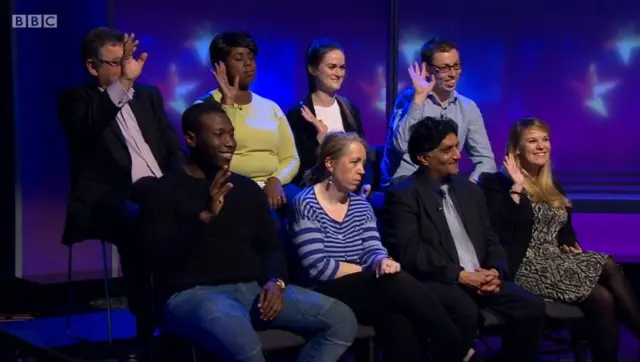
    Six panelists raise their hands

    Not as important as the economy, apparently. But we do have a referendum special on the economy on the 25th April so plenty more on that soon. 

    Here is Padraig on feeling European:

    Quote Message

    The EU was originally set up to keep warring nations on the same side. I'm Irish and I feel more European.

    Padraig, Works in the printing business

  10. What a difference £25 makespublished at 23:34

    Chris Cook
    Newsnight Policy Editor

    As we end the first of our of specials on the upcoming EU referendum, it’s worth bearing in mind how the campaigns are considering the questions at stake. Evan started the programme by talking about how we want to help you make up your mind. We’ll do our best, but it may be quite a challenge.

    Something I’ve heard from a lot of people on both sides of the fence is that there is a decent number of undecided voters who are seeking certain facts that will tell them which way to vote in the referendum. They don’t want an argument, they want to know “the answer” to the question of In or Out.

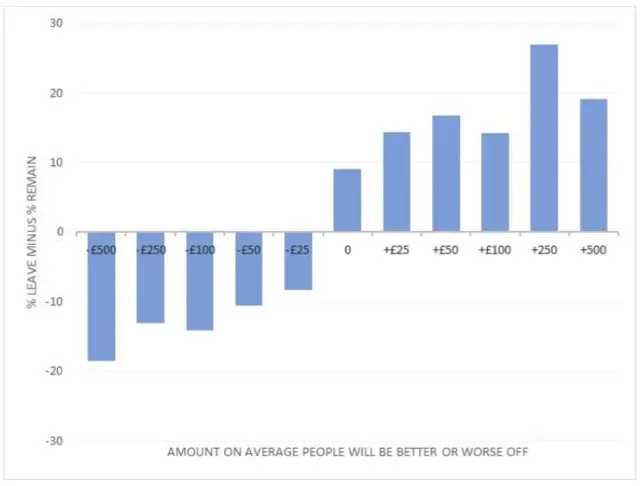
    I think there is a graph which bears on that here, produced by Prof Philip Cowley of QMUL (although it’s not how he presents it). He asked YouGov to ask people how they’d vote if they knew that going in would cost them or gain them a variety of sums of money.

    A graph showing impact of money on how people will voteImage source, Philip Cowley

    You can see how, if you tell people that they’ll be £25 down from Brexit, a segment of voters will move so the result is a fairly resounding vote against. If you tell them they’ll be £25 better off, they swing back behind it. This segment is big enough to decide the election. That’s all it takes.

    Prof Cowley notes that this polling helps you see "how much economic considerations might affect things.” That’s surely right - and his reading of it is borne out by other research. But also note his conclusion that increasing the sum of money on offer makes "not all that much difference”. 

    I read the fact that the lead doesn’t grow that much as supporting that idea that there is a bloc of certainty-hunting voters. They don’t care much about whether they’re £1 better off or £1,000. They want the certainty of the “right” answer and will back it. Why does this matter? Because there is no such answer. 

    On that big question - “will you better off out of the EU?” - there’s little uncontested truth out there. The “right" answer for you depends on your political priorities. Do you care more about defence or farming? So all we can give you is enough information for you to work out what you think.

    That might sound a bit trite, but - somewhat counterintuitively - this may mean there’s another adjustment you have to make to your reading of the polls. People on both sides of the campaign say the polls may understate final Remain’s position at the very end, because a number will only realise in the final days that they have not the certain facts they crave. 

    Research and prior experience suggests, then, that having had their heart back Leave during the campaign, they may then get worried as they approach the ballot box. And so, at the very end, there may be a break back to Remain, which is campaigning as the safer status quo option. 

  11. Vernon Bogdanor on European historypublished at 23:30 BST 11 April 2016

    Quote Message

    We've often seen ourselves as separate from European... Twice in the last century governments who have wanted to isolate themselves away from Europe found themselves forced into World Wars because of events that happened in far away parts of Europe

    Vernon Bogdanor, King's College London

  12. Sovereignty bill?published at 23:24 BST 11 April 2016

    David Grossman
    Newsnight

    What on earth has happened to the Sovereignty bill? David Cameron promised us one. He said it would help reassure anyone who wanted a guarantee that the UK parliament was sovereign over EU law. Mr Cameron told us that the government had already established the primacy of UK law in the European Union Act of 2011 but if people wanted even more clarification, to “put the matter beyond doubt” he hoped to publish a new sovereignty bill at the same time as wrapping up the EU renegotiations in Brussels.

    The EU heads of government shook hands on that deal in the middle of February, and yet we are still waiting for the new bill. Some said at the time that it was a fatuous exercise which had the sole objective of stopping Boris Johnson campaigning to leave the EU.

    Boris has let it be known that he had been initially happy with first draft of the sovereignty bill, but once it came back from the government lawyers it was so toothless and meaningless that he couldn’t accept it.

    Once the Boris horse bolted to the leave side there was little point in the government pressing ahead with it.

    Indeed it is hard to see how the government could do much more than point out the obvious. The UK is only subject to EU law because the UK parliament passed the European Communities Act of 1972. Parliament has the (sovereign) power to repeal that act and no longer be subject to EU law.

    However, trying to pretend that such an obvious constitutional point is in some way marks an important advancement of UK sovereignty is likely to be counterproductive. For that reason I’m not expecting to see the promised bill any time soon.

  13. The EU Charter of Fundamental Rightspublished at 23:23 BST 11 April 2016

    In 2000, as part of the Treaty of Nice, the European Union gathered together in a single document all of the existing rights of every individual within the EU as established by the case law of the Court of Justice of the EU, the rights and freedoms enshrined in the European Convention on Human Rights, and “other rights and principles resulting from the common constitutional traditions of EU countries and other international instruments”.

    The document - the EU Charter of Fundamental Rights – was initially non-binding, but in December 2009, as part of the Lisbon Treaty, it became legally binding on the EU institutions and on national governments. During the treaty negotiations, the British government was given a written assurance (“Protocol 30”) that the UK would only implement the Charter insofar as its provisions were already “recognised in the law or practices of the United Kingdom.”

    Some critics have expressed concern that – in spite of Protocol 30 - British judges have invoked the Charter when ruling on cases, and that Britain’s opt-out has therefore been undermined.

  14. Robert Tombs on a 'dysfunctional' EUpublished at 23:20 BST 11 April 2016

    Quote Message

    It's hard to see any sovereign body within the EU. If there were one they would be able to solve the Euro crisis and they would be able to solve the migrant crisis... What we seem to be having is a dysfunctional and probably unworkable system of many nations

    Robert Tombs, Cambridge University

    Robert Tombs
    Image caption,

    Robert Tombs

  15. Then and Nowpublished at 23:18 BST 11 April 2016

    Was sovereignty ignored in the 1975 referendum?

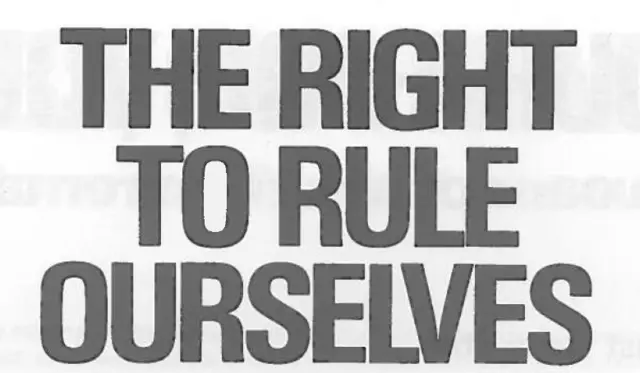
    A 1975 referendum leafletImage source, Museum of London
    Image caption,

    A 1975 leaflet from the "No" campaign

    One of the popular arguments about sovereignty is that supporters of the European Economic Community back in 1975 were not honest about conceding power to Europe.

    That the British people simply never had the opportunity to argue whether giving up powers to be part of something bigger is a worthy transaction.

    Take this piece, external from Dominic Lawson. 

    He argues that the UK never had a true debate about sovereignty; that the then Conservative government led by Edward Heath “skilfully evaded the issue.”

    To what extent is that the case? Well, one tiny snapshot of the 1975 referendum debate is the official leaflets circulated by each campaign.

    It may be interesting to note that some of these excerpts seem rather similar to the phrases we’re hearing tonight.

    “The fundamental question is whether or not we remain free to rule ourselves in our own way,” ran the No campaign’s leaflet urging voters to reject the EEC. The banner: “The right to rule ourselves.”

    On the other side, the question: “Why can’t we go it alone?”

    “If we came out, the Community would go on taking decisions which affect us vitally – but we should have no say in them. We would be clinging to the shadow of British sovereignty while its substance flies out of the window.”

  16. More of your thoughts on sovereigntypublished at 23:16 BST 11 April 2016

    Lots of comments coming in from people watching at home. Here are just a few.

  17. EU laws: The numbers gamepublished at 23:14 BST 11 April 2016

    Quote Message

    I wouldn't be arguing in terms of numbers, the questions I would be asking would be in terms of impact

    Chris Grayling, Leader of the House of Commons

    Quote Message

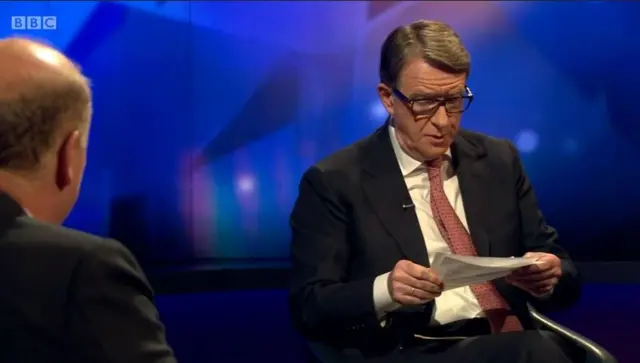
    It's very, very fundamental. This is not legislation imposed on us. We are part of the legislative process. If he went to Brussels more often he might understand how it works

    Peter Mandelson, European Commissioner for Trade, 2004-2008

    Mandelson
    Image caption,

    Mandelson

  18. Are there 26,911 words of EU regulations on the sale of cabbage?published at 23:08 BST 11 April 2016

    Radio 4's More or Less have had a look

    We can give you a straight answer on this one: It's false.

    Quote Message

    Just under 2,000 words of regulations on the size and labelling of cabbages were repealed in 2009. Today there are no regulations specifically about cabbages.

    Radio 4's More or Less

    The whole, myth-busting article is worth a read; it even suggests that British industry guidelines are more wordy than EU regulations.

  19. How much UK law comes from the EU?published at 23:06 BST 11 April 2016

    Clive Coleman
    BBC legal correspondent

    Well, it depends who you ask. Business for Britain, which campaigns for the UK to leave the EU, claims it is over 60% and a major burden. Others put the figure as low as 13%. It’s a massive difference based on what you count in or out. Between 1993 and 2014, parliament passed 945 Acts of which 231 implemented EU obligations of some sort. It also passed 33,160 Statutory Instruments, 4,283 of which implemented EU obligations. Add both of these together and divide by the total number of laws passed, and you get the 13% figure.

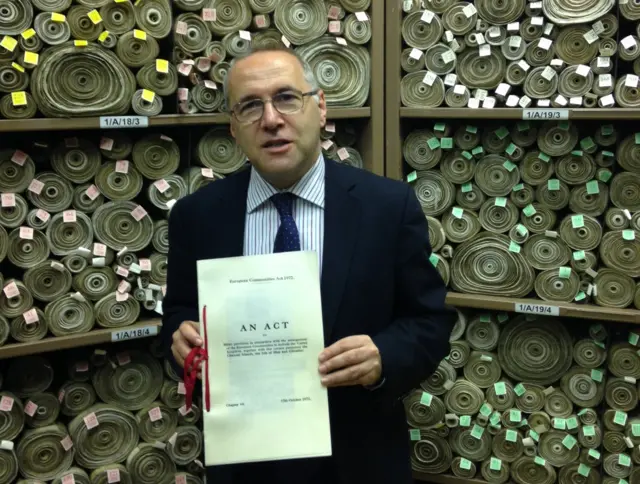
    Clive holding the original of the 1972 EU Communities Act which took UK into EU
    Image caption,

    Clive Coleman holding the original of the 1972 EU Communities Act which took UK into EU

    But most EU regulations don’t require new UK laws. They can be implemented in the UK without new legislation. So, if you count all EU regulations, external, EU-related Acts of Parliament, and EU-related Statutory instruments, about 62% of laws introduced between 1993 and 2014 that apply in the UK implemented EU obligations.

    These headline figures make it easy to take a position on the relative influence of EU law, but do they mean anything?

    Some EU regulations are agreed by all member states but don’t actually affect us at all. Like those governing the production of olive oil and tobacco because we don’t do have those industries. We also adopt some which codify existing UK law at a European level, so we’d effectively have that law anyway.

    And the numbers game doesn’t assess impact – it's tiny in areas like defence, much larger in areas at the heart of the EU, like trade. 

  20. The Luxembourg Compromisepublished at 23:05 BST 11 April 2016

    How Europe "ground to a halt"

    The Luxembourg Compromise was an agreement made in 1966 to resolve an "empty chair" crisis preventing decisions being made by the European community.

    France's Charles de Gaulle objected to the community's move to increase the use of majority voting so that one member state couldn't block particular measures - especially in agriculture.

    Effectively, he wanted a veto. And he knew how to get it.

    Sir Stephen Wall, former permanent representative to the EU, explains: "The French left an empty chair.

    "And effectively for about six months, from the middle of 65 to the beginning of 66 , the European Community ground to a halt."

    The name, Sir Stephen thinks, was a little generous.

    "It was basically a unilateral statement by the French", he adds.

    Prominent Brexiteer John Redwood argues it was never viable - having tried to suggest its use when in government.

    "I remember on a couple of occasions saying to the government, maybe this is a time we really need to use the Luxembourg Compromise and the official government machine was horrified and nobody wanted to go anywhere near it," he said.

    "Of course, we didn’t use it. And over the years of non-use it gradually lapsed."