Summary

  • Would the UK be better off in or out of the EU? Newsnight's special on the EU and the economy

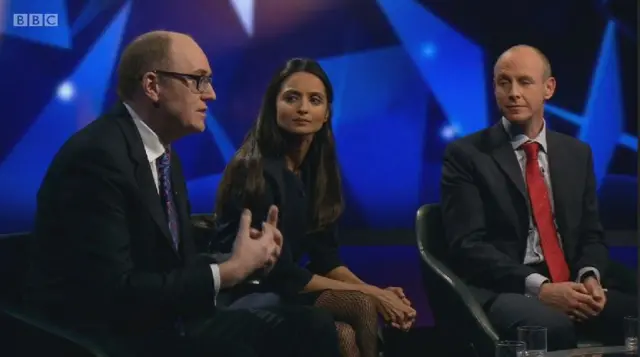
  • Evan Davis was joined by top politicians from both sides of the argument

  • Find out what the panel of experts and our group of undecided voters had to say

  1. In case you missed it...published at 00:22 BST 19 April 2016

    What would happen to trade if the UK leaves the EU?

    Here are two quick takes from our policy editor Chris Cook,first on trade with the EU, then on trade with the world.

    Thanks for following along. Join us next week for the next Newsnight EU special on security.

    Media caption,

    What might happen to trade if the UK left the EU?

    Media caption,

    What might happen to world trade if the UK left the EU?

  2. Some thoughts from our expertspublished at 00:15 BST 19 April 2016

    Quote Message

    It was interesting to hear other people’s points of view but the show just made me realise this is such a complex thing, with so many facets. What concerns me is how you get clear arguments across because there are just so many issues. If someone had landed here for Mars and looked at the situation, they’d be so confused.

    Quote Message

    I think the point about the single market not being complete was interesting. If we can complete the single market, it is in particular going to be massively beneficial to the UK economy because 78% of our GDP comes from the services sector.

    Nicola Horlick, CEO, Money&Co

    Quote Message

    The most surprising thing I took from the show is the apparent ease with which the Leave campaign thinks we’re going to be able to negotiate a trade agreement with Europe outside. We see no evidence of that happening within a two-year period anywhere in the world.

    Quote Message

    If Brexit happens, it has knock-on effect of EU breaking apart, and we actually end up weakening our strongest trading partner. And a weaker EU means a weaker Britain. I just think we need to be mindful of the bigger picture.

    Quote Message

    I’m surprised that we’re not really talking about this not just being about Great Britain. If Brexit happens, it has knock-on effect of EU breaking apart, and we actually end up weakening our strongest trading partner. And a weaker EU means a weaker Britain. I just think we need to be mindful of the bigger picture.”

    Juergen Maier, CEO, Siemens UK

    Quote Message

    What stood out to me is the constant scaremongering on both sides. I don’t think it’s useful for viewers. I don’t find the report from the government particularly endearing where they’re clearly massaging the figures… Liz Truss’ agenda was clearly to back up the report. Will she give us a fair perspective on Remain or Brexit? Absolutely not.

    Farzana Baduel, Managing Director, Curzon PR

  3. My thought on our economy debatepublished at 00:00 BST 19 April 2016

    Evan Davis
    Newsnight Presenter

    The Brexit side's toughest question felt to me to be whether the City would be harmed if it didn't get access to the single market (incomplete as the single market is).

    The remain side's vulnerability appeared to come from the failure of the EU to expand trade with the faster growing parts of the world – but could the UK on its own do better?

    Given this, we were unable to definitively answer the question, do we lose more trade with Europe by leaving the EU, than we gain with the rest of the world. But I think people will at least have seen the risks on either side.

  4. Will Brexit break the banks?published at 23:54 BST 18 April 2016

    Gerard Lyons (left)
    Image caption,

    Gerard Lyons (left)

    Gerard Lyons, the mayor of London’s economic advisor, was asked about whether British-based banks would still be able to trade across Europe post-Brexit.

    One example of a country that is outside the EU but does rather a lot of banking is Switzerland. Under the Swiss or Free Trade Area models the UK would have to negotiate access to EU markets in financial services. The EU only allows access to countries with equivalent regulations and the approach currently varies across directives. So we could get a deal – but it might be quite complicated, and we may well have to take a good chunk of EU regulation back on. 

    The UK is currently a leader in euro-denominated wholesale banking. However, there are already countries in the Eurozone that want this sort of activity to be moved to the Eurozone and be overseen by the European Central Bank. 

    Remainers point out that it would be much easier for the Eurozone to take this sort of activity away from the UK if it was out of the EU because it wouldn't be protected by ECJ enforcement of single market rules.

    But how much control do we really have over banking regulations as they stand? Open Europe point out that the UK accounts for 36% of the EU’s wholesale financial market and a 61% share of the EU’s net exports of international transactions in financial services. But under the new EU voting rules, the UK will only possess 12% of the votes in the Council of Ministers and 10% of the votes in the European Parliament. 

    This is what Goldman Sachs told the Parliamentary Commission on Banking Standards about UK membership of the EU:

    Quote Message

    We believe that a key risk to London’s retaining its status as a financial hub is an exit by the UK from the European Union. In common with financial institutions across the City our ability to provide services to clients and engage in investment activities throughout Europe is dependent on the passport that London-based firms enjoy to operate on a cross-border basis within the Union. If the UK leaves, it is likely that the passport will no longer be available, thereby forcing firms that wish to access EU markets to move their operations to within those markets.

    Goldman Sachs, Submission to Parliamentary Committee on Banking Standards

    As with so many of the economic issues discussed tonight, it's difficult to know for certain what impact remaining or leaving the EU might have on our access to European banking markets. 

    Remainers argue that if we are in the EU we get access to the single market - and we get to influence the regulations that govern it. Leavers argue that we can negotiate a deal that gets us pretty decent access to the market anyway - and perhaps we won't have to be subject to some of those regulations that we don't like but, for example, the French and the Germans do.

  5. Would Brexit mean a tax rise?published at 23:50 BST 18 April 2016

    George Osborne has said that a £36bn loss to the exchequer is equivalent to an 8p increase in income tax. 

    It's true that if the Government wanted to raise £36bn this year it would have to raise the basic rate of income tax by about 8p, at least according to HMRC’s ready reckoner, external

    Thing is, our understanding is that the £36bn figure is for 2030, when the Treasury’s own forecast suggests the economy would be about a third bigger. As such, the government’s tax base would most likely be larger. Even if the basic rate of income tax was still at 20%, it would be 20% of a much bigger pie. So it seems unlikely that the government would have to raise income tax by as much as 8p to raise an extra £36bn.

  6. Reality Check: £36bn black hole in the Government finances?published at 23:46 BST 18 April 2016

    George Osborne today said that Brexit would cause a "£36bn black hole" in tax receipts. 

    How much you believe the £36bn figure really depends on how much stock you put by the government’s two forecasts (for leave and remain) of how big the economy will be in 2030. 

    The government thinks that the economy will be smaller than it would have been if the UK leaves the EU – so it projects that tax receipts will be lower. But if, as many of those that want to leave the EU suggest, the economy is bigger than it would have been as a result of the UK leaving the EU, then tax receipts would most likely be higher.

    Read the full article

  7. Reality Check: Would Brexit mean extra £350m a week for the NHS?published at 23:42 BST 18 April 2016

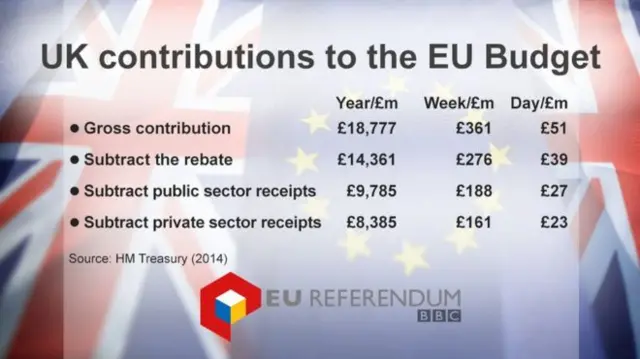
    Well, no. The UK does not send £350m a week to Brussels - the rebate is deducted before the money is sent, which takes the contribution down to £276m a week.

    The actual sum sent to the EU, once the money that returns to the UK is deducted, is £161m a week. 

    And before deciding to divert that £161m a week to the NHS, we would have to see what trade deal the UK ended up doing with the European Union.

    Countries outside the EU, which want access to the single market, such as Norway and Switzerland, still make contributions to the EU Budget.

    Reality Check verdict: Leaving the EU would not give the UK an extra £350m a week to spend on the NHS.

  8. Reality Check: Are more than 3 million jobs linked to EU membership?published at 23:40 BST 18 April 2016

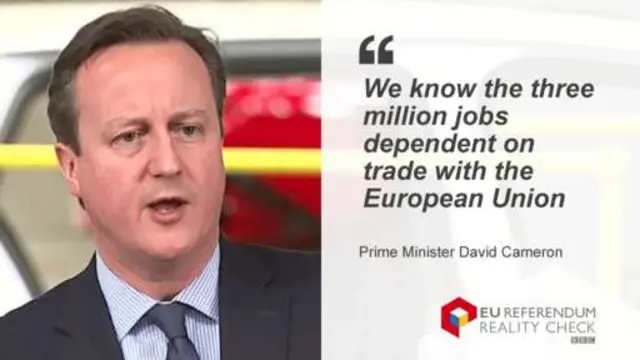
    David Cameron has claimed that three million jobs depend on trade with the EU
    Image caption,

    David Cameron has claimed that three million jobs depend on trade with the EU

    It is often claimed that more than three million jobs are linked to EU membership. David Cameron even went as far as to say they were dependent on EU membership. Is that true?”

    Two things to say about this figure: first of all, clearly not all of these jobs are dependent on the UK remaining part of the EU - nobody is suggesting that all exports to other EU countries would immediately stop if the UK left.

    Secondly, the methodology is a bit suspect. The Treasury worked out what proportion of the country's total economic output is made up of exports to the EU. Then it calculated that proportion of the UK labour force.

  9. Would Brexit cost your family £4,300?published at 23:39 BST 18 April 2016

    BBC Reality Check have been looking into it

    Osborne: 'Families would be £4,300 worse off'
    Image caption,

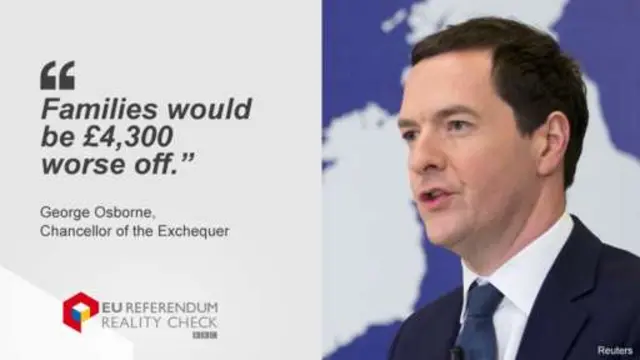
    George Osborne's claim

    The claim: In launching their analysis of the costs and benefits of EU membership, the Treasury said leaving the EU would cost families £4,300 per year by 2030. 

    Reality Check verdict: Families would not lose £4,300 per year if Britain left the EU.The Treasury model suggests that under one possible outcome of a Brexit, the UK's economy would be reduced by a sum equivalent to £4,300 for every household in the country by 2030. But that's not the same as saying it will cost every household that much. 

    Read the full Reality Check here

  10. What we've been reading...published at 23:36 BST 18 April 2016

    Want to sharpen your economic knowledge after tonight's programme? Here are some recommended reads from the Newsnight team to get you across the big economic arguments. 

    'The economic consequences', external - in which The Economist compares six economic forecasts projecting the effect of leaving the EU on GDP

    'What are the economic consequences of Brexit?', external an in-depth assessment by Chris Giles, the Economics Editor for the Financial Times

    'How Brexit would reduce foreign investment in the UK – and why that matters', external by John Van Reenen for The Conversation

    'How to Save Europe From Itself', external is on how to fix Europe's 'broken democracy' by Thomas Piketty, Jeremy Adelman and Anne-Laure Delatte for ForeignPolicy.com

    'Brexit: a referendum on Ireland’s future', external by Ruadhán Mac Cormaic for The Irish Times on how the referendum is seen in Ireland

    'I resigned so I could tell the truth about Brexit – and what it will cost Britain to stay, external' by John Longworth. The former director of the British Chambers of Commerce explains the small business case for Brexit.

    'The economic impact of Brexit, external' by Capital Economics for Woodford Investment management. A long read, but worth it for a more positive economic view of Brexit than the Treasury's from some well respected economists.

  11. A few of your thoughtspublished at 23:34 BST 18 April 2016

    Thanks for watching. Here are a quick few of your comments from while we were on air.

    This X post cannot be displayed in your browser. Please enable Javascript or try a different browser.View original content on X
    The BBC is not responsible for the content of external sites.
    Skip X post

    Allow X content?

    This article contains content provided by X. We ask for your permission before anything is loaded, as they may be using cookies and other technologies. You may want to read X’s cookie policy, external and privacy policy, external before accepting. To view this content choose ‘accept and continue’.

    The BBC is not responsible for the content of external sites.
    End of X post
    This X post cannot be displayed in your browser. Please enable Javascript or try a different browser.View original content on X
    The BBC is not responsible for the content of external sites.
    Skip X post 2

    Allow X content?

    This article contains content provided by X. We ask for your permission before anything is loaded, as they may be using cookies and other technologies. You may want to read X’s cookie policy, external and privacy policy, external before accepting. To view this content choose ‘accept and continue’.

    The BBC is not responsible for the content of external sites.
    End of X post 2
    This X post cannot be displayed in your browser. Please enable Javascript or try a different browser.View original content on X
    The BBC is not responsible for the content of external sites.
    Skip X post 3

    Allow X content?

    This article contains content provided by X. We ask for your permission before anything is loaded, as they may be using cookies and other technologies. You may want to read X’s cookie policy, external and privacy policy, external before accepting. To view this content choose ‘accept and continue’.

    The BBC is not responsible for the content of external sites.
    End of X post 3
  12. Expert view: Why I'm in favour of outpublished at 23:32 BST 18 April 2016

    Gerard Lyons is an economist and economic adviser to Boris Johnson. And he's in favour of OUT. Here's why.

    "Brexit will safeguard workers’ rights. Existing EU rules on areas such as maternity and other rights are already written into UK law. They will remain and in future be determined by UK voters and parliament, not Brussels bureaucrats. Mass migration that comes with EU membership also prevents low skilled wages from rising, and adds to pressure on housing and public services. We could better control migration numbers with Brexit.

    The country would save considerable money from Brexit. Some areas say we should stay in because of EU funding, but we give the EU the money in the first place! These areas, such as scientific research, can be covered fully with some of the large savings from our EU contribution. The rest could be spent on public services.

    Many people don't appreciate that we do not need a trade deal to trade with countries! We do not have a trade deal now with China, the USA, or vast chunks of the world with which we trade. Brexit will allow us to trade with the EU and deliver lower prices in the process." 

    A new ebook "The UK Referendum: An Easy Guide to Leaving the EU" by Gerard Lyons is released this week.

  13. Expert view: Why I'm in favour of INpublished at 23:31 BST 18 April 2016

    Juergen Maier is chief executive of Siemens. He's in favour of the UK staying IN the EU. Here's why.

    "Siemens is a big investor, manufacturer and employer in Britain and we think that EU membership is good for the UK economy. 

    For us the main benefits of EU membership are tariff-free access to our biggest market, common rules and standards that reduce business costs, and access to the big EU-wide innovation and research initiatives, which are helping to shape the industries of the future. 

    These advantages help to make Britain a better place to do business, not just for Siemens, but for companies across our supply chain and beyond. 

    We also have concerns about what Brexit would mean in practice. A new trade deal with the EU, for example, could take years to conclude and it is impossible to predict the terms that will be agreed and at what price. 

    This uncertainty, and threat of increased costs, could become a factor when Siemens is considering future investment in the UK. Pointing this out often leads to accusations of scaremongering. But we’re not saying we would leave, simply that we see absolutely no upside to Brexit and it will be far easier to grow our business here if the UK remains in the EU."

  14. How many of you are feeling daring?published at 23:28 BST 18 April 2016

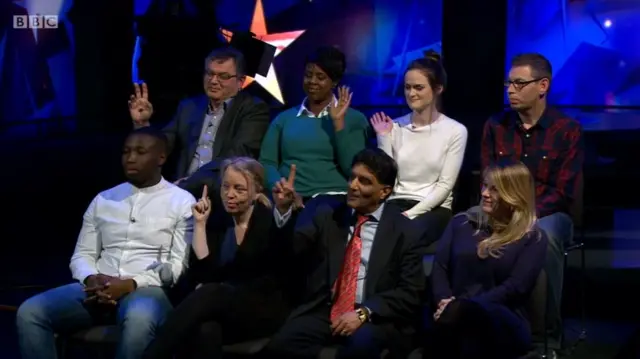
    5 hands up
    Image caption,

    Hands up

    Evan suggests that it's more daring to leave the EU, and a more cautious attitude that leads people to vote Remain. 

    Quote Message

    I think that we should be daring. Why don't we have the skills to set up these trade agreements?

    Holly, One of our undecided voters

    Let us know what you think using #Newsnight

  15. The state of the racepublished at 23:24 BST 18 April 2016

    Yes, the polls got it wrong in 2015. Yes, we should remain sceptical. But they are still interesting, just take from them what you will. 

    These two ICM polls from this afternoon appear to show that the race is tight, but also shows the widely discussed gap between online polls and telephone polls. Will tonight's debate have shifted any views?

    The Financial Times has a very interesting graphic here, external demonstrating not only the difference between online polls and telephone polls, but also where online bets are being placed.

    And this poll shows just how important the economy is in influencing people's voting decision, and why you should invest 50 minutes of your life watching Newsnight tonight:

  16. Gerard Lyons: 'Britain one of 28'published at 23:21 BST 18 April 2016

    Quote Message

    When I've spoken to business they tell me that Britain is one of 28.. We're at the back of the queue because often the EU is very focused on manufacturing

    Gerard Lyons, Economic advisor to Boris Johnson

    Gerard Lyons
    Image caption,

    Gerard Lyons

  17. International car standardspublished at 23:21 BST 18 April 2016

    Liz Truss warned that leaving the EU could leave us exporting fewer cars because we'd design to different standards. 

    While all EU countries are part of the World Forum for Harmonization of Vehicle Regulations, it also contains countries such as Russia, Australia and Japan. Established in 1952, the Forum's website, external boasts: "The benefits of such harmonized regulations are tangible in road safety, environmental protection and trade."

    So it would seem that if we left the EU we could still be part of this group, but if we decided we wanted our own standards, we'd be at odds with many countries.

  18. Liz Truss on trade dealspublished at 23:18 BST 18 April 2016

    Quote Message

    These deals with other countries take years and years and years... We have a bilateral trade deal with the US about getting our meat products in, it has taken about 20 years

    Liz Truss, Secretary of State for Environment, Food & Rural Affairs

    Liz Truss
    Image caption,

    Liz Truss

  19. Bilateral trade dealspublished at 23:17 BST 18 April 2016

    Quote Message

    I’d love the UK to have a bilateral trade agreement with India

    Fazana Baduel, MD, Curzon PR

    Fazana Baduel

    Fazana Baduel runs a British business that is trying to start up in India - and she thinks it'd be much easier if the UK had a bilateral trade deal with the EU. She (correctly) pointed out that the EU-India trade deal started negotiation 9 years ago - and still hasn't come to a conclusion. There are those that want to leave the EU that accept that the UK might lose a bit of trade with the EU, but think that we would be able to be negotiate much better deals, much more quickly with countries in the rest of the world. The argument runs that by being more nimble in our negotiations with the rest of the world we will more than make up for any shortfall from the EU.

  20. Reality Check: How much does the EU Budget cost the UK?published at 23:15 BST 18 April 2016

    Do we suffer an £8bn net loss to Europe?

    This table is a guide to numbers you may hear quoted. The figure in the second line, for example, is not the value of the rebate, it's how much is left after you subtract it.
    Image caption,

    This table is a guide to numbers you may hear quoted. The figure in the second line, for example, is not the value of the rebate, it's how much is left after you subtract it.

    The top line is the gross contribution. Now, £88m a week is paid back to the UK in the form of payments to support things like agriculture and regional development, leaving a net contribution of £188m a week.

    Out of that, £26m a week goes directly to private sector organisations in the UK such as universities to fund research, leaving £161m a week going to run EU institutions, pan-European projects and projects in other countries.

    And that £161m rounds to about £8bn a year. Still with us?

    You can read more on the BBC's Reality Check here