Summary

  • In the last of our EU specials, we looked at what the UK would look like if we vote to leave

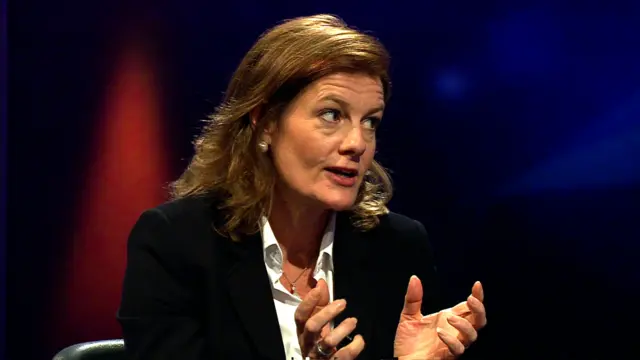
  • Evan Davis was joined by Conservative MP Andrea Leadsom and Labour MP Chuka Ummuna

  • Find out what the panel of specialists and our regular panel of undecided voters had to say

  • What three words sum up a post-Brexit Britain for you? Let us know using #Newsnight

  1. Sunny side up? Tonight's views of Britain outside the EUpublished at 00:19 BST 24 May 2016

    Ian Katz
    Newsnight Editor

    Three quick observations from tonight’s special show on what life for Britain outside the EU would look like:

    1. Though most leading Leave campaigners have coalesced around a vision of Britain outside the EU single market (but enjoying, they confidently predict, free access to it), there is by no means a settled view among Brexiters about what the relationship between a post-Brexit UK and the EU would look like.Tonight former British ambassador to Warsaw and Leave supporter Charles Crawford suggested that a post-Brexit UK might have to accept freedom of movement of EU citizens as the price of staying inside the single market, explaining somewhat gnomically: “There’s a big omelette here and we’re not going to be able to turn it into 28 eggs.” I think he meant it’s not going to be possible to change existing arrangements with the EU in a hurry.
    2. Although many Brexiters, like Daniel Hannan who made tonight’s film about what a post-Brexit might look like, are excited about the prospect of transforming the UK into a Hong Kong-style deregulated economy, there is real nervousness on the Leave side about alienating supporters of Brexit who value the kind of protections and rights that the EU has delivered. That perhaps explains why Andrea Leadson was keen to stress there would not be any watering down of worker protection laws post a Brexit: “In the area of employment law I wouldn’t expect to see deregulation.”
    3. When this referendum is over and pro-Brexit ministers return to their jobs, they are never going to be able to quote a Treasury prediction again. Andrea Leadsom, herself a former Treasury minister, was the latest minister to pour scorn on Treasury predictions tonight. “Generally economic forecasts are reliable for one thing,” she said. “And that is always being wrong.” I suspect it’s a quote she may be reminded of in years to come.
  2. Opinion: Nothing lasts foreverpublished at 23:57 BST 23 May 2016

    Charles Crawford, former diplomat

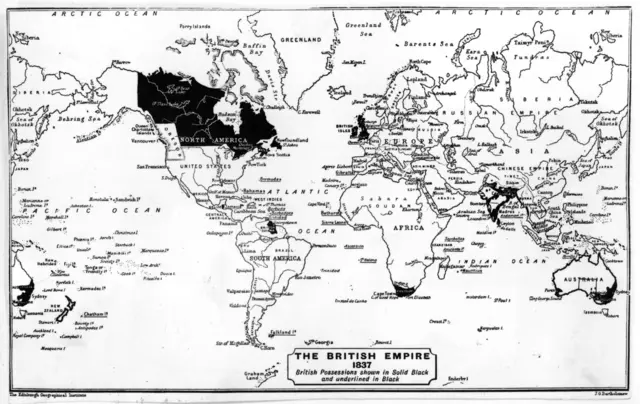
    A map of the British Empire in 1837Image source, Getty Images
    Image caption,

    How the British Empire looked in 1837

    European empires come and go. Roman. Polish/Lithuanian. Holy Roman. French. Spanish. Ottoman. British. Only the Tsarist/Russian empire lingers on. 

    The European Union will not be around in its current form in 50 years’ time. Given Eurozone and migration tensions it could crash uncontrollably far sooner than that. 

    The original European Economic Community worked because six member states sat round a small table. Now with 28 EU members complexity overwhelms transparency: EU processes are undemocratic, if not illegitimate. Hence rising popular discontent. This is not politically sustainable.

    A Leave vote opens the way to intelligent negotiation on controlled EU reform in a wider principled context.

    Doom? Gloom? On the contrary, a huge improvement on the incoherent and increasingly unstable situation we all have now.

    Charles Crawford is former ambassador to Poland, Serbia and Bosnia Herzegovina, and was a guest on the programme tonight.

  3. Opinion: Big consequences of Brexitpublished at 23:55 BST 23 May 2016

    Ngaire Woods, Oxford University

    Some countries can go it alone. The USA has such a big market (and firepower) that it can practically dictate the terms of its trade agreements with other countries. North Korea doesn't need them since it's closed to most of the world. But Britain is (and has been for centuries) an open trading economy. It attracts jobs and investors drawn to this English-speaking doorway to the EU and all its trading partners.

    If Britain leaves the EU, it will suffer three consequences. First, it will lose foreign investment and jobs because new trade deals take an average of 28 months to negotiate - and that's too much uncertainty, for too long, for most investors. Second, the U.K. will become a rule-taker in trade negotiations. Like Switzerland in its recent deal with China, Britain will have to accept what larger partners have to offer. Third, the U.K. will lose its special access to the 60+ countries with whom the EU has agreements. In a slowing and intensely competitive global economy, these are serious handicaps to creating the jobs Britain needs.

    Professor Ngaire Woods is dean of the Blavatnik School of Government and Prof of Global Economic Governance at the University of Oxford... and was a guest on the programme tonight. 

    Ngaire Woods
  4. Trade deals in 22 months?published at 23:51 BST 23 May 2016

    A very quick fact check

    Andrea Leadsom brought up the example of Singapore’s speed in negotiating free trade agreements tonight – she said they managed to negotiate deals in an average of 22 months.

    We’ve run a quick spot check, and that number seems plausible – or at least in the right ball park. 

    Singapore’s agreement with Japan started negotiations in 2000 and came into effect in 2002, China started in 2006 and came into effect in 2009, and Australia started in 2004 and finished in 2006.

    Both sides of the debate might be particularly interested in Singapore’s agreement with the European Free Trade Association – negotiated and brought into effect in the space of 2 years from 2001 to 2003.

    Outers might suggest that this shows Britain might be able to get a trade deal with the EU relatively quickly. But Remainers might hold it up as evidence that European institutions aren’t quite as slow in coming to trade agreements as the Brexiteers sometimes like to suggest.

    (Source for negotiation times: Asia Development Bank)

  5. Recap: What would post-Brexit negotiations look like?published at 23:45 BST 23 May 2016

    Here is the piece from earlier in which Jonathan Powell, former Chief of Staff to Tony Blair, tries to persuade António Vitorino, former European Commissioner, that the UK should get a good deal outside the EU.

  6. Recap: What would Britain look like after Brexit?published at 23:43 BST 23 May 2016

    Here's Daniel Hannan's upbeat vision on what Britain might be like outside the EU. 

  7. Our undecided voterspublished at 23:37 BST 23 May 2016

    Have they... well... decided?

    Undecided voters

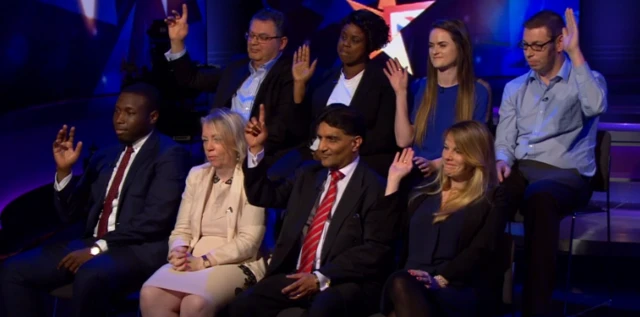
    It seems that our six one-hour specials have at least been helpful for our panel of undecided voters. The panel of "undecideds", recruited for us by pollsters Ipsos MORI, appear to have come down from the fence. Their verdict? It's a strong vote for Remain.

    "It's a good panel," Chuka Umunna tells us.

    But he would say that, wouldn't he?

  8. A quick check in with the polls...published at 23:35 BST 23 May 2016

    The programme is now finished but we'll be live here with more analysis of the hour. 

    We've had to look online to what the opinion polls were suggesting in our first EU special way back on the 11 April. Back then, the rolling poll of polls by WhatUKThinks showed a split of Remain: 51%, Leave: 49% - so neck and neck.

    The latest poll of polls shows Remain 54%, Leave 46%.

    Given what happened in 2015, we have no idea if they're right. You can read more from WhatUKThinks here. , external

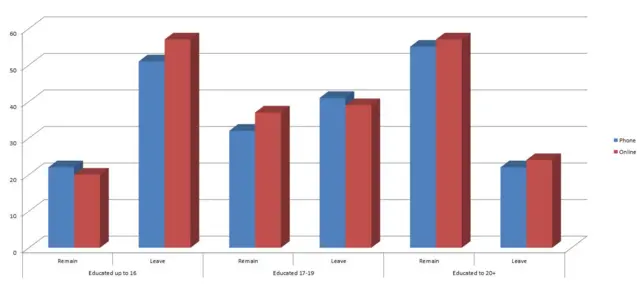
    YouGov also had some interesting polling last week showing a clear correlation between education and attitudes to the EU referendum, which you can see below:

    The poll shows that those who are educated to 20+ support Remain, those who aren't support Leave.Image source, YouGov
    Image caption,

    YouGov's poll from 20 May

    This is interesting in itself, but also shows the methodological challenges for polling companies, as too many or too few graduates in their samples could make a big difference to the data. You can read YouGov's write up here. , external

  9. Andrea Leadsom on why she's voting for her childrenpublished at 23:32 BST 23 May 2016

    Quote Message

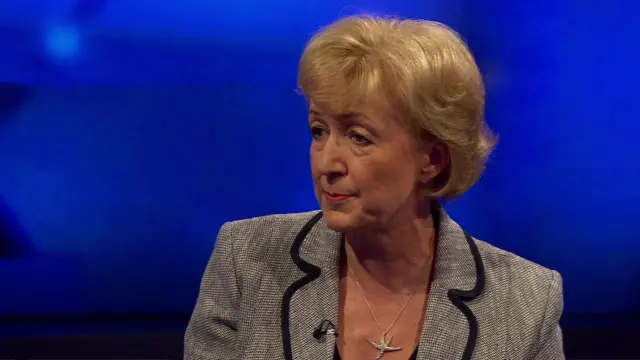
    I have three children... My views are all about their future. I believe their future would be brilliant outside of the EU

    Andrea Leadsom MP, Minister of State for Energy and Climate Change

    Andrea Leadsom MP
    Image caption,

    Andrea Leadsom MP

  10. Best and most confusing quote of the nightpublished at 23:31 BST 23 May 2016

    Eggs-cellent...groan etc

    This X post cannot be displayed in your browser. Please enable Javascript or try a different browser.View original content on X
    The BBC is not responsible for the content of external sites.
    Skip X post

    Allow X content?

    This article contains content provided by X. We ask for your permission before anything is loaded, as they may be using cookies and other technologies. You may want to read X’s cookie policy, external and privacy policy, external before accepting. To view this content choose ‘accept and continue’.

    The BBC is not responsible for the content of external sites.
    End of X post
  11. Kathrine Kleveland on Norway's dealpublished at 23:26 BST 23 May 2016

    Quote Message

    From the Norwegian point of view the EA agreement is much better than EU membership... but still in my organisation we want to get rid of the EA agreement... because by the EA agreement we had to accept a lot of the EU's laws and regulations.

    Kathrine Kleveland, Leader of the Norwegian 'NO to EU' party

  12. Ngaire Woods on the 'scary ghost' of the EUpublished at 23:26 BST 23 May 2016

    Quote Message

    There is a big part of the Leave campaign which is 'let's get away from a scary ghost'... That scary ghost was the European Union which was dreamed up 30 years ago... That's gone, there is no such European Union anymore. The European Union has been hugely modified over the past 30 years

    Ngaire Woods, Oxford University

  13. What would "In" look like?published at 23:25 BST 23 May 2016

    A reminder

    If the UK chooses Remain in one month's time, it won't be a vote for the exact status quo.

    David Cameron's renegotiation will mean changes. They include:

    • A treaty change so the UK is not bound to "ever closer union" with other EU member states;
    • An "emergency brake" on migrants' in-work benefits for four years when there are very high levels of immigration;
    • Child benefit for children of EU migrants living overseas will be paid at a rate based on the cost of living in their home country;
    • Protection for UK businesses to ensure they do not face "discrimination" for being outside the Eurozone

  14. Does Brexit mean an end to free EU migration?published at 23:23 BST 23 May 2016

    This could prove to be one of the most important parts of the debate. Polling shows a lot of voters are concerned about immigration from the European Union. But would quitting the EU mean we were able to reduce it? Or would any future trade deal mean the UK's borders will remain open?

    Quote Message

    You're going to have rules which apply to everybody... if you stay within the single market, the logic is you will have to carry on with some arrangement for free movement of people

    Charles Crawford, Former UK ambassador to Poland

    So, can Andrea Leadsom imagine a post-Brexit Britain where freedom of movement continues?

    Quote Message

    Certainly not where free movement was completely uncontrollable... I think voters should think, from the Leave side, that we would not have uncontrolled immigration

    Andrea Leadsom MP, Energy Minister

  15. Would we still have access to the single market?published at 23:20 BST 23 May 2016

    It depends on what deal we get. The UK could continue to trade with the single market following an EU exit, but we do not know on what terms that trade would take place because that would be subject to years of negotiations.

    Read the full Reality Check here.

  16. Brexit and borders...published at 23:16 BST 23 May 2016

    Paperwork for Prague? Visas for Vienna?

    The UK borderImage source, Getty Images

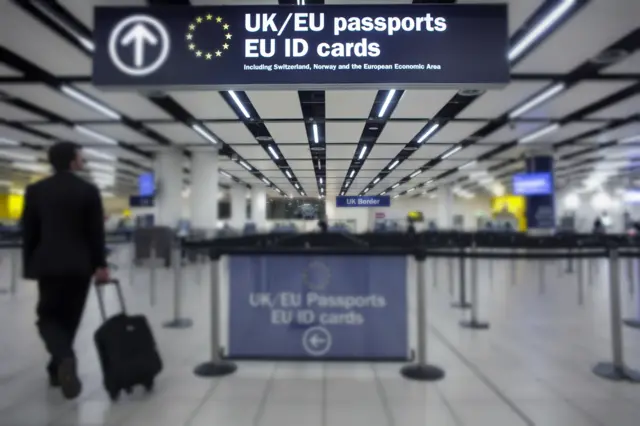
    It’s one of the biggest areas of contention. What happens to international borders in a post-Brexit Europe?

    Would Brits landing in Benidorm find themselves diverted to lengthy visa-controlled queues alongside visitors from Africa and the Americas? Could the UK effectively close its doors to EU migrants, admitting only those deemed likely to fill key roles?

    Cop out warning...

    The truth is, we don’t know. It depends entirely on the divorce package.

    Most people agree it’s very unlikely Britons would need a visa to visit EU countries as tourists.

    But equally, a free trade agreement that did not also allow EU members to freely visit and work would be breaking new ground. You might have noticed when landing in UK airports that the UK/ EU passports section also says “including Switzerland and the European Economic Area”.

    That’s because Switzerland, Liechtenstein, Iceland and Norway share free movement with the EU as part of their trade deals.

    There’s also an ongoing – and unresolved – argument over what would happen to the UK’s border controls in Calais.

    One thing we do know is that the UK has no plans to reintroduce border checks between the Irish Republic and Northern Ireland. 

  17. Jonathan Powell on his mock negotiationspublished at 23:14 BST 23 May 2016

    Quote Message

    I've been negotiating for 40 years, in my opinion, this is one of the most difficult negotiating hands I've ever seen. There's a choice on one side between sovereignty, and on the other side access to the single market. I'm going to have to go back and tell the Prime Minister he's got to choose.

    Jonathan Powell, Former Chief of Staff to Tony Blair

    Jonathan Powell
    Image caption,

    Powell says this is one of the most difficult negotiating hands he's ever seen

  18. The original Grexitpublished at 23:13 BST 23 May 2016

    Notes from a large island

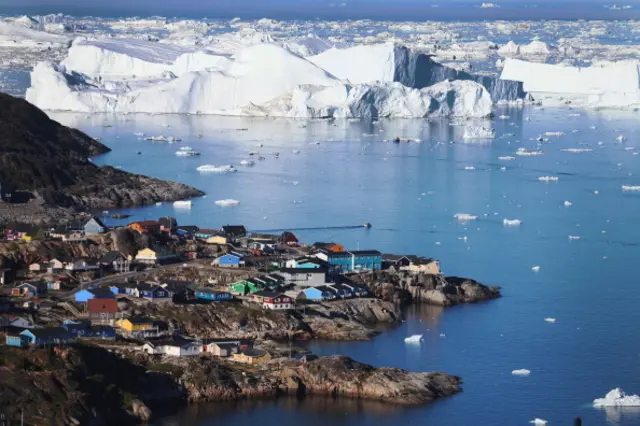
    A view of GreenlandImage source, Getty Images

    What would Brexit look like? Perhaps we should ask Greenland. 

    The world’s biggest island is the only territory to have quit the European project - so far - after its own referendum in 1982.

    Comparisons should probably be made with some caution. After all, Greenland is more than three-quarters ice cap, its population is smaller than Grimsby's and its only real industry is fishing.

    Perhaps one thing we can conclude from the original "Grexit" is that leaving is incredibly complicated. It took Greenland three years to negotiate its departure.

    Former cabinet secretary Lord O'Donnell cited it as evidence that a Brexit would take much longer than the stated two years.

    On the other hand, the multi-billion value of UK-EU trade makes reaching a deal much more of an imperative. And the UK has about seven civil servants for each person in Greenland, so you might think they’ll be able to get a deal done a bit quicker.

  19. Brexit: The negotiation processpublished at 23:11 BST 23 May 2016

    Leaving the club

    A wet EU umbrellaImage source, Getty Images

    Take out the politics, thunderous arguments and exhaustive negotiations, there is a formal process in place for agreeing a Brexit.

    It’s untested and quite new – until 2007 joining the EU was assumed to be a one-way ticket. But now we have Article 50 of the Lisbon Treaty, external, which boils it all down to two simple steps:

    • The Prime Minister writes a letter informing the President of the European Council of the UK’s intention to quit
    • The council appoints a negotiating team, and a two-year window opens for negotiating a withdrawal treaty

    That two-year window could be extended to three years if necessary. Any further extension would need all member states to agree. But that two or three-year countdown would only begin once David Cameron’s letter had been formally received by the Council.

    Shockingly enough, how smoothly these negotiations will go depends on who you ask.

    European Commission President and Brexit bogeyman Jean-Claude Juncker has warned the EU won't be fighting with "kid gloves". Some commentators point to imminent national elections in France and Germany, where incumbent parties are being buffeted by upstart nationalist and anti-EU parties.

    Others are more bullish, pointing out that the EU will want to retain its trade and diplomatic links with the UK – and the UK will be armed with an enormous mandate from its people.

    This X post cannot be displayed in your browser. Please enable Javascript or try a different browser.View original content on X
    The BBC is not responsible for the content of external sites.
    Skip X post

    Allow X content?

    This article contains content provided by X. We ask for your permission before anything is loaded, as they may be using cookies and other technologies. You may want to read X’s cookie policy, external and privacy policy, external before accepting. To view this content choose ‘accept and continue’.

    The BBC is not responsible for the content of external sites.
    End of X post