Summary

  • EU special - does the EU work for us? How much does it cost, and where does British money go?

  • Find out what politicians from both sides, a panel of experts and a group of undecided voters had to say

  • Get involved in the EU referendum debate on Twitter using #newsnight

  1. Arguing the casepublished at 00:20 BST 17 May 2016

    Ian Katz
    Newsnight Editor

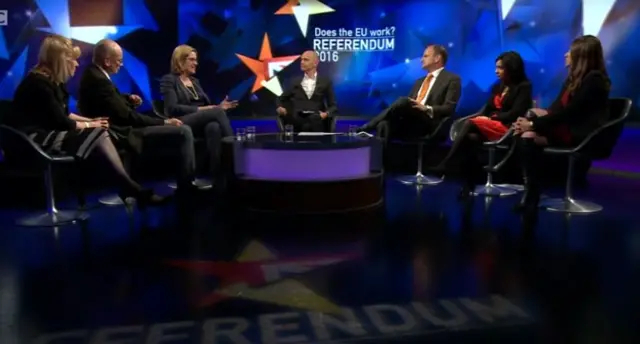
    It’s become a common refrain in the referendum campaign that voters want more facts and less rhetoric to help make up their minds. But two exchanges in tonight’s show threw into stark relief how even the most basic facts about our EU membership look very different according to which side of the argument they’re viewed from.

    The first was about the oft-touted claim by the Leave campaign that the UK sends £350m per week to Brussels. We thought we might avoid argument over it later in the show by running a short film laying out in more detail what we pay to Brussels and what we get back, and seeing if both sides could at least agree on our true membership fee for the European club. 

    Media caption,

    Evan Davies travels back in time to get to the bottom of the EU rebate

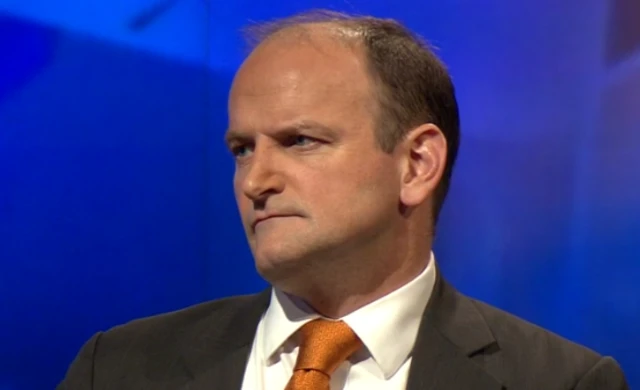
    But leading the Leave side of tonight’s debate, Douglas Carswell stuck doggedly to the line that neither our £5bn/year rebate nor £4bn/year of EU spending in the UK should be taken into account in calculating our EU contribution. The inability of both sides to even agree the cost of EU membership has become a striking indication of how tribal this argument has become.

    The two sides saw Britain’s influence in Brussels through equally different lenses. For Remain’s Stephen Wall, the UK was on the winning side of votes 85% of the time, and along with Germany was responsible for initiating most EU legislation. But for Carswell, the more relevant statistic was that the UK had been outvoted on 72 occasions and has just 10% of votes in the European parliament.

    In the US, some commentators have been talking about Trump’s rise in the context of a “post fact age”. Once or twice tonight, it felt like British politics may have entered it too.
  2. Reaction to tonight's showpublished at 00:13 BST 17 May 2016

    From a few familiar faces

    This X post cannot be displayed in your browser. Please enable Javascript or try a different browser.View original content on X
    The BBC is not responsible for the content of external sites.
    Skip X post

    Allow X content?

    This article contains content provided by X. We ask for your permission before anything is loaded, as they may be using cookies and other technologies. You may want to read X’s cookie policy, external and privacy policy, external before accepting. To view this content choose ‘accept and continue’.

    The BBC is not responsible for the content of external sites.
    End of X post
    This X post cannot be displayed in your browser. Please enable Javascript or try a different browser.View original content on X
    The BBC is not responsible for the content of external sites.
    Skip X post 2

    Allow X content?

    This article contains content provided by X. We ask for your permission before anything is loaded, as they may be using cookies and other technologies. You may want to read X’s cookie policy, external and privacy policy, external before accepting. To view this content choose ‘accept and continue’.

    The BBC is not responsible for the content of external sites.
    End of X post 2
  3. Recap: John Sweeney visits Strasbourgpublished at 00:13 BST 17 May 2016

    Why does the European Parliament travel from Brussels to Strasbourg? John Sweeney went to the European Parliament to find out – watch his film here:

    Media caption,

    John Sweeney travels to Strasbourg to find out more about the European Parliament

  4. Deja vu?published at 23:55 BST 16 May 2016

    Here's another look at a snippet of John Sweeney's European tour.

    Sweeney's French teacher and all speakers and appreciators of the French language: close down this page or avert your eyes.

    This X post cannot be displayed in your browser. Please enable Javascript or try a different browser.View original content on X
    The BBC is not responsible for the content of external sites.
    Skip X post

    Allow X content?

    This article contains content provided by X. We ask for your permission before anything is loaded, as they may be using cookies and other technologies. You may want to read X’s cookie policy, external and privacy policy, external before accepting. To view this content choose ‘accept and continue’.

    The BBC is not responsible for the content of external sites.
    End of X post
  5. How many UK laws are made in the EU?published at 23:52 BST 16 May 2016

    Exactly how many UK laws come from Brussels?

    Is it most of the law – or just a bit? It would be lovely to be definitive about this. We asked Queenie, a British bulldog, a national symbol no less, to answer the question. She got the BBC's legal affairs correspondent, Clive Coleman to help. 

    Media caption,

    How many UK laws are made in the EU?

  6. What you thought of tonight's debatepublished at 23:46 BST 16 May 2016

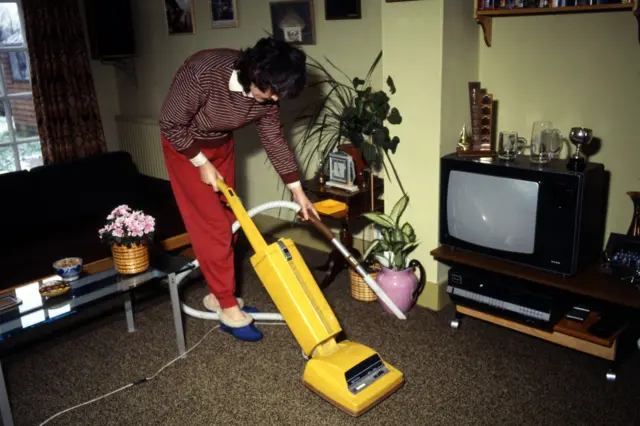
  7. What are the EU rules around vacuum cleaners?published at 23:44 BST 16 May 2016

    EU laws explored

    A vacuum cleaner in action

    Since September 2014, EU energy saving measures have banned vacuum cleaners with motors exceeding 1,600W. From 2017 this will drop to 900W.

    But is the outrage a whole load of hot air?

    Before the deadline many people snapped up high wattage machines. But experts pointed out that suction is more important than power, and that a higher wattage doesn’t necessarily mean it performs any better.

    So you can still buy a high performance machine, but it’s worth doing some research to make sure your machine’s suction doesn’t suck.

  8. Does the EU really prevent bendy bananas?published at 23:41 BST 16 May 2016

    EU laws explored

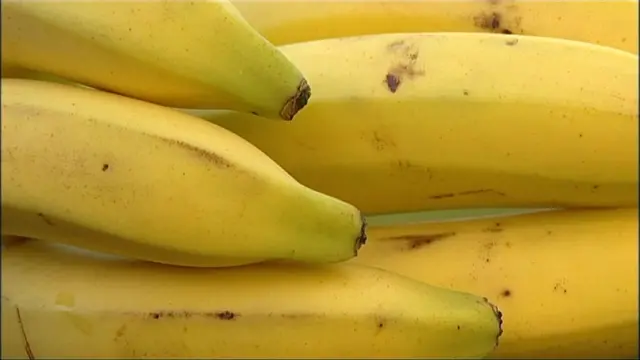
    Bananas

    Not really, as bendy bananas aren’t banned. But the curvature of a banana is regulated.

    This isn’t all that crazy; bananas have always been classified by quality and size for international trade. The European Commission drew up rules to standardise banana bendiness laws in EU countries.

    But controls are in place. Bananas must be "free from malformation or abnormal curvature". "Extra class" must fully comply, but Class 1 bananas can have "slight defects of shape", and Class 2 bananas can have full-on "defects of shape", as Commission Regulation (EC) 2257/94 so eloquently puts it.

  9. Godwin's Lawpublished at 23:33 BST 16 May 2016

    Newsnight responds to the recent spate of post-mayoral Hitler references

    How did Brussels react when they heard that Boris Johnson was comparing the European Union to Nazi Europe? By pure good fortune, the exact moment was caught on camera. 

    This YouTube post cannot be displayed in your browser. Please enable Javascript or try a different browser.View original content on YouTube
    The BBC is not responsible for the content of external sites. YouTube content may contain adverts.
    Skip youtube video

    Allow YouTube content?

    This article contains content provided by Google YouTube. We ask for your permission before anything is loaded, as they may be using cookies and other technologies. You may want to read Google’s cookie policy, external and privacy policy, external before accepting. To view this content choose ‘accept and continue’.

    The BBC is not responsible for the content of external sites. YouTube content may contain adverts.
    End of youtube video
  10. Douglas Carswell on whether he'd like to see the whole EU disintegrate or just Brexitpublished at 23:32 BST 16 May 2016

    Quote Message

    I think if I was Austrian or German I might have a different perspective but from our point of view the safe thing to do is to take back control - this is a failing project.

    Douglas Carswell MP, Ukip

    Douglas Carswell MP
  11. Is the EU frequently outvoted on Europe?published at 23:26 BST 16 May 2016

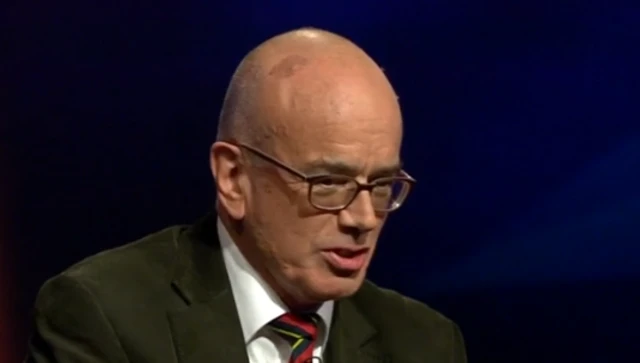
    Sir Stephen Wall
    Image caption,

    Sir Stephen Wall, former UK Permanent Representative to the EU

    There's some disagreement between our politicians over how much influence and control the UK has in the EU.

    This academic study, external suggests that our panelist Sir Stephen Wall is basically right – we lose votes in the EU about 12 per cent of the time. 

    And whether that's inconsequential or a great screaming outrage probably depends on which side of the debate you're on. 

  12. Amber Rudd and Douglas Carswell clashpublished at 23:25 BST 16 May 2016

    Quote Message

    72 times we've been outvoted, 40 times since David Cameron became Prime Minister. And how often does it never go to a vote because the negotiators know we're not going to get a majority

    Douglas Carswell MP, UKIP

    Quote Message

    Or because we just got our way Douglas, and persuaded other people that our way is the right way. We are one of the most influential players on the EU

    Amber Rudd MP, Secretary of State for Energy and Climate Change

    Amber Rudd and Douglas Carswell clash
  13. At last! An agreement!published at 23:19 BST 16 May 2016

    Nobody thinks moving to Strasbourg once a month is a good idea

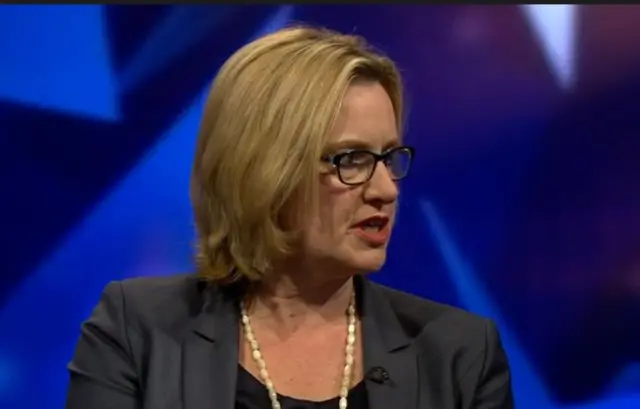
    Amber Rudd MP
    Image caption,

    Amber Rudd MP

    Quote Message

    No-one supports it. We certainty don't. It's part of the origin of the Parliament... I think it reflects the fact that it's a compromise

    Amber Rudd MP, Secretary of State for Energy and Climate Change

    Quote Message

    This curious need to move to and fro illustrates quite well the extent to which the European project is beholden to vested interests. In that example, it's the French state interest in Strasbourg

    Douglas Carswell MP, UKIP

  14. A US perspective on EU Bureaucracypublished at 23:18 BST 16 May 2016

    Quote Message

    I find it to be very fascinating the entire system just because I come from the United States and we're 50 states, but we're a federalist system and it takes about eight and a half months to pass legislation... whereas in the European parliament with eight different political parties and 28 member states it takes about 22 months to get legislation to pass. So it's a lot slower.

    Tara Palmeri, Reporter, POLITCO Europe

    This X post cannot be displayed in your browser. Please enable Javascript or try a different browser.View original content on X
    The BBC is not responsible for the content of external sites.
    Skip X post

    Allow X content?

    This article contains content provided by X. We ask for your permission before anything is loaded, as they may be using cookies and other technologies. You may want to read X’s cookie policy, external and privacy policy, external before accepting. To view this content choose ‘accept and continue’.

    The BBC is not responsible for the content of external sites.
    End of X post
  15. A tale of, erm, four citiespublished at 23:12 BST 16 May 2016

    It's not just Brussels

    “Brussels” has become the foremost byword for the European Union in its entirety, and “Brussels Bureaucrats” synonymous with Eurosceptic laments of EU excess. But the EU is actually made up of seven institutions split across four cities.

    Brussels

    Brussels hosts the European Commission, which proposes new laws and the European Council of ministers, which approves or vetoes decisions, and most of the EU’s 23,000 civil servants. It also hosts the European Parliament for three weeks of each month.

    Strasbourg

    Strasbourg remains the official “home” of the European Parliament, although in reality it only sits for a few days each month – usually for meetings of the full Parliament when votes take place.

    Luxembourg City

    The European Court of Justice, which ensures EU law is applied equally in all member states, is based in Luxembourg – the second smallest country in the Union. Despite being home to just 0.11 per cent of the EU population, Luxembourg also hosts a 4,000-strong Secretariat and the Court of Auditors.

    Frankfurt

    The European Central Bank oversees EU monetary policy and the Euro. It opened in Frankfurt in 2008 – a decision which prompted France to demand the first president be French. He wasn’t, but they got the second – Jean-Claude Trichet – who served from 2003 to 2011.

  16. Should we pay to help develop poorer countries?published at 23:11 BST 16 May 2016

    Audience with hands up

    How many of our undecided voters support spending British taxpayers money on the development of poorer central and eastern European countries? Well, all of them. Perhaps surprisingly.

    Douglas Carswell isn't convinced – he tell us that money might not even be available if the Union continues to expand and admits countries like Turkey.

    And speaking of Turkey, there's a BBC Reality Check on that here

  17. Living in a boxpublished at 23:09 BST 16 May 2016

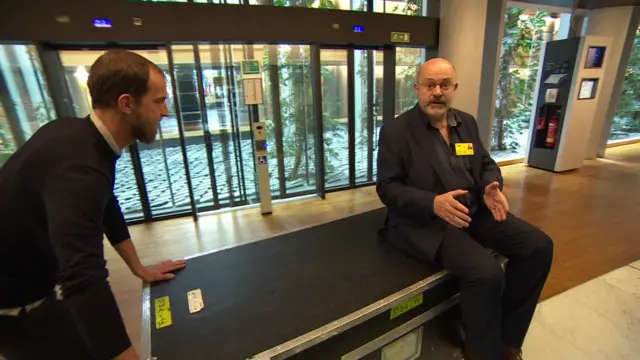
    Here's John Sweeney sitting on one of those boxes used to move the entire European Parliament from Brussels to Strasbourg for a week. Our hearts go out to the man pushing that box for 300 miles... 

    John Sweeney sits on a box being pushed through the European Parliament
    Image caption,

    John Sweeney explains the move

  18. The Strasbourg Shufflepublished at 23:08 BST 16 May 2016

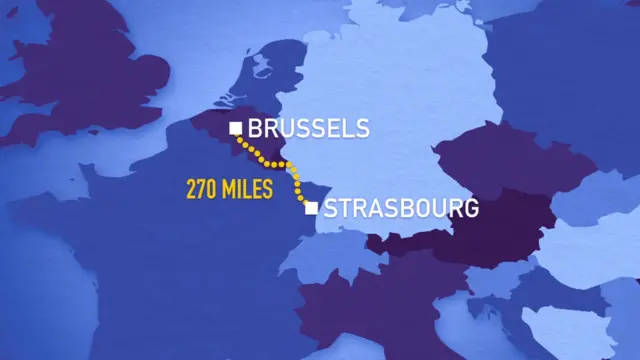
    A map showing the route from Brussels to Strasbourg
    Image caption,

    Brussels to Strasbourg and back – every month

    For one week every month, the entire European Parliament abandons Brussels in Belgium and moves wholesale to Strasbourg in France.

    More than 2,000 plastic trunks are loaded on to lorries and sent 270 miles southeast, while officials, translators and MEPs make the same expedition on specially-chartered trains.

    Critics put the annual bill for this Strasbourg shuffle at about £100 million

    The process has continued since the nascent days of the Union despite widespread criticism even within the Parliament itself.

    Why? Well, the simple answer is that France doesn’t want to give up its stake.

    Abolishing the French wing of the parliament would require treaty change – that means all 28 states have to agree to it, and France won’t.

    Strasbourg was originally chosen partially for symbolic reasons – it borders Germany and thus represents the overcoming of adversity between the two nations.

    Splitting the locations originally meant sharing the burden of creating - and the rewards of hosting – an entirely new parliament. It was, the founding fathers noted, a compromise.

    Responding to a plan hatched by some commissioners in 2013 to end the monthly pilgrimage, France’s Europe Minister said: “The decision is sacrosanct and non-negotiable.”

    Compromise indeed.

  19. The EU: "A cartel of rich countries"published at 23:07 BST 16 May 2016

    This X post cannot be displayed in your browser. Please enable Javascript or try a different browser.View original content on X
    The BBC is not responsible for the content of external sites.
    Skip X post

    Allow X content?

    This article contains content provided by X. We ask for your permission before anything is loaded, as they may be using cookies and other technologies. You may want to read X’s cookie policy, external and privacy policy, external before accepting. To view this content choose ‘accept and continue’.

    The BBC is not responsible for the content of external sites.
    End of X post